manifestation for life areas
Health Manifestation: Future-Self Audio for Safety
Health manifestation can support body safety through daily future-self audio, nervous system cues, and grounded care without replacing medical advice.
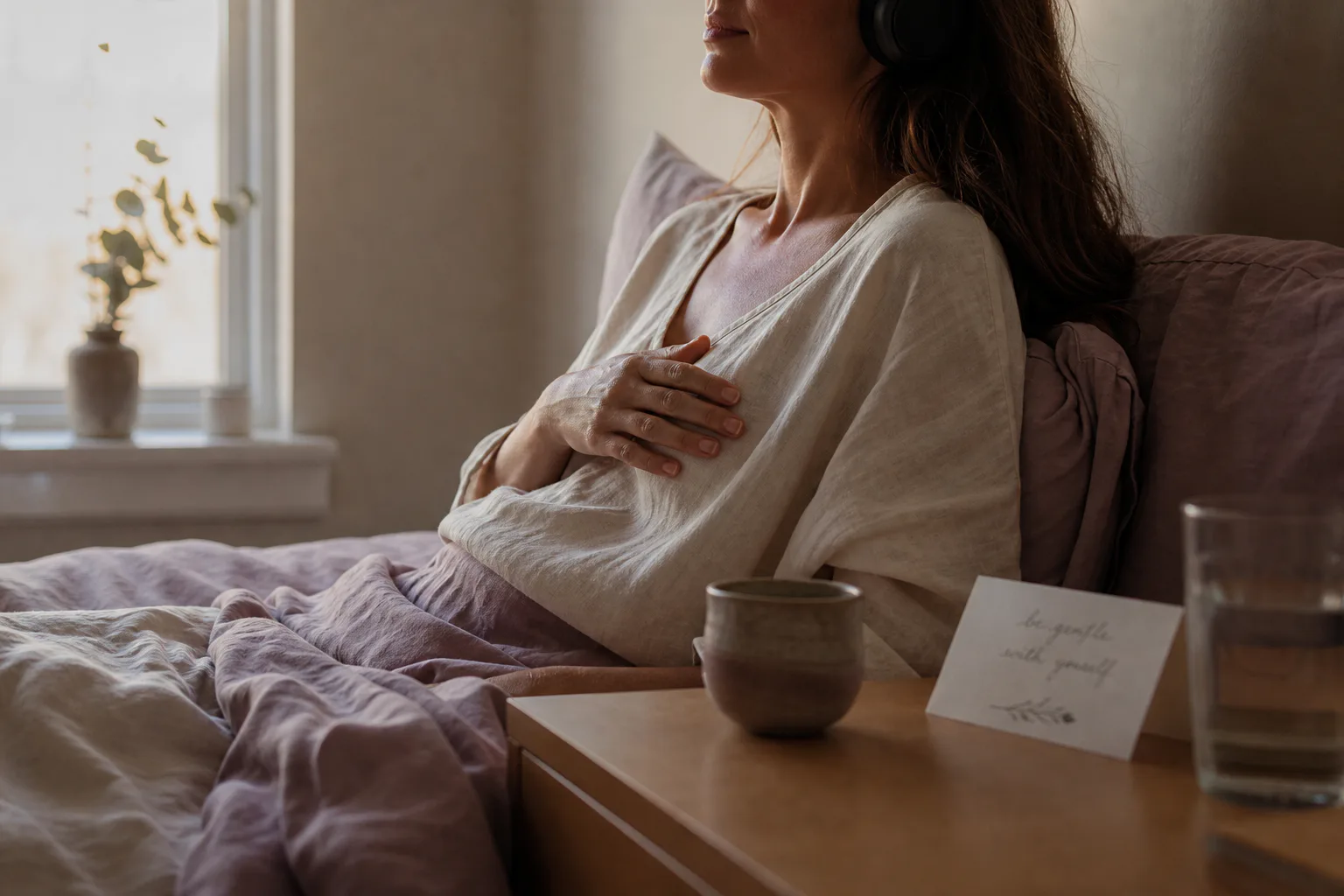
A cup sits beside the bed. The room is dim. Health manifestation is not a promise that thought cures the body. It is a daily way to rehearse safety, listen for care, and let your future self speak in a voice your nervous system can believe.
What does health manifestation actually mean?
Health manifestation means practicing the felt identity of someone who relates to the body with safety, care, and steadier attention.
It isn’t denial. It isn’t pretending symptoms aren’t here. It isn’t a replacement for blood work, medication, surgery, therapy, physical therapy, or the ordinary grace of sleep. The CDC has reported that 6 in 10 adults in the United States live with at least one chronic disease. That number matters because health isn’t a neat before-and-after line for many people. It’s a daily relationship.
The quiet question is not, “Can I force my body to be different?” The better question is, “Can I become less frightening to my own body while I care for it?” Research doesn’t support magical health claims. It does support the fact that stress, attention, expectation, and behavior can affect symptoms and health choices. A 2014 JAMA Internal Medicine review by Madhav Goyal and colleagues looked at 47 trials and found mindfulness meditation programs showed moderate evidence for improving anxiety, depression, and pain.
Health manifestation sits in that human place. You repeat a future-self story that makes care easier to choose. You speak as the person who books the appointment, takes the walk, rests before collapse, and stops turning every sensation into a verdict.
The body hears repetition before it believes argument.
If you want the larger frame, the Manifestation pillar names manifestation as a practice of identity and attention. For health, that identity must stay honest. “I am safe enough to listen” is truer than “nothing is wrong.” Truth is kinder than force.
Why use future-self audio instead of just affirmations?
Future-self audio gives the body a voice cue, a rhythm, and a repeated scene, which can feel easier to receive than words on a page.
The AYA Method is a daily audio manifestation practice. Each day you listen to a short personalized recording — your Dream-Self Moment — narrated from the version of you who has already manifested the life you intend. Listening is the practice. Repetition is the work. The audio is the method. You can read more about the AYA Method when you want the full structure.
This matters for health manifestation because the body is not only persuaded by ideas. It responds to sound, timing, breath, memory, and prediction. Dr. Andrew Huberman often describes the nervous system through states of alertness and calm. In a 2023 Cell Reports Medicine study from Stanford researchers, 5 minutes a day of cyclic sighing improved mood and reduced physiological arousal more than mindfulness meditation over one month. Small daily cues can matter.
Affirmations can still help. The Affirmations pillar is useful when you need one sentence to return to. But audio is different. It carries pace. It leaves less room for the mind to debate every word. It can sound like someone sitting near you, speaking plainly.
Here is the difference in a simple way:
| Practice | Best use | Health caution |
|---|---|---|
| Future-self audio | Daily rehearsal of body safety and care | Don’t claim a cure |
| One affirmation | A short sentence during stress | Keep it believable |
| Manifestation Board | A visual reminder of the life you’re caring for | Don’t use images that shame the body |
| Medical plan | Diagnosis, treatment, monitoring | Keep this first when symptoms need care |
The audio is not louder than medicine. It is a quiet companion to it.
How do you create a health manifestation audio that feels safe?
You create it by writing from a future self who is cared for, not from a frightened self trying to control the body.
Start small. Choose one health relationship, not your whole body at once. Sleep. Pain. digestion. movement. recovery. medical anxiety. A 2022 National Health Interview Survey found that about 18% of U.S. adults used meditation, up from earlier years. Many people are looking for ways to meet stress without adding more pressure. Your script should do that too.
Use this 5-step structure:
- Name the body area or health moment. “When I wake with tightness in my chest, I slow down and check what I need.”
- Speak from the future self. “I know how to respond without panic.”
- Include real care. “I keep my appointments. I ask questions. I take the next right step.”
- Add one felt cue. “My jaw softens. My hands unclench. My breath has room.”
- End with enough. “I don’t have to solve my whole body tonight.”
Avoid sentences that make illness sound like failure. Avoid “I never feel pain,” “My body is perfect,” or “I don’t need help.” If you’ve lived with symptoms for months or years, your body may not trust sudden perfection. It may trust gentleness.
Neville Goddard wrote often about assuming the feeling of the wish fulfilled. In health manifestation, that feeling must be ethical. The wish fulfilled may be, “I am supported, discerning, and calm enough to care for myself.” Joe Dispenza’s work also emphasizes rehearsing a future self, though claims about healing should be held carefully and checked against medical evidence.
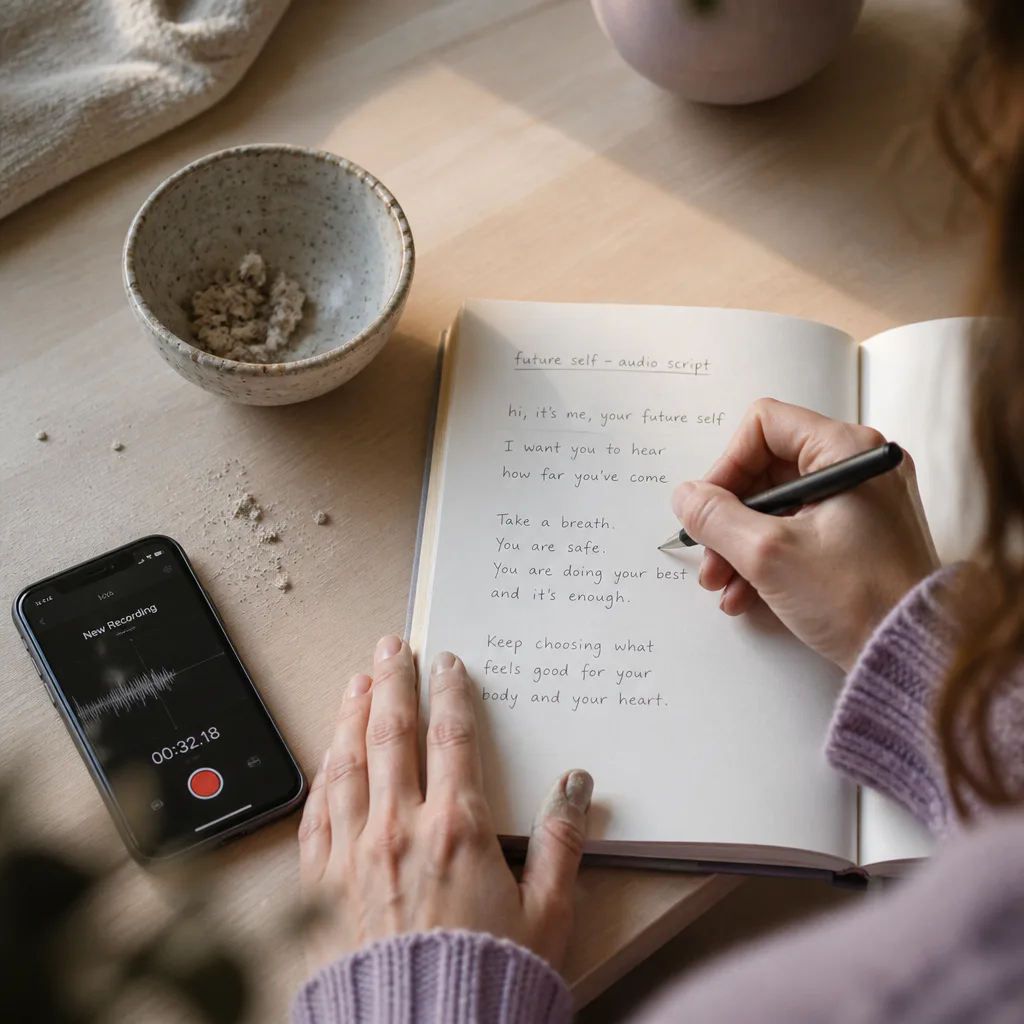
A future self should never bully the present body. If the audio makes you tense, rewrite it softer.
What words belong in the script?
The best script uses present-tense, body-safe language that your mind doesn’t need to fight.
A health manifestation script should be specific enough to feel real and plain enough to repeat. The placebo literature is useful here, not because you should trick yourself, but because expectation and meaning can change how symptoms are perceived. In a 2010 PLoS ONE trial, Ted Kaptchuk and colleagues found that open-label placebo helped people with irritable bowel syndrome more than no treatment, even when participants knew the pills were placebo. Meaning is not nothing.
Try lines like these:
- “I listen to my body before I argue with it.”
- “I can feel a sensation without making it a story.”
- “I ask for help when help is the next honest thing.”
- “My body and I are on the same side.”
- “I return to care in small ways.”
- “I don’t need fear to keep me responsible.”
If astrology is part of how you reflect, keep it supportive and not fatalistic. The page on Astrology and manifestation can help you use timing and symbols without handing your body over to prediction. Your body is not a chart to be blamed. It’s here. Warm. Changing. Asking to be met.
A short script may sound like this:
I wake and I listen. My body doesn’t have to earn my kindness. I notice what is true. I take the next small care step. I know when to rest. I know when to ask. I am not alone inside myself. I am learning safety in real time.
Keep it under 150 words if you’re recording it yourself. At a slow pace of about 120 to 140 spoken words per minute, that gives you a recording close to 1 minute. You can repeat it twice. Short is not weak. Short is repeatable.
When should you listen each day?
Listen at the same low-friction moment each day, ideally beside a care action your body already knows.
You don’t need to wake earlier. You don’t need candles, a notebook, or a better personality. Habit research from Phillippa Lally and colleagues, published in the European Journal of Social Psychology in 2009, found that automaticity took a median of 66 days to form, with wide variation from 18 to 254 days. Repetition is human. It takes the time it takes.
Choose a listening cue that already exists:
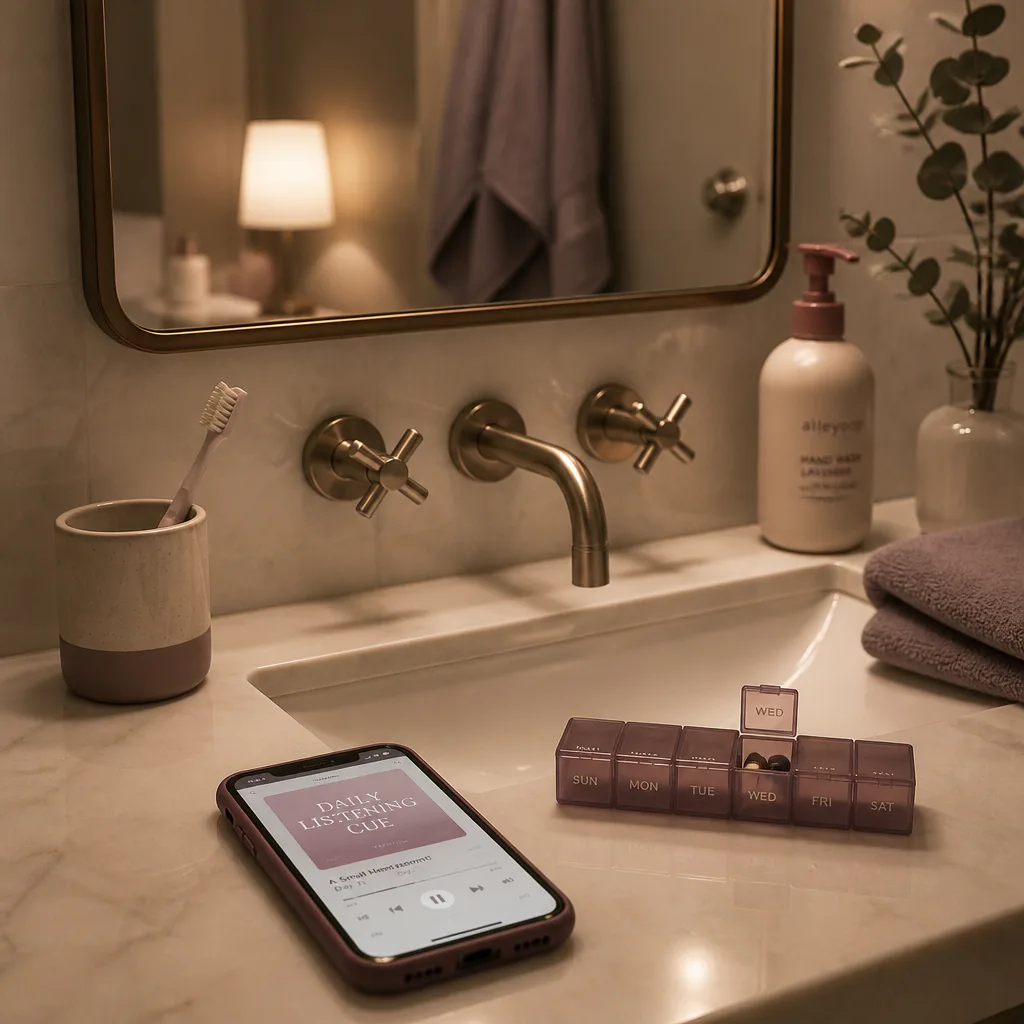
- After taking morning medication or supplements
- Before a physical therapy exercise
- While lying down for a 10-minute rest
- After brushing your teeth at night
- Before opening a test result portal
- After a medical appointment, when your body needs settling
This is where a manifestation practice becomes less dramatic and more real. It gets attached to the sink, the pill bottle, the floor mat, the bus ride home. You aren’t trying to become someone else. You’re letting the cared-for version of you become familiar.
The app also includes a daily affirmation and a Manifestation Board, but treat them as complements. The audio is the method. The affirmation can become one sentence for the hard minute. The board can hold an image of the life you’re tending, not a body you’re punishing yourself to get.
If symptoms flare when you listen, pause. Try eyes open. Lower the volume. Sit upright. Use neutral words. Trauma research, including Bessel van der Kolk’s writing on the body and memory, reminds us that safety can’t be commanded. It has to be sensed.
How do you keep health manifestation from becoming pressure?
You keep it clean by refusing blame, refusing medical avoidance, and refusing sentences that make fear sound holy.
This is the tender edge. A manifestation practice can become another way to judge yourself if you’re not careful. If pain remains, the mind says you didn’t believe enough. If the scan is unclear, the mind says you listened wrong. No. Bodies are not moral scorecards.
Use these guardrails:
- Keep medical care in the room. If a symptom is new, severe, or changing, seek care.
- Never use the audio to override pain. Pain is information, even when it isn’t the whole truth.
- Remove blame words. No “I caused this.” No “I failed.” No “I attracted illness.”
- Measure practice by return, not results. Did you listen? Did you soften? Did you take one care step?
- Let the script change. If a line tightens the body for 3 days, it doesn’t belong.
A 2021 Pew Research Center report found that 31% of U.S. adults said they go online almost constantly. Health anxiety can feed on that endless checking. Your audio can become a boundary: 3 minutes of listening before searching, or 3 minutes after. Not as avoidance. As regulation.
There are also claims around consciousness research, including Princeton’s former PEAR work and Global Consciousness Project data. They are culturally influential, but contested and not a medical basis for treatment. You don’t need them to justify this practice. You only need a daily cue that helps you return to care.
The safest manifestation is the one that makes you more honest, not less.
Health manifestation is allowed to be humble. It can sound like, “I don’t know everything, and I can still be kind to my body now.”
What does a 7-day health manifestation practice look like?
A 7-day practice gives your body enough repetition to recognize the audio without turning the practice into a test.
Use this as a quiet beginning. Seven days won’t rewrite a whole health pattern. It can show you which words help, which ones pressure you, and which care cues are easy enough to keep. In clinical behavior change, small adherence improvements matter. The World Health Organization has long noted that adherence to long-term therapies is often around 50% in developed countries. Any practice that helps you return to care gently is worth respecting.
A simple 7-day plan
| Day | Listen when | One small care action |
|---|---|---|
| 1 | Before sleep | Put water by the bed |
| 2 | After waking | Notice one true body sensation |
| 3 | After medication or tea | Send one health-related message if needed |
| 4 | Before a walk or stretch | Move for 5 minutes, if appropriate |
| 5 | After checking symptoms | Stop searching after one reliable source |
| 6 | During rest | Place one hand on the chest or belly |
| 7 | Before sleep | Rewrite one line to be kinder |
You can use the AYA Method for the daily audio container, then let a single line from your affirmations practice carry you through the day. The order matters. Audio first. Complements after.
At the end of 7 days, ask only these 3 questions:
- Did any line make my body soften?
- Did any line make me feel blamed?
- What care action became easier to take?
That’s enough data. Not perfect data. Human data.
A body doesn’t become home because you win an argument with it.
Stay near the soft true thing.