manifestation for life areas
Manifest Dream Home With 3-Minute Future-Self Audio
Manifest dream home with a quiet 3-minute future-self audio practice that trains attention, emotion, and daily choices toward the place you mean to live.

The kettle clicks off. You don’t need a longer ritual to manifest dream home; you need a true one. A 3-minute future-self audio helps you rehearse the feeling, choices, and daily evidence of living there, so your attention and actions begin to move toward that specific home.
What does it mean to manifest your dream home with audio?
It means you listen to a short recording from the self who already lives there, then let repetition shape what you notice and choose.
A dream home is not only a floor plan. It’s a nervous system state. It’s the sound your door makes when it closes. It’s the way your shoulders drop near the sink. It’s knowing where the morning light lands at 7:20. When you use audio, you don’t stare at an idea from across the room. You hear it from inside your own life.
The AYA Method is a daily audio manifestation practice. Each day you listen to a short personalized recording — your Dream-Self Moment — narrated from the version of you who has already manifested the life you intend. Listening is the practice. Repetition is the work. The audio is the method.
That definition matters here. You’re not trying to force a house to appear. You’re training the part of you that accepts or refuses rooms, prices, compromises, help, timing, and rest. A 2023 Pew Research Center report found that 60% of U.S. adults said housing affordability was a major problem where they lived. Dreaming about home has to live beside numbers. It has to be soft and exact.
A future-self audio gives the desire a daily appointment. Three minutes is long enough for detail and short enough to repeat when the sink is full. In behavior research, repetition is not glamour. It’s the bridge. A 2009 University College London study by Phillippa Lally and colleagues found that habit automaticity took a median of 66 days, with a range from 18 to 254 days. The body learns slowly. That’s not failure. That’s how it knows something is real.
A home becomes believable when your body has heard itself living there.
You can read more about the larger practice of manifestation if you need the frame. For this ritual, keep it small. One recording. One listening. One home that feels true enough to return to tomorrow.
How do you define the home before you record?
You define it by naming the life the home protects, not only the rooms it contains.
Before recording, write one plain sentence: “I live in a quiet, affordable home with morning light, enough space to work, and a kitchen where I cook without rushing.” That sentence is stronger than a list of ten finishes. It gives your attention something to recognize. Cognitive psychology often calls this selective attention; when something matters, you start seeing related cues more often. The classic 1999 Simons and Chabris attention study showed how easily people miss visible things when attention is elsewhere.
Your home sentence should hold both feeling and limits. If you need to be within 30 minutes of work, say it. If you need stairs to be few, say it. If you want land for herbs, say how much care you can truly give. I run an apothecary from a greenhouse, and I can tell you: a garden you can’t tend becomes a quiet accusation.
Use this small table before you record:
| Question | Soft answer | Practical answer |
|---|---|---|
| What do I feel there? | I feel safe and unhurried. | I can afford the monthly cost. |
| What does the home support? | Sleep, cooking, prayer, work. | Two rooms, good light, less noise. |
| What do I release? | Proving I deserve beauty. | Listings that break my budget. |
| What do I welcome? | Belonging in ordinary hours. | A lease, offer, or search radius that fits. |
Specific numbers help the mind stay honest. Name your upper monthly payment. Name the neighborhoods you’ll consider. Name the date you’ll review listings each week. According to the U.S. Census Bureau, the median monthly housing cost for owner-occupied homes with a mortgage was over $1,800 in recent American Community Survey estimates; local numbers vary sharply, but the point is simple. A home vision that ignores cost becomes fog.
A true dream home has edges. Edges make it kind.
How do you write a 3-minute future-self script?
You write it in present tense, with sensory detail, emotional steadiness, and one or two practical signs that the home is yours.
Three minutes is about 390 to 480 spoken words for many people, since average conversational speech often lands near 130 to 160 words per minute. You don’t need to fill the space with decoration. You need to speak as if you’re already inside the ordinary day. The recording can begin like this: “I’m standing in my kitchen. The floor is cool under my feet. I hear one bird outside the window. This home is mine to care for, and I can afford it without shrinking my life.”
Keep the script gentle. If your voice starts performing, slow down. Neville Goddard often taught imaginal scenes as already fulfilled, usually brief and repeatable. You don’t have to accept every metaphysical claim to use the structure. The practical wisdom is clear: the scene should imply completion. You don’t rehearse longing. You rehearse living.
Use this 5-part script:
- Arrive. Name the room and the time of day.
- Sense. Add one sound, one texture, one smell.
- Belong. Say what your body knows here.
- Ground. Include one practical proof, such as keys, lease, payment, or commute.
- Return. End with one sentence you can believe tomorrow.
Here is a short sample:
“It’s morning in my home. The window is open just enough for cool air. My mug is warm in my hand. I know where everything is. The payment is handled. The rooms are simple, clean, and mine. I sleep well here. I invite people I love without apologizing for the space. I tend this place, and it tends me. I came here one honest step at a time.”
If you also use affirmations, let one line become a daily complement, not the whole practice. Something like: “I know the home that knows me.” The audio holds the fuller scene. The affirmation is a small thread you can carry.

How do you record it so your body believes you?
You record it slowly, privately, and in a voice you would trust at the end of a long day.
Use your phone. Sit somewhere ordinary. A bed is fine. A parked car is fine. A kitchen chair is fine. Dr. Andrew Huberman has often discussed the role of breath and physiological state in learning; the simple version is that your body encodes information differently when it’s agitated. Before you record, take 3 slow breaths with a longer exhale than inhale. If you inhale for 4 counts, exhale for 6. Do that 3 times.
Then record without trying to sound special. The future self isn’t a polished host. She’s you, with less fear in her throat. Speak a little slower than normal. Leave a pause after lines that matter. Audio carries tone in a way text cannot. A 2017 study in the journal Emotion found that people often detect emotional states more accurately from voice-only communication than from visual-only cues. Your own voice is not decoration. It’s evidence.
A clean recording helps, but perfection doesn’t. Do this:
- Put the phone 6 to 10 inches from your mouth.
- Turn off loud appliances for 3 minutes.
- Record one take if you can.
- If you stumble, keep going.
- Save it with a simple name: “Home, morning, July.”
You may want music. Keep it low, or skip it. Words need room. If music makes you sentimental instead of steady, it may pull you away from the real home and into a mood. The AYA app uses audio as the daily anchor, and the app also includes supports like a daily affirmation and Manifestation Board. They can help, but they orbit the listening.
The voice you trust is rarely the loudest one. It’s the one that tells the truth without rushing.
If astrology is part of how you mark timing, you might enjoy reading about astrology and manifestation. Use timing as a mirror, not a cage. Record today if today is quiet enough.
When should you listen each day?
Listen at the same small threshold each day, when your mind is still close to feeling.
Morning works because the day has not gathered its full noise. Night works because the mind is less defended. The best time is the one you can repeat. Habit studies are plain about this: stable cues help behavior return. In Lally’s 2009 study, missing one day did not destroy habit formation, but consistency over time mattered. Be devoted, not brittle.
Choose one of these listening windows:
- Before your feet touch the floor. Lie still and listen once.
- After tea or coffee. Let the cup become the cue.
- Before opening listing apps. Listen first, search second.
- After work. Use the audio to remember what you’re not willing to normalize.
- Before sleep. Let the last image be home, not worry.
If you already practice with the AYA Method, your Dream-Self Moment can hold the home scene inside the wider life you intend. Keep it brief. The method is not improved by strain. Three minutes done daily will teach more than 30 minutes done once under pressure.
There is also a biological kindness in repetition. The brain likes familiar paths. Neuroscientist Donald Hebb’s often-summarized principle, “neurons that fire together wire together,” comes from mid-20th-century learning theory and is still used as a rough teaching phrase. It doesn’t mean thought replaces action. It means repeated inner rehearsal can make certain choices feel less foreign.
After listening, don’t leap up to fix your whole life. Take one homeward action. Save $10. Delete a listing that insults your limits. Wash the bowl in the sink. Ask the landlord one question. Make the budget visible. The body believes what it hears more easily when the day offers one small proof.
Manifestation without contact with daily life becomes theater. Daily life is where the sign appears.
What practical actions should follow the audio?
Follow the audio with one measurable action that makes the home easier to find, fund, receive, or prepare for.
The recording changes attention. Action gives attention a place to land. If you want to manifest dream home, pair the inner scene with a simple external rhythm. A 2022 National Association of Realtors report noted that many buyers searched for several weeks or months before finding a home; renters in tight markets often move even faster. Your practice should steady you for both patience and timing.
Use a weekly home rhythm:
| Day | Homeward action | Time needed |
|---|---|---|
| Monday | Review budget and savings | 15 minutes |
| Tuesday | Save or remove listings | 20 minutes |
| Wednesday | Clear one drawer or shelf | 10 minutes |
| Thursday | Ask one question or make one call | 15 minutes |
| Friday | Walk one possible neighborhood | 30 minutes |
| Saturday | Rest and listen without searching | 3 minutes |
| Sunday | Update your home sentence | 10 minutes |
This is not busywork. It’s devotion made visible. If the future-self audio says, “I live somewhere calm,” but your search keeps returning to streets that spike your body, the practice will show you. If the audio says, “I can afford this home,” but your numbers are hidden, the practice will ask for a spreadsheet.
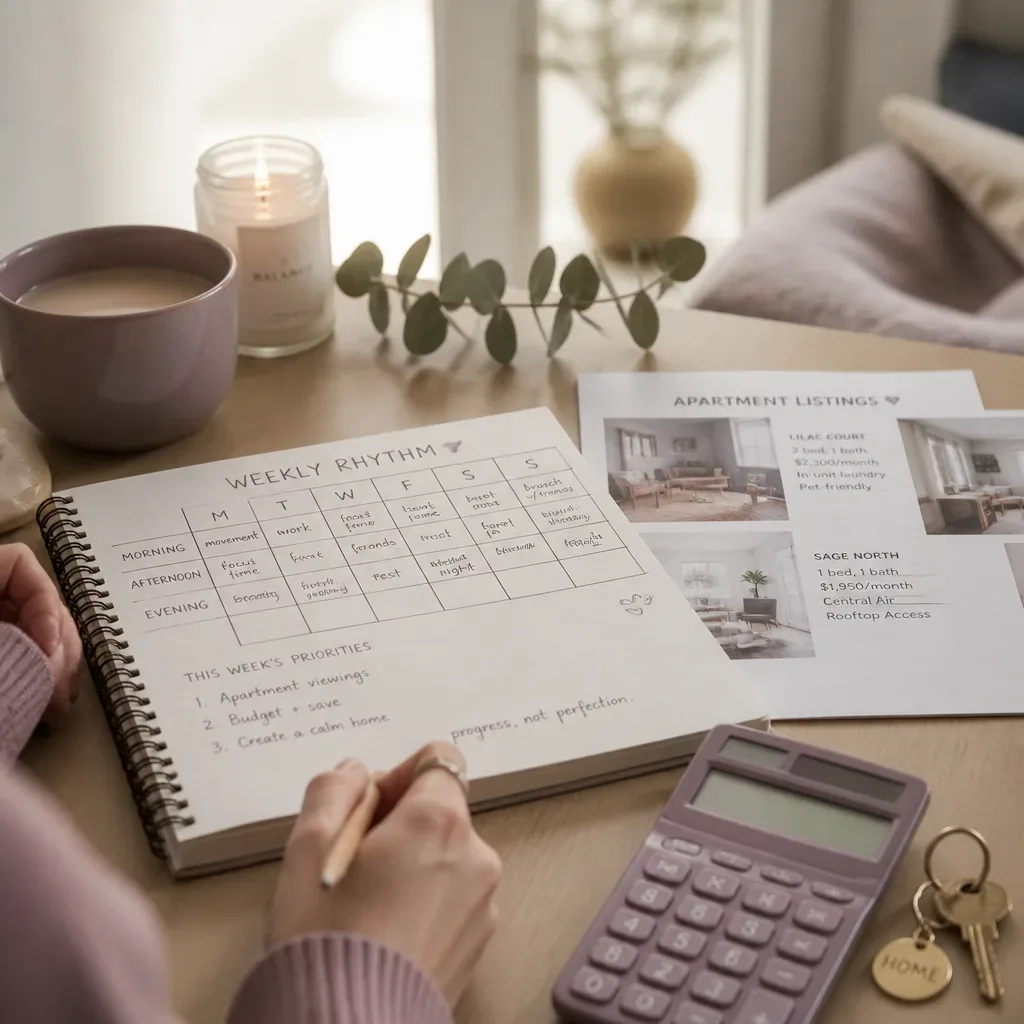
You can use the broader manifestation guide when you need language for belief, doubt, and desire. For home, keep the action concrete. Housing is one of the most regulated, priced, paperwork-heavy parts of adult life. A 2024 Harvard Joint Center for Housing Studies report found that cost burdens remain high for both renters and owners in the United States. The ritual should not make you vague. It should make you braver with facts.
Some homeward actions are emotional, too:
- Stop touring homes you already know would make you small.
- Tell the truth about who you want nearby.
- Clear objects from a past life with care.
- Practice receiving help without performing helplessness.
- Let a good-enough home be good if it truly holds you.
A dream home is not always bigger. Sometimes it’s quieter. Sometimes it’s closer. Sometimes it’s the first place where your sleep returns.
How do you know the practice is working?
You know it’s working when your choices become more honest, not when every sign looks dramatic.
Look for ordinary evidence. You stop saving listings that don’t fit. You speak sooner about money. You notice which neighborhoods soften your jaw. You clean one corner because you remember you’re already in relationship with home. These are small signals, but small signals are how a life changes direction without frightening the body.
Joe Dispenza writes often about rehearsing a future state until the body begins to recognize it as familiar. You don’t have to make his whole framework yours. The useful part is this: repetition can move a desire from fantasy into identity. In the Journal of Behavioral Medicine, mental rehearsal and imagery practices have been studied across health and performance settings for decades, often with modest but real effects when paired with behavior. The pairing matters.
Track for 14 days. Not forever. Two weeks is enough to see whether the audio is sharpening or blurring you. Make three columns in a notebook:
- What I heard. One line from the audio that stayed.
- What I noticed. A listing, a feeling, a resistance, a number.
- What I did. One action, however small.
After 14 days, revise the recording if needed. Maybe the first version was too grand. Maybe it ignored the dog, the commute, the debt, the need for silence. Revision is not doubt. It’s listening more closely. The home doesn’t need you to pretend. It needs you to become available to what is true.
If you work with moon dates, transits, or seasonal markers, keep them supportive. Astrology and manifestation can offer timing language, but the daily audio is still the practice. A chart can’t listen for you. A calendar can’t choose the apartment you know is wrong.
The right home doesn’t ask you to abandon yourself to enter it.
When the recording has become familiar, you’ll hear its sentences in small moments: at a viewing, during a budget talk, while folding sheets. That’s how you know. The audio has moved from something you play to something you remember.
What should you do when doubt comes in?
Let doubt speak, then answer it with facts, care, and the next small listening.
Doubt is not a spiritual error. It’s often your mind protecting you from disappointment. Housing can carry old grief: eviction, crowded rooms, family tension, debt, shame, leaving, not being chosen. If a 3-minute home audio brings tears, don’t call that failure. Call it contact. In a 2021 American Psychological Association survey, money and housing-related stress remained common themes for many adults. Your body may need time to feel safe wanting something specific.
Try this when doubt arrives:
- Say, “I hear you.”
- Name the fact underneath: “The market is hard,” or “I’m scared of debt.”
- Return to one line from the audio.
- Take one grounded action within 24 hours.
- Rest before you re-decide your whole future.
You can also add a short line to the end of the recording: “I don’t need to know every step today. I know the next honest one.” That sentence keeps the practice from becoming pressure. It gives your nervous system room. In trauma-informed care, pacing matters; too much activation can make people freeze rather than act. The same is true in desire.
If your doubt is practical, respect it. Get pre-approved. Talk to a tenant adviser. Ask a friend to review the lease. Save the deposit. Read the inspection report. Manifestation is not a substitute for legal or financial care. It’s the inner posture that helps you stop abandoning yourself while you do the work.
One final note from an herbalist: some plants root quickly; others spend a long season underground. You can’t scold a seed into becoming a door. But you can water the place where the door will be.
Listen once. Then live one small inch closer to home.