manifestation for life areas
Freedom Manifestation: Listen Before You Say Yes
Freedom manifestation helps you pause before overcommitting, hear your future self, and choose the yes that feels honest instead of automatic.

The phone lights up on the table. Freedom manifestation is the practice of pausing before you say yes, listening for the self who is already free, and answering from that place. It helps you choose from truth instead of guilt, speed, or the need to be liked.
What does freedom manifestation actually mean?
Freedom manifestation means rehearsing inner freedom before the next choice asks for your old self.
You can call it a manifestation practice, but keep it plain. You are not trying to float above your life. You are practicing the feeling of having room inside it. The request arrives. A meeting. A favor. A family expectation. A soft pressure to be available. Before you answer, you return to the life you say you want.
Self-Determination Theory, developed by Edward Deci and Richard Ryan, names autonomy as one of 3 basic psychological needs, alongside competence and relatedness. When autonomy is low, even good opportunities can feel tight. That matters because many people don’t need a better planner first. They need a cleaner yes.
Manifestation becomes useful here when it is not treated as wishing. It becomes a rehearsal. You picture, hear, and repeat the identity of someone who does not abandon herself at the first sign of approval. A free life is built in the small second before the automatic answer.
There is a quiet difference between desire and obligation. Desire has breath in it. Obligation often arrives already apologizing. In freedom manifestation, you learn the texture of both.
The freest yes is the one that does not require you to disappear.
Why should you listen before you say yes?
You should listen first because your fastest answer is often your oldest pattern.
The brain likes speed. Daniel Kahneman’s work popularized the split between fast and slow thinking, and the basic lesson still helps here: quick responses are efficient, but they are not always wise. If you grew up being praised for being easy, helpful, or low-maintenance, your body may answer before your truth has entered the room.
A 2023 Gallup report found that 44% of employees worldwide said they felt a lot of stress the previous day. Stress narrows choice. Under pressure, a yes can become a reflex, not a decision. This is why the pause matters. It returns one inch of authorship to you.
Listening can mean silence. It can also mean audio. The AYA Method is a daily audio manifestation practice. Each day you listen to a short personalized recording — your Dream-Self Moment — narrated from the version of you who has already manifested the life you intend. Listening is the practice. Repetition is the work. The audio is the method.
The daily affirmation and Manifestation Board inside the app can support the practice, but they are complements. The audio is where the body begins to recognize the future self as familiar. That matters before a yes, because the nervous system often trusts the familiar more than the true.
Try this today:
- Read the request once.
- Put the phone face down for 60 seconds.
- Listen to your Dream-Self Moment, or sit in quiet if you do not use audio yet.
- Ask: who am I trying to keep safe with this yes?
- Answer only after your breath slows.
A pause is not a delay tactic. It is a doorway back to yourself.

How do you know if a yes is real?
A real yes leaves you with steadier breath, not a private bill you will pay later.
You do not need a dramatic sign. You need a few honest signals. A true yes may still feel scary, especially if it asks you to grow your skill or speak in public or be seen. But it does not feel like self-erasure. It does not demand that you betray sleep, money, health, or the promise you made to your own life.
The American Psychological Association’s 2023 Stress in America report found that 77% of adults said stress affected their health in the prior month. That number is not small. Many yeses are not single events; they become sleep debt, resentment, shallow breathing, and weekends that never repair you.
Use this small table before answering:
| Signal | False yes | True yes |
|---|---|---|
| Body | Tight chest, rushed typing | More breath, even with nerves |
| Thought | They will be upset if I don’t | This fits what I am making room for |
| Time | Requires hidden sacrifice | Has a clear place in the week |
| Aftertaste | Resentment, dread, collapse | Steadiness, clarity, clean effort |
AFFIRMATIONS can help when you use them as a small daily reminder, not as a substitute for choice. A line like I am allowed to pause before I answer can retrain the moment. In small studies on self-affirmation, including work discussed in the Journal of Behavioral Medicine, values-based statements have been linked with better stress responses in certain groups.
Be careful with the yes that performs goodness. It may look generous from the outside and feel like theft on the inside. Goodness that costs you your inner home is not goodness. It is fear wearing clean clothes.
What is the 7-minute freedom manifestation practice?
The 7-minute practice is a short listening ritual that helps you answer from your future self instead of from pressure.
Set a timer if that helps. Seven minutes is long enough to interrupt the reflex and short enough to use before a text, meeting, or family call. BJ Fogg’s behavior research at Stanford has often emphasized small actions attached to existing moments. This practice attaches to a moment you already have: the second before reply.
Here is the shape:
- Minute 1: Name the request. Say it plainly. They asked me to lead the extra call. My cousin asked for money. My friend wants an answer tonight.
- Minutes 2 to 4: Listen. Play your Dream-Self Moment through the AYA Method, or use a short recording you made in your own voice.
- Minute 5: Feel the first honest answer. Do not justify it yet.
- Minute 6: Check capacity. Look at time, money, care, and health.
- Minute 7: Choose the clean sentence. Yes, I can. No, I can’t. I can answer Friday. That is enough.
A clean sentence is a mercy. It does not drag the other person through your guilt. It also does not invite negotiation when the answer is already true.
If you follow the moon, timing, or symbolic cycles, astrology and manifestation can be used as a reflective layer. Let it help you notice seasons. Do not let it replace your own consent. No chart gets to vote before your body does.
Freedom is not the absence of requests. It is the return of choice inside them.
What do you say when the answer is no or not yet?
You say no with less decoration than fear wants, and with more kindness than avoidance gives.
Most people overexplain because they are trying to manage the other person’s feeling in advance. That is understandable. It is also exhausting. A 2022 Microsoft Work Trend Index reported that meetings had increased 153% for the average Teams user since early 2020. Many people are carrying too many asks. Clarity is not rude in a culture of excess access. It is care.
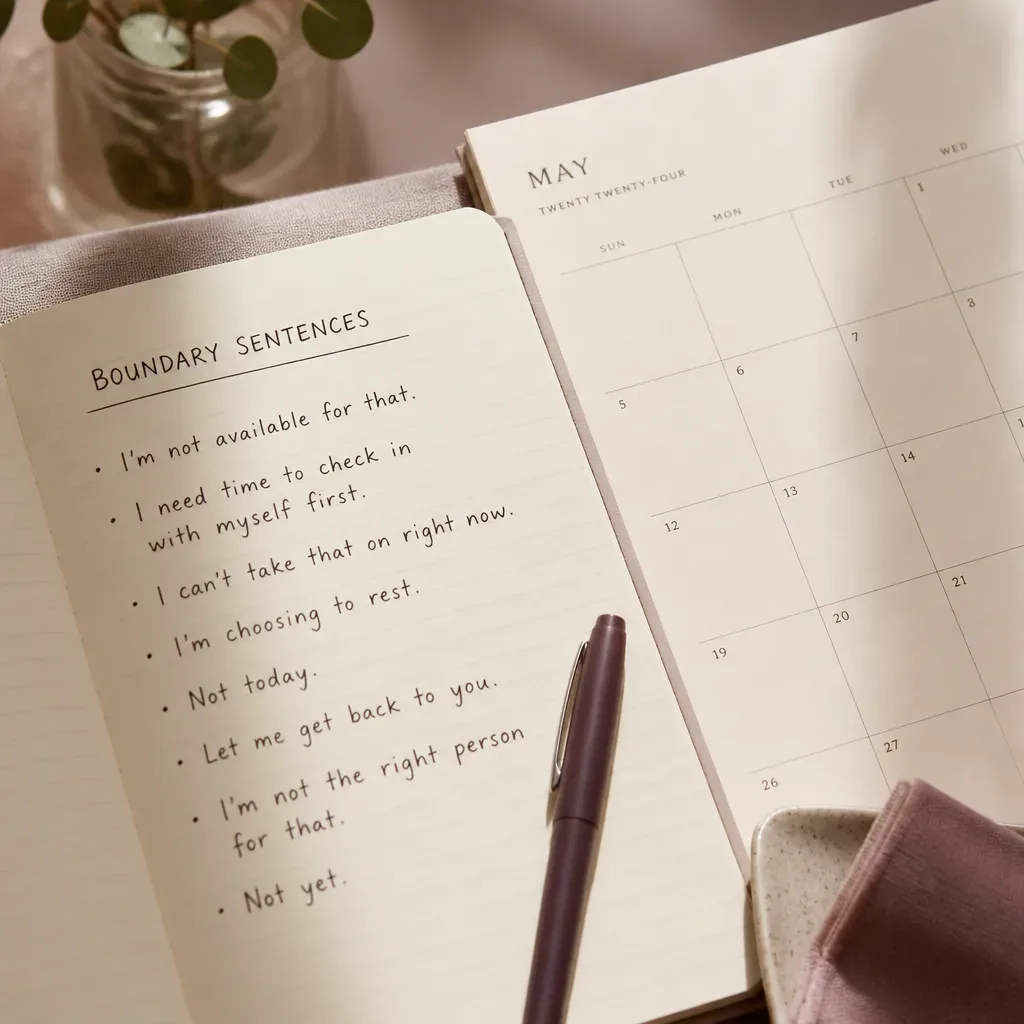
Keep a few sentences ready. Your future self does not need to invent language while flooded.
- Thank you for thinking of me. I can’t take this on.
- I can’t say yes this week. Please ask me again next month.
- I need to check my capacity before I answer.
- That doesn’t fit what I’m giving time to right now.
- I can do a smaller version: 20 minutes on Tuesday.
- I want to support you, but I can’t be the person for this.
Notice the shape. No long defense. No false promise. No sentence that begins with I’m the worst. You are not confessing a crime. You are giving information.
This is where manifestation practice becomes practical. Each morning, you rehearse the self who can survive being temporarily misunderstood. Then, when the moment comes, the sentence is not brand new. You have already heard her. You have already met the one who stays.
How do you make freedom feel normal every day?
You make freedom normal by repeating it in small, ordinary choices before the large ones arrive.
A free life is not only made by quitting, moving, ending, or beginning. It is made by the 2-minute pause, the honest calendar, the shorter reply, the evening you protect without making a speech. Repetition teaches the mind what is allowed. Joe Dispenza often speaks about mental rehearsal as a way the body begins to know a future before it is visible. You do not have to accept every claim around that idea to use the simple part: what you repeat becomes easier to reach.
Keep the practice close to things you already do:
- Before opening messages, listen for 3 minutes.
- Before accepting a meeting, look at the week as a whole.
- Before helping, ask whether help would become rescue.
- Before buying time with money, ask what the purchase is protecting.
- Before saying maybe, ask whether maybe is just a slow no.
If your practice includes affirmations, choose one that points to behavior. Not I am free in a vague way. Try I pause before I promise. Or My yes is allowed to be whole. Specific language gives the mind a handle. In a 2016 review in Social Cognitive and Affective Neuroscience, self-affirmation was linked with brain systems involved in valuation and future orientation.
Neville Goddard taught the practice of assuming the feeling of the wish fulfilled. In this context, the wish is not a fantasy of having no needs placed on you. The wish is simpler. You are someone who can answer from inner permission.
What you practice in quiet becomes available under pressure.
Return to the audio daily. Let the Dream-Self Moment become a room you recognize. The app may also hold your affirmation and Manifestation Board, but the listening remains the center. The more often you hear the free self, the less strange she feels when she speaks through you.
What if guilt gets loud after you choose yourself?
Guilt may get loud because an old role is losing its grip, not because your choice was wrong.
This is the part many people mistake. They expect the right decision to feel peaceful immediately. Sometimes it does. Sometimes the right decision trembles for 20 minutes, then becomes quiet. The body can protest a new boundary even when the boundary is kind. Old patterns do not vanish just because the new sentence was clear.
Research on habit formation is often traced to a 2009 study in the European Journal of Social Psychology, which found an average of 66 days for a new behavior to become automatic, with wide variation. That number is not a rule for your soul. It is a reminder that repetition is not failure. Repetition is how the new path becomes easier to walk.
When guilt rises, do 3 things:
- Put one hand on your chest or table. Make contact with something real.
- Repeat the exact sentence you used. Do not revise it while afraid.
- Listen again, even for 90 seconds, to the self who knows why you chose this.
You can repair if you were unkind. You can clarify if you were unclear. But do not use guilt as proof that you should have abandoned yourself. Guilt is information. It is not always instruction.
The Princeton Engineering Anomalies Research program, often called PEAR, studied intention and random systems for nearly 28 years. Its claims remain debated. Still, the broader lesson for a practice like this is modest: attention changes participation. When you repeatedly attend to freedom, your choices begin to collect around it.
There will still be hard asks. People you love will still need you. Work will still make demands. Freedom manifestation does not remove life. It changes the place you answer from.
The phone can wait while you come home to yourself.