manifestation for life areas
Creativity Manifestation: Listen Before You Make
Creativity manifestation becomes steadier when you listen first: a 12-minute audio-led practice for artists, writers, and makers before the next small move.

A pencil waits beside the cup. Creativity manifestation means listening to the self who already makes, then taking one small action from that state. It is not wishing for art to arrive. It is a short audio-led practice that steadies attention, names the next move, and brings your hands back to the work.
What is creativity manifestation, really?
Creativity manifestation is the practice of rehearsing the identity and conditions of the maker before you make.
It begins before the page. Not far before. Maybe 12 minutes. You listen. You hear a version of yourself who has already finished the poem, sent the pitch, hung the photographs, or returned to the piano after years away. Then you do one plain thing. You open the file. You rinse the brush. You take the first bad photograph. The manifestation practice becomes useful only when it touches matter.
The the AYA Method is a daily audio manifestation practice. Each day you listen to a short personalized recording — your Dream-Self Moment — narrated from the version of you who has already manifested the life you intend. Listening is the practice. Repetition is the work. The audio is the method.
That matters for creative people because making is often blocked by noise, not by lack of desire. A 1994 meta-analysis by Driskell, Copper, and Moran reviewed 35 studies and found that mental practice can improve performance, especially when paired with physical practice. The point is not to think instead of doing. The point is to let the mind rehearse the doorway so the body can enter it.
Creativity is not a lightning strike. It is a relationship with return. Teresa Amabile’s research on creativity, including her 1996 work on intrinsic motivation, found that creative output is strongly shaped by attention, autonomy, skill, and the meaning attached to the task. Manifestation, when it is honest, supports those conditions. It asks: who are you when the work is already part of your life?
The work does not need your panic to become real.
Why listen before you make?
Listening before making lowers the inner static so your first creative move can be specific.
A maker often sits down with too many voices in the room. The critic. The teacher. The market. The person who said it would not sell. The younger self who was praised only when the result was neat. Listening creates a smaller room. In that room, you can hear the next honest instruction.
Neuroscientist Dr. Andrew Huberman often points to the role of state in performance: attention, arousal, and rest all shape what the nervous system can do. Creativity research says something similar. Beaty and colleagues, in a 2018 paper in Proceedings of the National Academy of Sciences, described creative thought as coordination between brain networks linked with spontaneous thought, control, and salience. In simple language: creative work asks you to wander and choose.
Audio helps because it gives wandering a rail. You are not staring at a blank wall, trying to force vision. You are listening to a short narrative that your body can recognize. For many people, sound is more intimate than text. A 2022 Edison Research report found that 73 percent of the U.S. population age 12 and older had listened to online audio in the previous month. Listening is already a daily doorway for many minds.
The order is important. First the audio. Then the making. The app may also include a daily affirmation or a Manifestation Board, but they are complements. They are not the center. For creative work, the center is the moment you hear the self who already returns to the practice, then you let that hearing become a verb.
A blank page is less frightening when your future self has already spoken there.
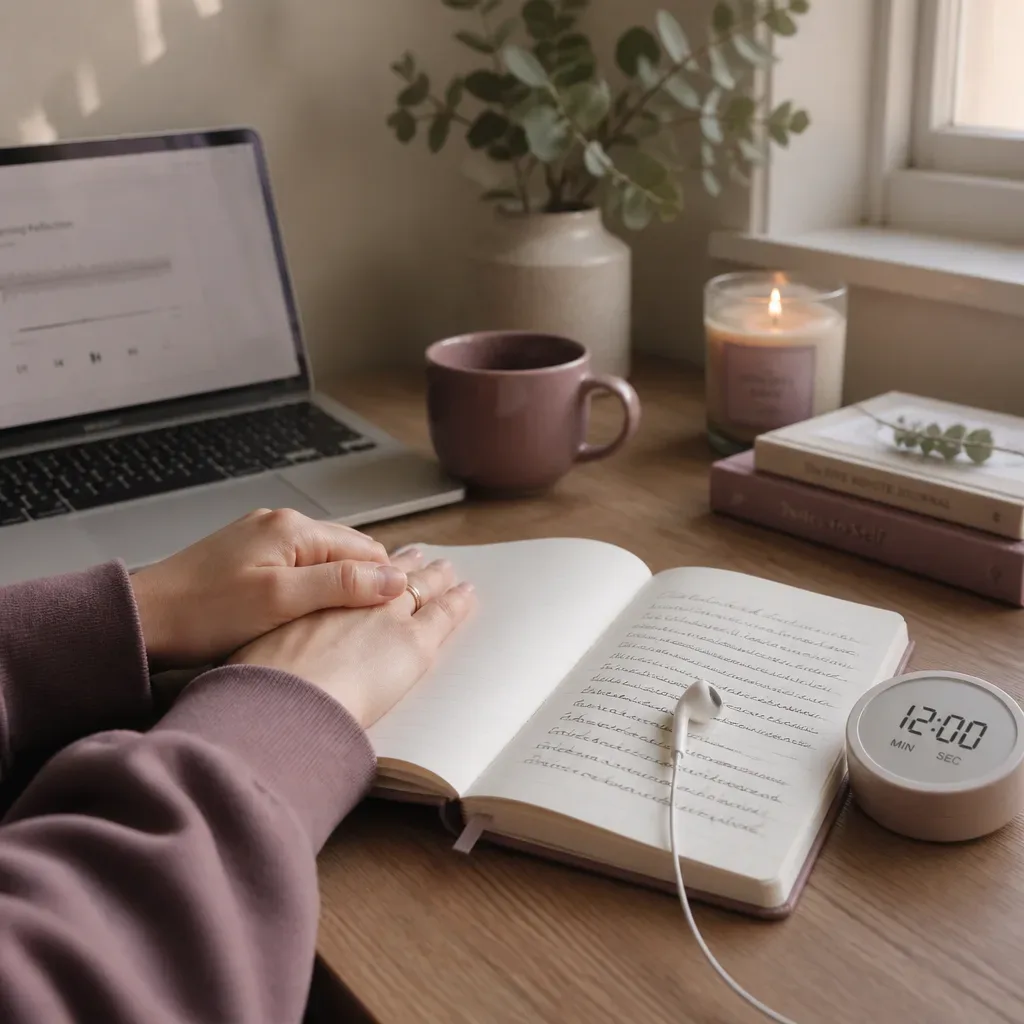
How do you do creativity manifestation in 12 minutes?
You do it by keeping the listening short, the action concrete, and the promise small enough to keep.
Here is a 12-minute structure I use when I am editing photographs or beginning an essay. I set a timer because time can become a fog. In Lally and colleagues’ 2010 study in the European Journal of Social Psychology, habit automaticity took 66 days on average, with wide variation from 18 to 254 days. Repetition matters more than intensity.
- Minute 0 to 1: set one tool in reach. Put the notebook, camera, clay, laptop, or instrument where your hand can touch it.
- Minute 1 to 5: listen to your Dream-Self Moment. Let the audio name the creative self who already lives close to the work.
- Minute 5 to 7: write three details. Do not write a plan. Write what you noticed: a line, color, texture, sentence, person, or place.
- Minute 7 to 11: make one small mark. Four minutes is enough to begin badly, which is often enough to begin truly.
- Minute 11 to 12: close with one line. Write what you did, not what you think it means.
This is not a productivity system. It is a listening ritual with a physical ending. If you want a sentence after the audio, choose one from the affirmations practice and make it behavioral. Not I am a genius. Try I stay with the page for ten minutes. The nervous system trusts what it can test.
Small is not weak. Small is how the door agrees to open.
What should you listen for after the audio?
Listen for concrete signals, not grand declarations.
A good signal can be almost embarrassingly small. The blue shirt. The word salt. The need to photograph the chair again at 4 p.m. Creativity often arrives as detail before it arrives as direction. Graham Wallas described four stages of creative thought in 1926: preparation, incubation, illumination, and verification. The listening practice sits between preparation and illumination. It gives incubation a place to speak.
Use this table when you finish listening:
| What you notice | What it may mean | What to do next |
|---|---|---|
| A repeated image | Your attention is gathering there | Sketch or describe it for 5 minutes |
| A body sensation | The work has an emotional charge | Name it in one sentence |
| A specific tool | The next action is physical | Touch the tool and begin |
| A person or place | The work wants context | Write the scene without explaining it |
| A sentence fragment | Language is leading | Copy it at the top of the page |
The table is not mystical theater. It is a way of respecting attention. In a 2012 paper in Psychological Science, Baird and colleagues found that an undemanding task improved performance on a later creative task compared with rest or a demanding task. The mind often needs a soft channel before it can make a new connection.
You may also notice resistance. That counts. If the audio brings up embarrassment, grief, or anger, do not treat it as failure. Creative work is close to memory. A 2005 study by Creswell and colleagues in the Journal of Personality and Social Psychology found that self-affirmation reduced stress responses in threatened participants. A true sentence can give you enough room to stay.
The signal is usually quieter than the fear.
How do you keep listening from becoming avoidance?
You keep the practice honest by attaching every listening session to one visible action.
Avoidance can wear beautiful clothes. It can look like researching, preparing, buying new pens, saving references, or listening again because the first time was not perfect. The test is simple: after the audio, does something exist that did not exist before? It can be one sentence. One thumbnail sketch. One chord progression. One contact sheet. One sent email.
Use three rules:
- One listen only. Replaying can become a way to delay the hand.
- One small output. The output must be visible, audible, or saved.
- One time boundary. Ten minutes of making is better than an open promise you cannot keep.
The American Psychological Association’s 2023 Stress in America report noted that many adults reported persistent stress affecting daily functioning. Creative people are not outside that number. Pressure makes the mind crave certainty, but art rarely gives certainty at the start. So the practice must stay kind and firm. Listen once. Make once. Stop before you turn the ritual into a test.
This is also where timing tools can be used with care. If you like symbolic timing, astrology and manifestation can help you reflect on cycles, beginnings, and review periods. But it should not become permission to wait forever. The moon does not have to approve your paragraph. The paragraph needs your hand.
A practice is true when it returns you to the material.
What changes after seven days of listening before making?
After seven days, you may not have a finished work, but you should have evidence that you return.
Seven days is a small sample, not a verdict. Treat it like a contact sheet. You are looking for patterns: which time of day works, which audio phrases stay with you, which tools invite action, which fears repeat. In behavioral science, tracking a behavior for even one week can increase awareness of cues and friction. The National Cancer Institute’s behavior-change materials often name self-monitoring as a core technique because seeing the pattern changes the next choice.
At the end of seven days, ask:
- What did I make, even in rough form?
- What did I avoid more than once?
- Which detail kept returning?
- What time of day felt most merciful?
- What is the next 10-minute action?
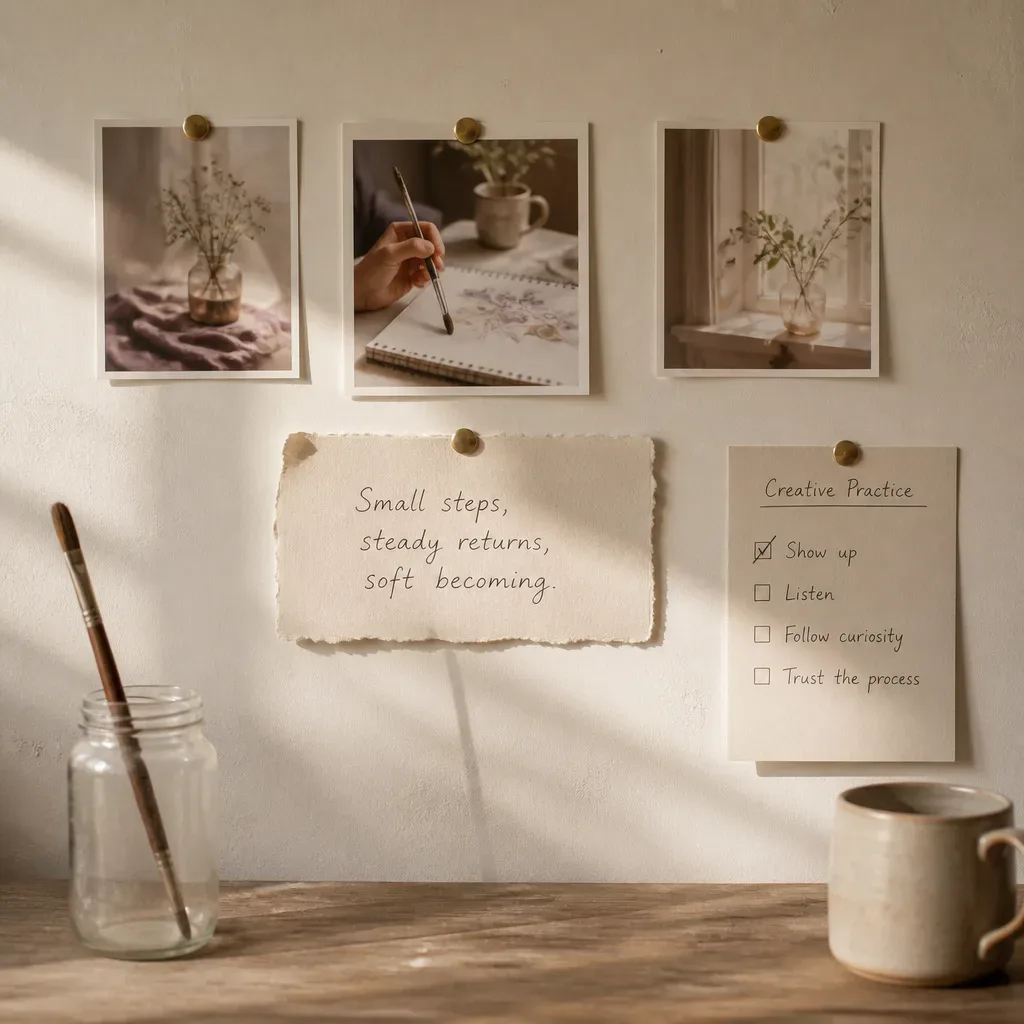
If you want to go further, pair your daily audio with one visible anchor: a folder called first drafts, a wall with three printed images, or a notebook page dated each morning. The Manifestation Board can hold images of the creative life you are practicing toward, but it remains a complement. The audio is the method. The making is the proof.
There is a quiet dignity in unfinished work that keeps being touched. Joe Dispenza often speaks about rehearsing a future state until the body knows it; Neville Goddard wrote about assuming the feeling of the wish fulfilled. You do not need to borrow every claim from either teacher to use the human truth inside the practice: repeated inner rehearsal changes what you are willing to do next.
For a wider frame, keep the main manifestation guide close, and return to the AYA Method when you want the practice named simply. Creativity manifestation is not about becoming someone else. It is about recognizing the maker already near enough to hear.
The page is quiet. Your hand knows where to begin.