manifestation for life areas
Manifest Travel with a 3-Minute Future-Self Audio
Manifest travel with a 3-minute future-self audio practice that pairs quiet repetition, sensory detail, and one real-world step each day.
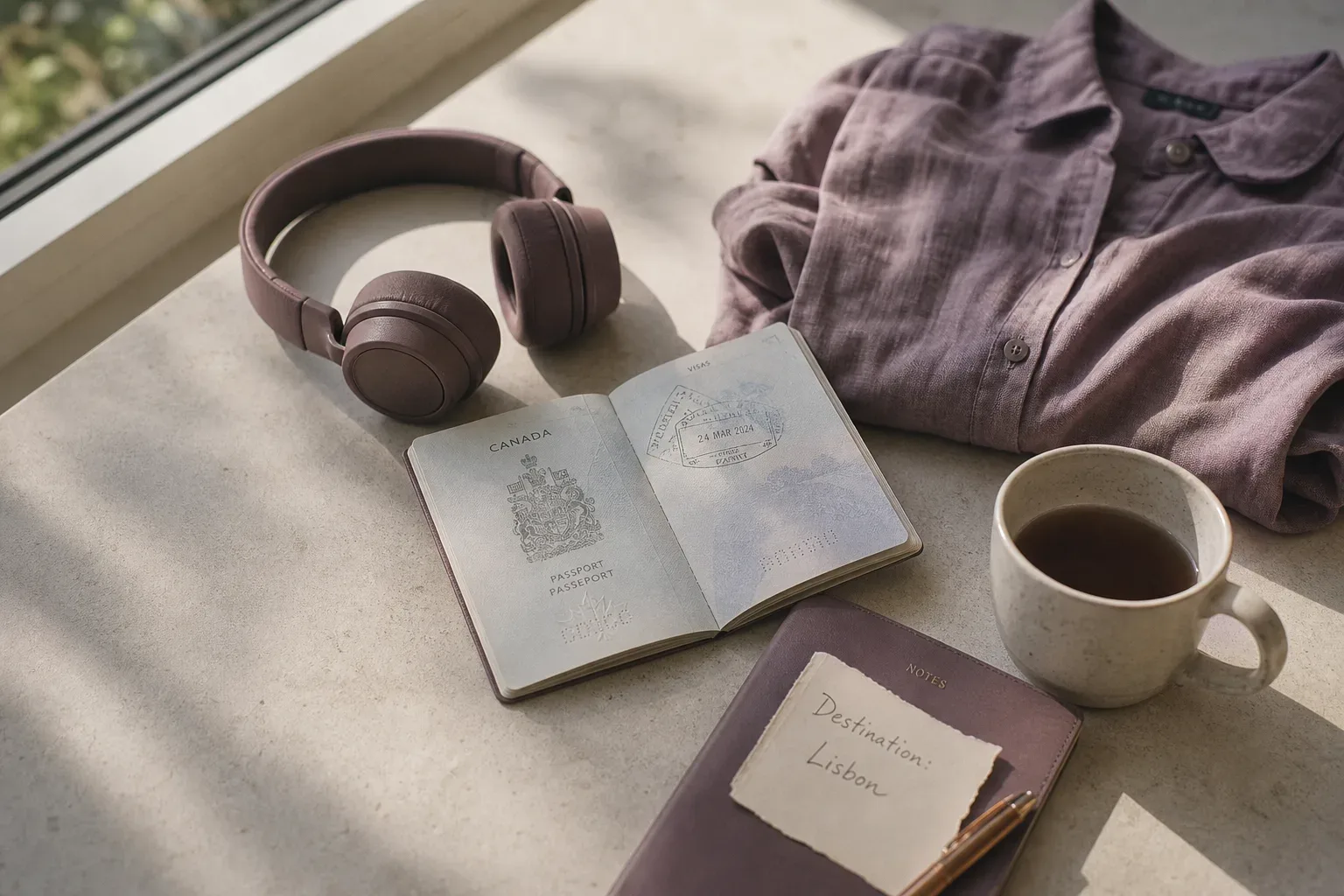
A passport on the table is not enough. To manifest travel, choose one real trip, record a three-minute future-self audio, listen daily, and take one small travel action after each listen. The practice works best when your mind hears the trip as already lived, then meets it with practical movement.
What does it mean to manifest travel without forcing it?
To manifest travel is to let one possible trip become familiar enough that your choices begin to make room for it.
This is not a spell against airline prices, visa rules, family duties, or paid leave. It is attention training. You give your mind one clear picture, then you return to it often enough that the next true step becomes easier to see. A 2023 Pew Research Center report found that 90% of U.S. adults own a smartphone; for many people, the tool for this practice is already in a pocket, beside the bed, or under a cup of tea.
Travel desire can stay vague for years. Paris someday. Bali when work calms down. Kyoto after the hard season. Vague desire feels romantic, but it asks nothing of you. A named trip asks a different question: what would have to be true for this to happen?
Manifestation, in the quiet sense, is not pretending logistics don’t exist. The Manifestation pillar frames it as a practice of attention, identity, and repeated inner rehearsal. That matters because the brain predicts from what it knows. If your nervous system only knows delay, a trip can feel like a story for other people.
Your future-self audio gives the brain new material. Not fantasy. Evidence. The sound of you saying, calmly, “I remember standing at the gate with my bag under my hand.” One sentence can become a room you enter every day.
Neville Goddard called this kind of practice “living in the end” in his 1944 lectures. Joe Dispenza often describes mental rehearsal as teaching the body a future before it arrives. You don’t have to accept every claim from either teacher. You can simply test the smaller truth: repeated inner scenes change what you notice and what you do.
Why use a 3-minute future-self audio instead of only thinking about the trip?
Audio gives your intention a place to live outside the noise of thought.
Thinking is slippery. It changes tone every few seconds. One minute you’re picturing the hotel window. The next you’re checking rent, comparing yourself to a friend, or remembering the last trip that fell apart. A recording holds the same shape each day. Three minutes is short enough to repeat and long enough to include a beginning, middle, and return.
The AYA Method is a daily audio manifestation practice. Each day you listen to a short personalized recording — your Dream-Self Moment — narrated from the version of you who has already manifested the life you intend. Listening is the practice. Repetition is the work. The audio is the method.
The method matters here because travel is sensory. You don’t only want a line on a calendar. You want the first key card in your hand. The station sign. The small hunger after landing. In cognitive psychology, imagery research has repeatedly shown that mental simulation can influence planning and motivation; a 2011 review in Current Directions in Psychological Science noted that imagining specific future events can support goal-directed behavior when paired with concrete steps.
Three minutes also protects the practice from becoming another performance. Dr. Andrew Huberman often points to brief, repeated nervous-system practices as more usable than heroic routines. You don’t need 45 minutes, incense, or a perfect morning. You need a cue, a recording, and the willingness to listen again.
| Practice | Time | What it gives you | What it still needs |
|---|---|---|---|
| Thinking about travel | 10 seconds to hours | Desire and possibility | Shape and repetition |
| Written travel list | 5 to 20 minutes | Clarity and details | Emotional rehearsal |
| 3-minute future-self audio | 3 minutes daily | Voice, memory, identity | One real action after listening |
The quiet rule is this: if a practice can’t survive an ordinary Tuesday, it won’t hold you for long.
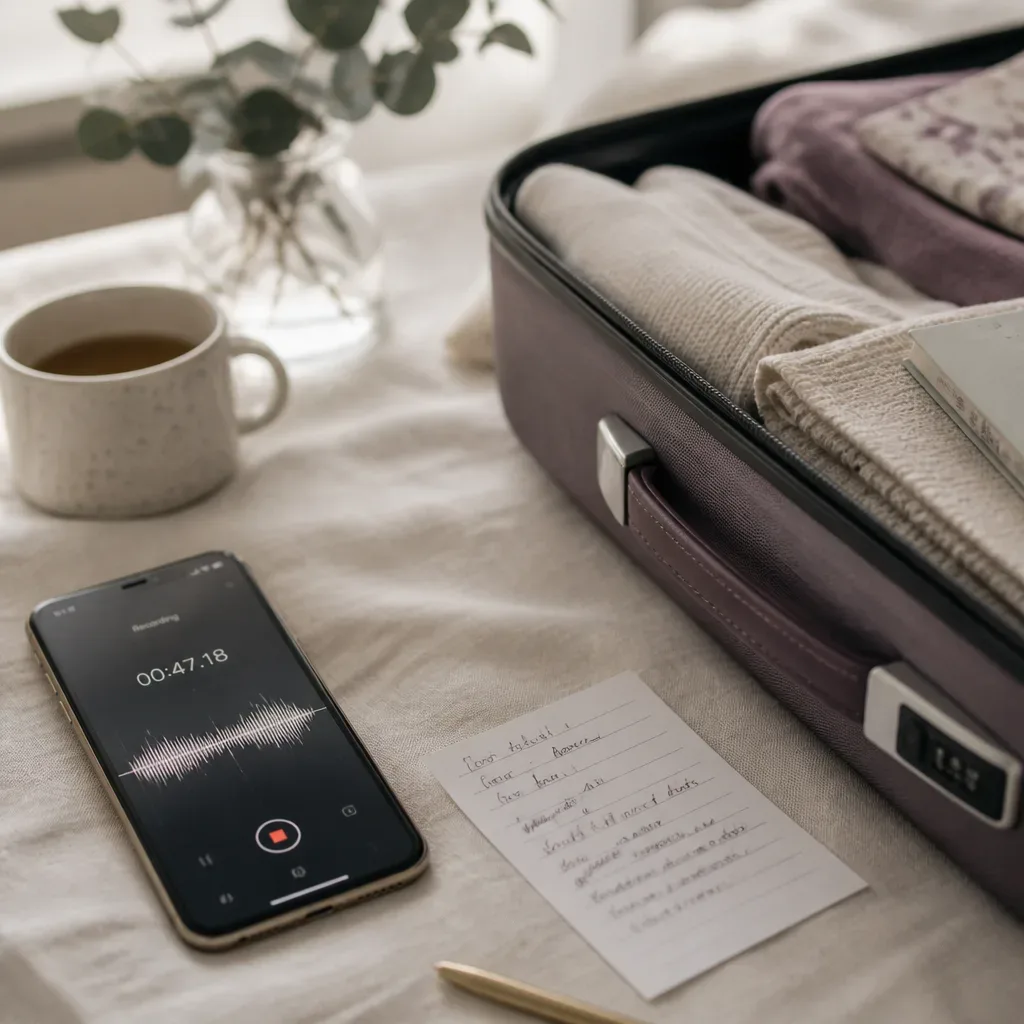
How do you write the travel audio so it feels true?
Write it from after the trip, using details your body can believe.
Start small. Choose one destination, not six. Choose one time window, not a lifetime. “I went to Lisbon in October” is easier for the mind to hold than “I travel all the time.” If money is tender, don’t use language that makes your chest tighten. Say, “I watched the fare, saved steadily, and booked when the number became possible.” Truth has a softer nervous-system signature than force.
A 2009 study by Lally and colleagues in the European Journal of Social Psychology found that new habits took 66 days on average to become automatic, though the range was 18 to 254 days. That number is useful because it lowers the drama. You are not failing if the trip doesn’t appear after three listens. You are laying down a route.
Use this five-part script:
- Name the place. Say the city, coast, mountain, or country.
- Name the moment after arrival. Choose one scene you can see.
- Name the proof. Boarding pass, stamp, receipt, photo, message.
- Name who you became. Calm planner, careful saver, brave asker.
- Name today’s step. One action under 10 minutes.
Here is a simple frame:
“I’m back from [place]. I remember [sensory detail]. I can still see [proof]. What surprised me is how calmly I prepared. I checked what needed checking. I asked for the dates. I saved what I could. I let this trip become normal in my mind before it became visible in my calendar. Today I take one small step.”
Keep the words plain. The future self doesn’t need to impress you. She needs to sound like someone you recognize.
When should you listen, and what should you do right after?
Listen once a day at a stable cue, then take one small travel action before the day absorbs you.
The cue can be after brushing your teeth, before the first message, during a short walk, or once you’re in bed. Habit design researcher BJ Fogg has long taught that tiny behaviors attach best to existing routines. You don’t need a new life structure. You need a hinge. The recording hangs from that hinge.
After listening, act while the scene is still warm. Not a grand action. A real one. Search one fare. Put ₹500, $10, or €10 into a travel account. Check passport validity. Read one visa page. Message the friend you’d stay with. Save the name of one neighborhood. The act tells the mind, “I heard you.”
Small action is not less spiritual than belief. It is belief with shoes on.
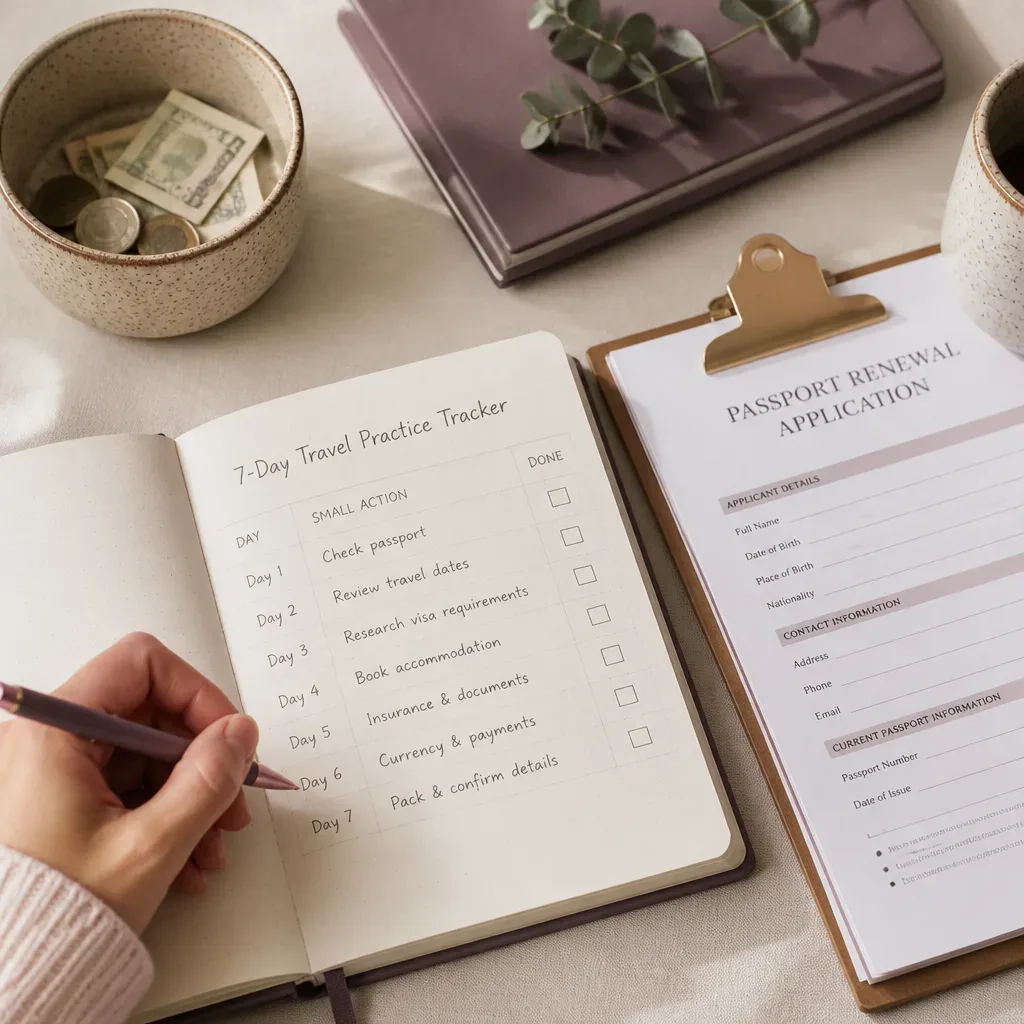
Use this 7-day rhythm if you like structure:
- Day 1: Listen and choose the exact destination.
- Day 2: Listen and check the best travel months.
- Day 3: Listen and estimate the first honest cost range.
- Day 4: Listen and check your documents.
- Day 5: Listen and save one amount, however small.
- Day 6: Listen and ask one person or calendar for space.
- Day 7: Listen and edit the audio only if it now feels more true.
A 2018 American Psychological Association survey reported that money remains a major source of stress for many adults. That is why the after-listen step must be kind and concrete. If the number is too large, break it down. A flight is made of many small payments before it is made of one departure.
If you’re drawn to timing, you can place the practice near a new moon or a personal transit, but keep it grounded. The piece on astrology and manifestation can help you use symbolic timing without handing your choices away.
What gets in the way when you try to manifest travel?
The most common blocks are vague desire, hidden permission issues, and a gap between the scene you rehearse and the steps you take.
Vague desire sounds like “I just need to get away.” That may be true, but it isn’t enough. Away from what? Toward what? A quiet hill town has a different instruction than a work trip to Berlin or a month near the sea. Specificity is not control. Specificity is care.
Permission is often harder. You may have enough time and still feel selfish. You may have the money and still feel watched by old family rules. You may be a parent, caregiver, partner, employee, daughter, son. Travel can touch loyalty. Name that in the audio. “I let myself plan this without making my love smaller.” A 2022 Pew survey on work and family life found that many adults still report time pressure around care and employment; your practice has to live inside that truth.
Then there is the action gap. If you listen beautifully but never check the price, the practice stays private. If you only compare prices but never let yourself feel arrival, planning becomes dry and punishing. You need both.
The app also includes a daily affirmation and a Manifestation Board as complements. For travel, an affirmation might be one sentence you carry into the day, while the board holds a few images that steady the scene. If you want to understand that shorter form, the Affirmations pillar is a good home base. Still, the audio remains the method.
Here are signs the practice is working, even before anything is booked:
- You know which trip matters now.
- You stop collecting ten destinations to avoid choosing one.
- You can look at costs without shutting down.
- You notice dates, invites, fare drops, and document deadlines sooner.
- You take one step most days, even when the step is small.
A trip begins to move when your attention stops scattering.
How do you keep the practice ethical, grounded, and yours?
Keep the audio centered on your choices, your preparation, and your consent to receive help without controlling other people.
Don’t script someone else into behavior they haven’t chosen. Don’t make a friend pay, a partner agree, or a boss approve in your recording. You can say, “The right conversations became clear,” or “I found a fair way to ask.” You stay inside your own agency. That is cleaner. It also works better because your next step remains available.
Be honest about safety and access. Some passports carry more ease than others. Some bodies are treated differently in airports, hotels, streets, and borders. Some budgets have less give. Manifestation should not erase those facts. It should help you meet them with steadier eyes. The Princeton Engineering Anomalies Research program, often cited in manifestation spaces, reported small statistical deviations in intention experiments over decades; even those controversial findings were small, not permission to ignore material conditions.
Grounded practice asks better questions:
| Question | Why it matters |
|---|---|
| Is this trip mine, or borrowed from someone else’s life? | Desire gets clearer when comparison leaves. |
| What would make this safe enough? | Safety is part of the manifestation, not an afterthought. |
| What is the next step under 10 minutes? | Small steps reduce avoidance. |
| What support can I ask for with respect? | Asking is different from scripting others. |
There is no need to make the trip prove your worth. You are not more real because you boarded. You are not less real because you’re still saving. The audio is a daily place to remember that the version of you who travels is not a stranger. She is a quieter arrangement of choices.
What should your 3-minute practice look like today?
Today, keep it simple: choose the trip, record the scene, listen once, and take one step.
Set a timer for three minutes before recording. Speak slowly. Leave a little air between sentences. If you stumble, keep going. A human voice with one stumble is often easier to trust than a polished script. In small studies on self-talk and performance, including work summarized in sport psychology journals, instructional and motivational self-talk have been linked with better focus when the statements are specific and practiced.
Try this exact outline:
- Minute 1: Arrival. “I’m in [place]. I can see [detail]. I feel [quiet, steady word].”
- Minute 2: Proof. “I booked it. I prepared. I have [proof]. I remember the moment it became real.”
- Minute 3: Identity and action. “I’m someone who makes room for true travel. Today I [one step].”
Then listen once. Don’t judge the recording. Don’t redo it ten times. The practice is not to make perfect audio. The practice is to hear the future self often enough that she stops sounding distant.
If you want a wider frame for the practice, return to the AYA Method and let the Dream-Self Moment do the holding. If you want to understand how this sits inside manifestation as a whole, read the Manifestation pillar after your listen, not before. Practice first. Explanation second.
For the next seven days, keep a small note with only three columns:
| Day | I listened | One step I took |
|---|---|---|
| 1 | yes / no | |
| 2 | yes / no | |
| 3 | yes / no | |
| 4 | yes / no | |
| 5 | yes / no | |
| 6 | yes / no | |
| 7 | yes / no |
Seven days is enough to see whether the trip feels alive or borrowed. It is enough to notice whether your resistance is about money, permission, time, fear, or simple disinterest. That noticing is not small.
Your next room is already making space for you.