manifestation for life areas
Family Manifestation: Listen Before Old Roles
Family manifestation helps you hear your future self before a call, visit, or hard room pulls you back into old roles. A quiet guide.

The phone lights up on the table. You know the name before you read it. Family manifestation means listening to the self you are becoming before the room, the call, or the old script claims you again. It is not control over them. It is a daily return to you.
What does family manifestation actually change?
Family manifestation changes your practiced response before it tries to change anyone else.
A family role is often older than your current life. You may be thirty-seven, paying rent, choosing your own work, and still become twelve when one parent sighs. Family systems theory, named by psychiatrist Murray Bowen in the 1950s, described this pull as part of an emotional system, not a personal failure. The body remembers patterns faster than the mind can explain them.
That is why the first goal is not to make everyone kinder by Friday. The first goal is to rehearse a new internal position. If you have read the quiet overview of manifestation, you already know that manifestation asks for lived inner contact, not wishful noise. In family life, that means you practice being the one who does not disappear, over-explain, perform, or fight for a seat you already have.
There is evidence for the value of rehearsal. Psychologist Peter Gollwitzer’s work on implementation intentions, published across studies since 1999, found that if-then planning can improve follow-through across many goals. A line as small as if my sister criticizes my choice, then I take one breath before answering gives your mind a track to find under pressure.
You do not become free from an old role by hating it. You become free by practicing another room inside yourself.
Family manifestation is quiet because the work is often invisible. No one may know you listened before the visit. No one may praise the breath you took before answering. Still, the pattern has been interrupted. One interruption counts.
Why should you listen before you see them?
You should listen before contact because old family roles can arrive in seconds, before language has caught up.
Think of the first three minutes of a family call. The greeting. The tone. The question that sounds harmless but lands in an old place. Research on emotional reactivity often shows that the nervous system responds quickly to familiar cues; Joseph LeDoux’s work on threat processing in the 1990s helped popularize how fast the brain can flag danger before the thinking mind is fully online. Family cues do not have to be dangerous to be activating. Familiar is enough.
This is where the AYA Method enters softly. The AYA Method is a daily audio manifestation practice. Each day you listen to a short personalized recording — your Dream-Self Moment — narrated from the version of you who has already manifested the life you intend. Listening is the practice. Repetition is the work. The audio is the method.
For family manifestation, your Dream-Self Moment might sound like you before Sunday lunch, already steady. It might speak from the self who can love without shrinking, leave without punishing, answer without proving. The app also includes a daily affirmation and a Manifestation Board, but those are complements. The listening is the center.
Dr. Andrew Huberman has often spoken about the nervous system needing state shifts before cognitive shifts can hold. You do not need to adopt every protocol to know the simple truth: a body already braced will not easily receive a new thought. A two-minute audio before contact can become a threshold. You listen, then enter.
The room remembers who you were. Your practice helps you remember who you are.
How do you name the old role without making it your identity?
Name the role as a pattern, not as the truth of you.
Old roles often have names. The good daughter. The difficult one. The rescuer. The quiet son. The one who always knows. The one who cannot be trusted. In a 2022 American Psychological Association report on stress, family responsibilities and relational strain remained common sources of pressure for adults, even when work and money took more attention in headlines. Family is not just memory. It is labor.
Try this small inventory before your next contact:
- Write the family situation you are entering: call, dinner, visit, group chat.
- Name the role that usually appears within the first ten minutes.
- Name the cost of that role in one sentence.
- Name the future-self response in one sentence.
- Listen to your audio before you enter.
For example, the role may be fixer. The cost may be I leave every conversation with someone else’s life in my chest. The future-self response may be I can care without taking over. That is not cold. It is clean.
A useful distinction:
| Old role | Hidden promise | Future-self practice |
|---|---|---|
| Fixer | If I solve it, I belong | I can listen without carrying |
| Good child | If I agree, I stay safe | I can be kind and separate |
| Silent one | If I vanish, no one reacts | I can speak one true sentence |
| Judge | If I stay above it, I will not feel it | I can be honest without contempt |
Small studies in self-distancing research, including work by Ethan Kross at the University of Michigan, suggest that seeing a difficult situation from a little distance can reduce emotional intensity. Naming the role gives you that distance. You are not the role. You are the one who can see it.

What should your listening practice sound like before family contact?
Your listening practice should sound specific, present, and already true enough for your body to recognize.
A vague recording says, I am calm with my family. A useful Dream-Self Moment gives the body a scene. I stand at the kitchen counter. My mother asks the question she always asks. I feel my feet. I answer once. I do not audition for approval. Specificity matters because mental rehearsal uses sensory detail. In sports psychology, imagery training has been studied for decades; a 2017 review in Frontiers in Psychology noted that imagery can affect motor and emotional preparation when it is vivid and repeated.
Keep the audio short. Many people can stay with two to four minutes more honestly than twenty. Repetition is not punishment. It is design. As a former architect, I think of it like drawing the same line until the hand stops shaking. One line. Then again.
Use these ingredients:
- A real family cue, such as a doorway, ringtone, dining table, or message thread.
- One bodily anchor, such as feet, palm, breath, jaw, or shoulders.
- One chosen response, not ten.
- One boundary sentence if needed.
- One image of yourself after the contact, still whole.
If you also work with affirmations, keep them close to the audio, not instead of it. An affirmation may be I can be loving without being available for every demand. It is a handrail. The Dream-Self Moment is the room you practice entering.
Joe Dispenza often speaks about rehearsing a future self until it feels familiar, while Neville Goddard wrote in 1944 about assumption as an inner state lived now. You do not have to agree with every claim from either teacher to use the practical thread. The self you rehearse is the self you find sooner.
How do you stay yourself in the first ten minutes?
You stay yourself by choosing fewer moves and noticing the earliest pull.
The first ten minutes of family contact are not neutral. They contain old greetings, old jokes, old rankings, and old permissions. John Gottman’s research on couples is not family-of-origin research, but his well-known 5 to 1 ratio of positive to negative interactions shows how strongly patterns of tone can shape relational climate. Families have climates too. You can feel them at the door.
Before contact, choose three quiet moves:
- One breath before answer. Not a dramatic breath. Just enough to come back.
- One sentence you will not explain twice. For example: I am not discussing money today.
- One exit option. Bathroom. Walk. End call. Change room. Leave at 8.
The point is not to become serene. The point is to reduce the number of automatic sacrifices. If you usually explain for twelve minutes, try explaining for two. If you usually say yes in the room and resent it in the taxi, try I need to check and tell you tomorrow. The new life often begins as a delay.
Pew Research Center has reported for years that many adults are part of intergenerational support networks, with money, caregiving, housing, and emotional help moving in more than one direction. This means boundaries in families are not abstract. They touch calendars, kitchens, bank accounts, and bodies.
If astrology helps you track timing or emotional seasons, use it as a mirror, not as a command. The Aya journal on astrology and manifestation holds that same quiet distinction. A chart can help you reflect. Your practiced response is still yours.
A boundary is not a wall around your heart. It is a door with a handle on your side.
What if you fall into the old role anyway?
If you fall into the old role, repair the pattern without turning the slip into a verdict.
You will forget. You will answer too fast. You will become the fixer halfway through the soup. You will hear yourself performing and keep performing for another five minutes. This is not failure. It is data. A role practiced for twenty years will not retire because you listened twice.
Behavior change research is plain about this. Relapse is common in habit work, and the National Institute on Drug Abuse has often framed return to an old behavior as part of many change processes, not proof that change is impossible. Family roles are not addictions, but the nervous system does repeat what it knows. Shame makes that repetition stickier.
Use a repair ritual after contact:
- Write the moment you left yourself.
- Write the cue that pulled you.
- Write the first signal in the body.
- Write the sentence you wish you had used.
- Listen again, as the one who is learning.
Do not write a courtroom transcript. Write a map. If the cue was your father’s silence, note it. If the first signal was heat in your face, note it. If the sentence was I need a minute, practice hearing it in your own voice.
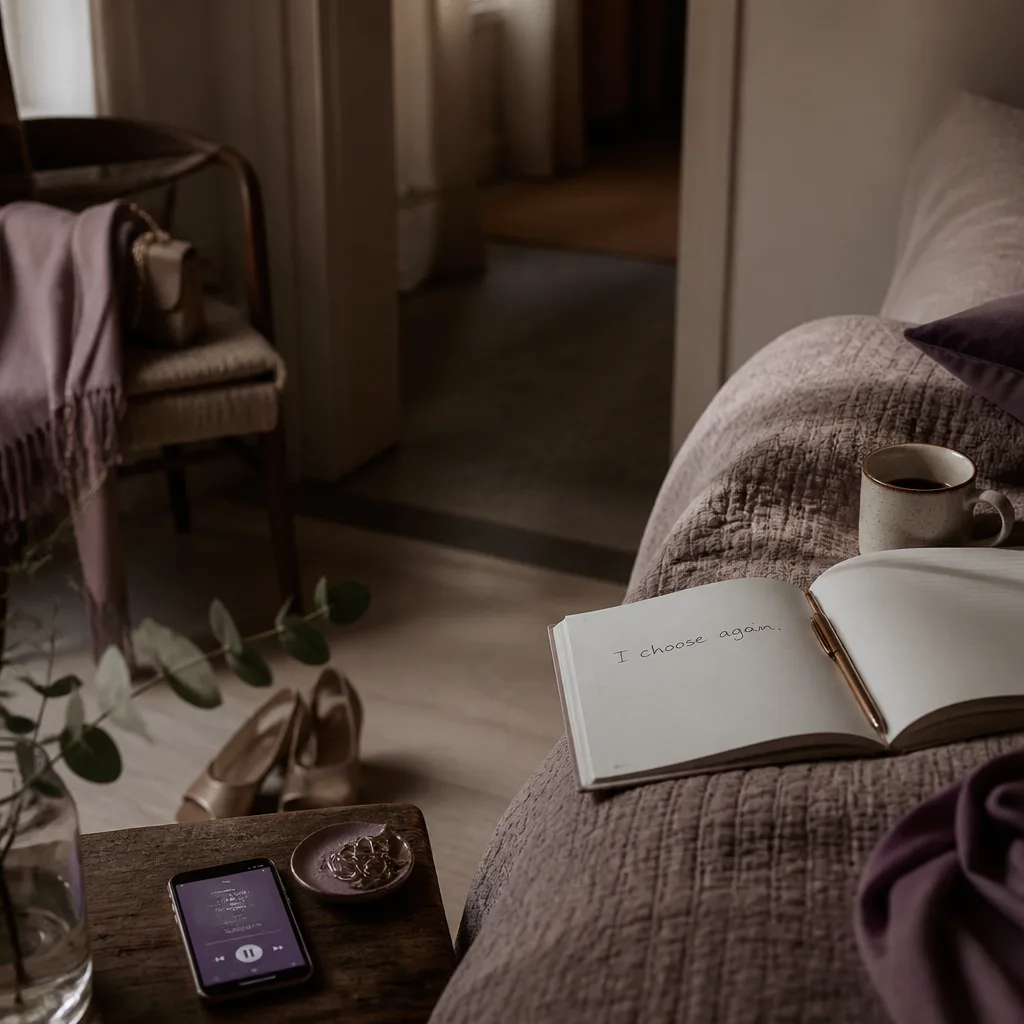
Self-compassion researcher Kristin Neff has found across many studies that self-compassion is linked with greater resilience and less fear of failure. In family manifestation, compassion is not softness without structure. It is how you come back quickly enough to practice again tomorrow.
For more grounding in the wider practice, return to the main guide to manifestation. Then come back here, to the phone, the table, the old role, the one new breath.
How long should you practice family manifestation?
Practice long enough for the new response to become more familiar than the old performance.
Start with seven days before a known family contact. Seven is not magic. It is small enough to begin and long enough to notice a pattern. In habit research, the often-repeated 21-day claim is too simple; a 2009 study by Phillippa Lally and colleagues at University College London found that habit formation averaged 66 days, with wide variation. Let that comfort you. Slow change is still change.
A simple seven-day plan:
| Day | Practice | Time |
|---|---|---|
| 1 | Name the old role and listen once | 5 minutes |
| 2 | Add one body anchor | 4 minutes |
| 3 | Write one boundary sentence | 6 minutes |
| 4 | Listen before a small contact | 3 minutes |
| 5 | Notice the first cue | 5 minutes |
| 6 | Repair one slip without shame | 7 minutes |
| 7 | Listen and choose one next room | 5 minutes |
If you are already using the AYA Method, let your family manifestation practice live inside your daily listening. Do not build a second altar of tasks. Keep it simple. The audio is the method. The daily affirmation and Manifestation Board can support what you hear, but they do not need to become another way to grade yourself.
You may also want to track one number: how long it takes you to notice the role. At first, you may see it after the visit. Then after one hour. Then in the room. Then before your mouth opens. This is real progress. The moment of noticing is a hinge.
You are not late to your own life because your family knew an earlier version of you.
Come back before you enter.