audio manifestation
Passive Manifestation: 3-Minute Future-Self Audio
Passive manifestation can be a 3-minute audio practice: listen to your future self daily, repeat softly, and let identity become familiar.
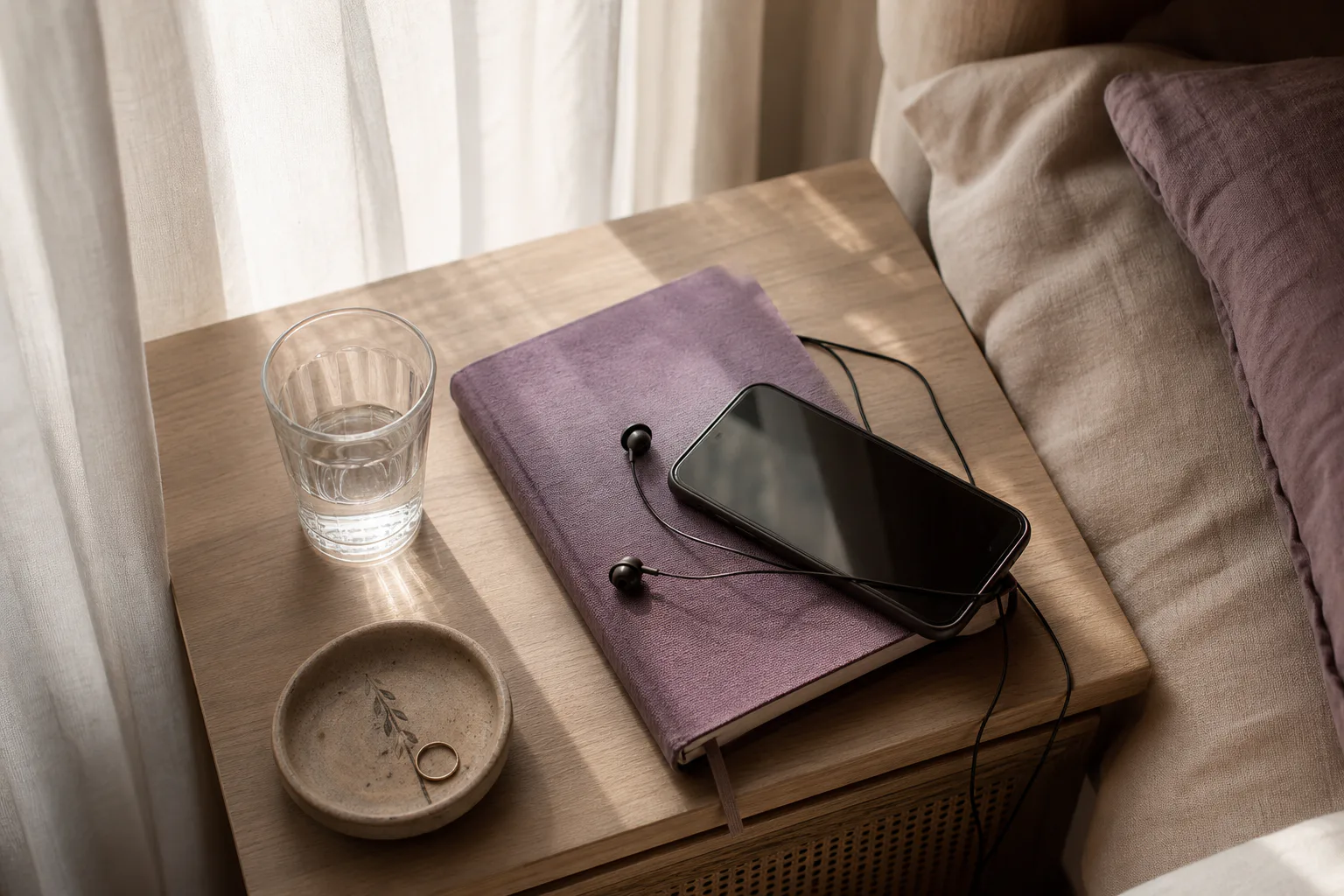
Your phone rests beside a glass of water. Three minutes are enough for passive manifestation when the practice is audio: you listen to a future-self recording, let the voice name what is already yours, and repeat daily until the identity feels familiar, not forced.
What is passive manifestation?
Passive manifestation is manifestation practiced through receiving, not performing.
It does not mean you do nothing. It means you stop treating effort as tension. You stop making the practice a test of how hard you can visualize, script, or stay positive. For 180 seconds, you listen. The voice does the holding. Your attention softens enough to hear it.
In the AYA Method, this is named with care: The AYA Method is a daily audio manifestation practice. Each day you listen to a short personalized recording — your Dream-Self Moment — narrated from the version of you who has already manifested the life you intend. Listening is the practice. Repetition is the work. The audio is the method.
That sentence matters. Audio is not decoration around a practice. It is the practice. A 2010 Harvard study by Killingsworth and Gilbert found that minds wander about 46.9% of waking life. Passive manifestation works with that fact, not against it. You do not need to keep your mind perfectly still. You give it something steady to return to.
Passive does not mean empty. Passive means receptive. The photographer knows this. You can stand in a room for twenty minutes and still not take the picture. Then the light arrives. You did not force it. You were there when it came.
Passive does not mean nothing is happening; it means you stop making tension the proof of effort.
If you are new to the wider practice, the manifestation guide can give you the larger frame. Here, the frame is narrow on purpose: one audio, one daily return, one future self spoken close to the ear.
Why can three minutes be enough?
Three minutes can be enough because consistency changes more than intensity does.
A practice that takes 30 minutes may look more serious. It may also be easier to abandon by Thursday. Three minutes is 180 seconds. In a seven-day week, that is 21 minutes total. Small enough to repeat. Long enough to hear a full scene, a few future-self sentences, and one clear emotional cue.
Habit research supports the quiet case for repetition. In a 2009 study from University College London, Phillippa Lally and colleagues found that habit formation took 66 days on average, with wide variation from 18 to 254 days. The exact number is less important than the shape: repeated cues make behavior easier to begin.
A 3-minute audio practice also respects the body. Dr. Andrew Huberman often points to the nervous system as pattern-based: repeated states become easier to access when they are paired with consistent cues. You do not need to make yourself believe everything at once. You need a repeatable doorway.
Here is the difference in plain terms:
| Practice length | What it asks of you | What often happens |
|---|---|---|
| 30 minutes | Time, privacy, strong focus | Easy to postpone |
| 10 minutes | Some planning, some focus | Useful, but still negotiable |
| 3 minutes | A small cue and headphones | Easier to repeat daily |
The smallest practice is often the one that survives.
Three minutes is not a compromise. It is a design choice. The mind is more likely to return to a practice that does not humiliate it for being human. If you miss a day, you return the next day. No ceremony. No punishment. Just the voice again.
How do you do the 3-minute future-self practice?
You do it by pairing one daily cue with one short future-self audio and listening without trying to improve the moment.
Do not begin by rebuilding your whole morning. Begin with a cue that already exists. The kettle clicks. The train doors close. Your hand reaches for the lamp at night. According to Pew Research Center, 97% of U.S. adults reported owning a cellphone in 2024, and most keep it close through the day. Your tool is probably already within reach.
Try this simple sequence:
- Choose a cue you already do. Waking, walking, washing your face, or sitting in a parked car.
- Put on the same audio. Keep it to about 3 minutes.
- Listen as if it is a message from your future self. Do not analyze every word.
- Notice one detail. A sentence, image, or physical feeling that felt true.
- Return tomorrow. The return is the practice.
The key is not to chase a big feeling. Neville Goddard wrote often about assuming the feeling of the wish fulfilled, but feeling does not always arrive as brightness. Sometimes it arrives as relief. Sometimes it is simply the absence of arguing with yourself for a few seconds.
Joe Dispenza speaks about mental rehearsal as a way the brain and body begin to know a future before it is visible. You do not have to accept every claim around that idea to use the practical core. Rehearsal matters. Repetition matters. The scene you revisit begins to feel less foreign.

If you want a quiet companion practice, affirmations can help you name one sentence from the audio. But keep the order clear. Listen first. Let the audio lead. The written sentence can come after, like a note left on the table.
What should your future-self audio say?
Your future-self audio should sound like a true day in the life you are learning to recognize.
Not a speech. Not a performance. A scene. The version of you who has already crossed the threshold speaks in ordinary detail: where you wake, how your shoulders feel, how you answer a message, what you no longer over-explain. Specificity helps the mind. In cognitive psychology, mental imagery is often stronger when it includes sensory detail, and several small studies on guided imagery have found links to reduced stress and improved coping.
A useful future-self audio includes four kinds of details:
- Place: the room, street, desk, studio, kitchen, or train seat.
- Body: breath, posture, pace, hands, jaw, sleep, appetite.
- Choice: the action you now take naturally.
- Proof: one small sign that life is different now.
For example: I wake before the second alarm. My chest is quiet. I open the message and answer plainly. The invoice has already been paid. I do not rush the coffee. I know what the day asks of me.
That kind of language is simple, but not vague. A 2015 review in the Journal of Behavioral Medicine discussed self-affirmation research and noted that values-based reflection can reduce defensive stress responses in some settings. Future-self audio is not identical to that research, but it shares a useful principle: the self becomes steadier when it hears a coherent story about who it is.
Audio lets the future arrive with a human voice.
If astrology is part of how you reflect on timing, you might read astrology and manifestation as a symbolic calendar. But do not give timing all the authority. The daily listening still belongs to you. The recording brings the far thing close.
How is passive manifestation different from affirmations or a board?
Passive manifestation is different because it asks you to listen before you speak or arrange.
Affirmations can be useful. A Manifestation Board can be beautiful and clarifying. The app may include both as supports. But they are complements here, not the center. The center is audio. The Dream-Self Moment carries tone, pacing, and identity in a way a single line or image may not.
This matters because many people turn manifestation into another place to be good. They write the perfect sentence. They choose the perfect image. They try to feel certain. Then, if their mood drops, they decide they have failed. A passive manifestation audio gives the practice back to the ear. You can be tired and still listen.
Consider the difference:
| Tool | Primary action | Best use |
|---|---|---|
| Future-self audio | Listening | Daily identity rehearsal |
| Affirmation | Speaking or reading | Naming one clear belief |
| Manifestation Board | Seeing | Keeping visual cues nearby |
The audio can include the affirmation. The board can echo the audio. But neither replaces the daily recording. The AYA Method keeps this simple: listening is the practice, repetition is the work, and the audio is the method.
There is also a reason sound feels intimate. A 2022 review in Frontiers in Psychology noted that voice carries emotional information through pitch, rhythm, and tone, often before words are fully processed. This is why one sentence can land differently when you hear it spoken. The future self is not only an idea. It has a voice.
Belief becomes less dramatic when it has a time and a place.
When should you listen, and how often?
Listen once a day, at the time you can repeat with the least resistance.
Morning is common because the mind is not yet crowded. Night is useful because memory consolidation happens during sleep, and many studies connect sleep with learning and emotional processing. A 2021 report from the CDC noted that about 1 in 3 U.S. adults do not get enough sleep. So if a night practice becomes another pressure, choose a softer time.
You might listen:
- before your feet touch the floor
- while walking the same small route
- after lunch, before opening messages again
- in the car before going inside
- after washing your face at night
The best time is not the most aesthetic time. It is the time that survives ordinary life. If you care for children, work shifts, or share a room, you do not need a sacred hour. You need three protected minutes and a pair of headphones.
Try the practice for 14 days before judging it. Two weeks is not a magic number, but it is long enough to notice whether the cue is realistic. If you miss more than 4 days, make the cue smaller. Put the audio after something you never skip, like brushing your teeth.
Small repetition has a quiet authority. A 2018 American Psychological Association article on stress and behavior change noted that realistic goals are more likely to be maintained than extreme ones. Manifestation is no different. A daily practice that fits your actual life is kinder and often more durable.
For a broader map of language, desire, and identity, the affirmations pillar can sit beside this practice. Just remember the order. The audio leads. The other pieces gather around it.
What changes when it starts to feel real?
What changes is not that life becomes perfect; what changes is the version of you that feels available.
At first, future-self audio may feel like listening to someone else. Then one line begins to sound familiar. Then a choice appears in the day: answer calmly, ask clearly, rest sooner, send the work, stop explaining. These are small signs. They count.
Psychologist Hazel Markus introduced the idea of possible selves in 1986, describing how imagined versions of the self can guide motivation and behavior. Passive manifestation uses that same human capacity in a daily, sensory form. You are not trying to escape your current life. You are letting a chosen self become easier to recognize.
The change may show up as less bargaining. You do the thing without needing a mood to approve it. You remember the sentence from the audio while standing in a grocery line. You hear the future-self voice before sending the old apology. The practice is working when it becomes ordinary.
Keep evidence small and honest. Write one line after listening if you want: Today I noticed my shoulders drop. Today I answered without rushing. Today the room felt possible. Over 30 days, these small notes become a record. Not proof for anyone else. Proof for your own nervous system.
If you want to understand how this sits inside the larger field, return to manifestation when you have time. But do not wait until you understand everything. Three minutes is enough to begin.
The future does not need to shout to be heard.
Three minutes. Then the room remembers you.