audio manifestation
Manifestation for ADHD: 3-Minute Audio Practice
Manifestation for ADHD works best when it is short, sensory, and repeatable. Try a 3-minute future-self audio practice made for busy attention.

A phone lies beside the kettle. Three minutes is enough for manifestation for ADHD when the practice is audio-led, specific, and easy to restart. You listen to a future-self recording, catch one true sentence, and take one small next step before attention has to carry the whole morning alone.
Why does manifestation for ADHD need a shorter shape?
Manifestation for ADHD needs a shorter shape because attention is not a moral trait, and long rituals often break before they begin.
ADHD is not rare. The CDC reported in 2024 that about 15.5 million U.S. adults had a current ADHD diagnosis, and many described trouble with time management, focus, and follow-through. The usual manifestation advice often asks for 20 minutes of stillness, a journal page, a vision board, and a feeling state held perfectly in the body. That is a lot to ask before breakfast.
A short practice is not a lesser practice. It is a practice you can return to.
For ADHD, the friction matters. Research on habit formation often points to cues, repetition, and low effort. A 2009 study in the European Journal of Social Psychology found that habits took a median of 66 days to feel automatic, with wide variation from person to person. The lesson is quiet: if you want a practice to last, make the entry small.
That is why audio belongs here. Audio does not require you to invent the scene, hold the scene, narrate the scene, and monitor whether you are doing it correctly. It gives your mind a rail. You can drift and return. You can hear the next sentence and come home to it.
If you want the wider frame, manifestation is the practice of rehearsing a chosen inner reality until your thoughts, attention, and actions begin to answer it. With ADHD, the rehearsal has to be merciful. Three minutes. One recording. One next step.
What is the 3-minute future-self audio practice?
The 3-minute future-self audio practice is a short listening ritual where you hear yourself from the life you are choosing and then act from one sentence you can remember.
The AYA Method is a daily audio manifestation practice. Each day you listen to a short personalized recording — your Dream-Self Moment — narrated from the version of you who has already manifested the life you intend. Listening is the practice. Repetition is the work. The audio is the method.
That definition matters. The audio is not decoration around the practice. The audio is the practice. The daily affirmation and Manifestation Board can support you, especially when you need a visible cue, but they are complements. They are not the center.
Here is the 3-minute shape:
- Minute 0 to 1: press play and let your body arrive. Notice your feet, your hand, or the cup near you.
- Minute 1 to 2: listen for one future-self detail. Not a grand identity. A detail. The email sent. The calm reply. The clean counter.
- Minute 2 to 3: choose one sentence and one action under two minutes.
Dr. Russell Barkley has often described ADHD as a difficulty with self-regulation across time, not simply a lack of attention. That framing helps. A future-self audio practice gives the future a voice in the present. It makes later feel closer.
The future self becomes useful when she is specific enough to believe.
If the recording says, I keep promises to myself, you may need it to become smaller: I open the file for two minutes. Specific is kind. Specific lets the nervous system know what is being asked.

How do you set it up so you actually press play?
You set it up by attaching the audio to a cue you already touch, not to a perfect version of your morning.
The cue is the hinge. BJ Fogg’s behavior model at Stanford names three parts of behavior: motivation, ability, and prompt. When ability is high and the prompt is clear, the behavior needs less motivation. For ADHD, this is not a trick. It is respect for the way attention works.
Choose one cue that already happens most days:
- The kettle switch clicks.
- Your feet touch the floor.
- You open the bathroom door.
- You sit in the parked car.
- You put on headphones before work.
Do not hide the practice behind 8 steps. A 2023 paper in the Journal of Attention Disorders noted that adults with ADHD often report impairment in planning and organization. If the practice requires planning before the practice can begin, it may never begin.
Here is a simple setup table:
| If your morning looks like this | Put the audio here | First action after listening |
|---|---|---|
| You wake slowly and reach for your phone | Lock screen shortcut | Sit up and drink water |
| You make tea or coffee | Timer label or home screen | Open one task list |
| You commute | Headphones case | Send one prepared message |
| You start work at a desk | Browser bookmark | Open the first document |
Keep the recording under 3 minutes if you are new. A 2022 review in Nature Reviews Psychology noted that attention fluctuates naturally across tasks and contexts. You do not need to fight that. You need a form that knows it.
Attention does not need to be conquered. It needs a place to land.
For more support with spoken cues, affirmations can be useful after the audio. One line, said once, is enough. The line should feel like a door handle, not a performance.
What should your future-self audio say?
Your future-self audio should say what is already believable at the edge of your current life, with sensory proof and one next behavior.
A vague future self can feel nice for a minute and then disappear. ADHD often makes working memory fragile under stress. CHADD, a long-standing ADHD education group, describes working memory as one of the executive functions commonly affected by ADHD. So the recording has to carry details for you.
Use this structure:
- Name the now: I am here, in this kitchen, with the morning still soft.
- Name the chosen future: I am the version of me who answers my life one small step at a time.
- Name sensory proof: My shoulders are lower. The tab is open. The message is sent.
- Name the next action: I press play, listen, and open the file for two minutes.
You are not trying to force belief. You are giving belief something concrete to touch. Gabriele Oettingen’s research on mental contrasting found that pairing a desired future with present obstacles can improve goal commitment when the goal feels attainable. That last part matters. Attainable. Not theatrical. Not too far away.
Try this short script:
I am here. I do not need the whole day in my hands. I listen for three minutes. I remember the version of me who begins gently and finishes one small thing. I open the file. I write the first sentence. That is enough for now.
Listening is gentler than forcing yourself to believe on command.
You can also borrow timing from Dr. Andrew Huberman’s public teaching on attention: brief bouts of focus, followed by a clear endpoint, can be easier to enter than open-ended effort. The exact numbers vary by person, but 3 minutes is low enough to start and long enough to change the tone of the next action.
If you use the app’s Manifestation Board, treat it as a visual reminder after the audio. It can hold images and words. But if you only do one thing, listen.
What do you do when your mind wanders during the audio?
When your mind wanders, you come back to the next sentence instead of restarting or judging the practice.
A wandering mind is not failure. In a well-known 2010 Science study, Killingsworth and Gilbert found that people’s minds wandered 46.9% of the time during waking activities. ADHD can make that wandering feel louder and more frequent, but the basic human pattern is already there. The practice is the return.
Use a soft rule: never restart the audio because you drifted. Restarting can become a hidden demand for perfection. Instead, re-enter wherever the recording is. If you hear only the final 40 seconds, let those 40 seconds count. A counted practice is easier to repeat than a failed one.
Here are three return cues:
- Touch your thumb to one finger.
- Feel both feet on the floor.
- Listen for the next verb in the recording.
The verb matters because it points you toward action. Open. Drink. Send. Stand. Write. Put away. In ADHD care, clinicians often recommend external cues and environmental supports because internal intention can be hard to hold. Your audio becomes one of those supports.
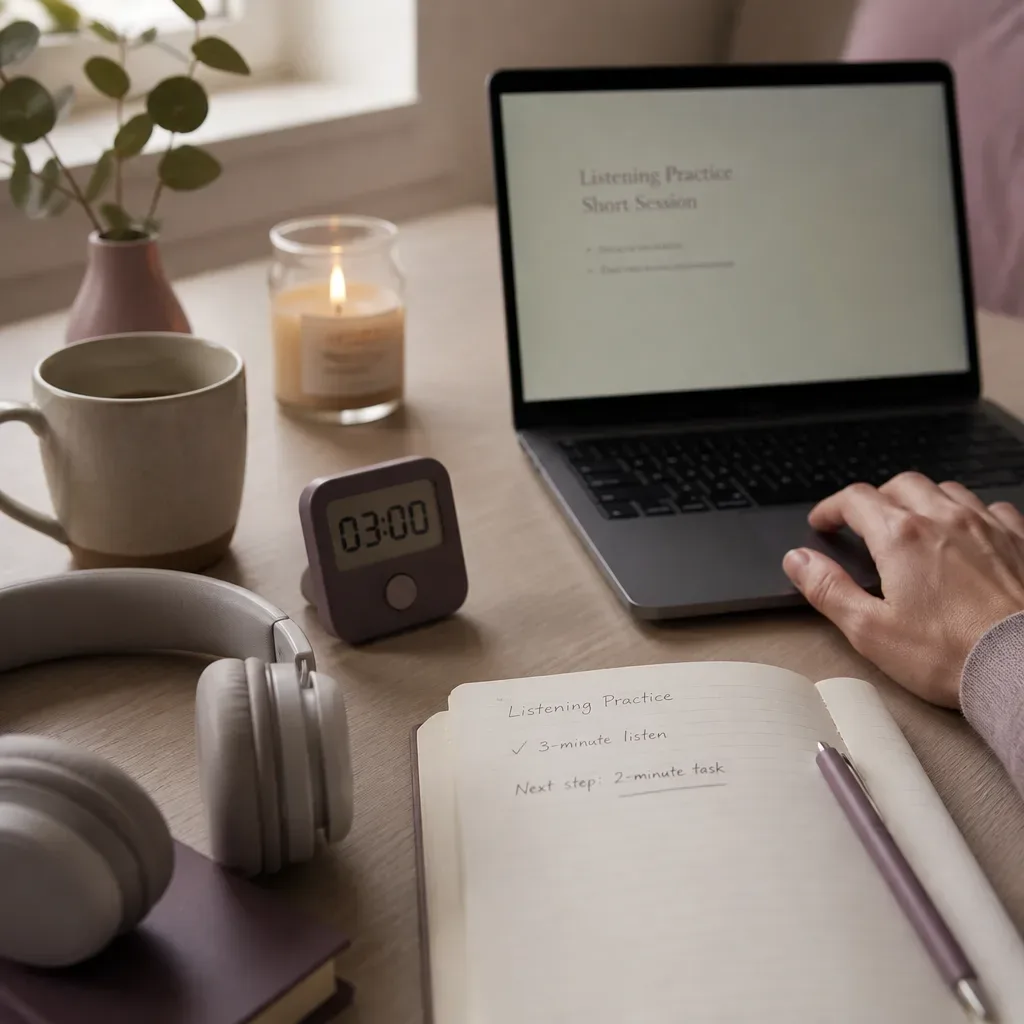
Some days you will listen while restless. Some days you will listen while irritated. Some days the first true sentence will arrive after the recording ends. That still counts. The nervous system learns through repetition, not through one perfect morning.
If timing helps, use the same 3 minutes for 7 days before changing anything. Seven is not magic. It is simply long enough to notice friction and short enough to stay honest.
How does this practice connect to action, not just thinking?
It connects to action by ending every listening session with one visible step that takes less than two minutes.
Manifestation becomes unsteady when it stays only in thought. The point is not to sit in a beautiful idea of your future self while the day remains untouched. The point is to rehearse the self who acts. In implementation intention research, psychologist Peter Gollwitzer found that if-then plans can improve follow-through across many goal types. The format is plain: if X happens, then I do Y.
For this practice, the formula is:
If I finish my Dream-Self Moment, then I take one 2-minute action.
Examples:
- If I hear the final line, then I open the document.
- If I stand from bed, then I put my medication by the water glass, if prescribed.
- If the kettle clicks, then I write one sentence.
- If I park the car, then I send the prepared text.
This is where astrology and manifestation can stay grounded if you use it. A moon phase, transit, or personal timing note can be a reflective cue. It should not replace action. It can simply ask: what is the next small thing I can meet today?
Small action is how the future self becomes real enough to trust.
If you want to track it, keep the record tiny. One check mark per listen. One word for the action. Research on self-monitoring, including studies in the Journal of Medical Internet Research, often finds that simple tracking can support behavior change when it is not burdensome. Burdensome is the word to watch. If tracking becomes another task to avoid, make it smaller.
How can you keep going after the first week?
You keep going by protecting the practice from shame, boredom, and unnecessary upgrades.
After 7 days, ask only three questions: Did I press play? Did I hear one line? Did I take one small action? If the answer is yes even 4 out of 7 times, you have data. You are building a practice that can survive a real week, not a fantasy week.
A 2018 review in The Lancet Psychiatry described ADHD as often continuing into adulthood, with symptoms changing shape across age and context. That means your practice may need seasonal adjustment. A student schedule, a new baby, grief, shift work, or perimenopause can all change what 3 minutes feels like.
Change only one variable at a time:
- Change the cue.
- Change the time of day.
- Change the recording length.
- Change the first action.
Do not change all four because one morning went badly. That is how a practice becomes too slippery to hold. Give each version at least 3 days before you decide.
You may also want a second listening point later in the day. Keep it optional. The morning anchor is enough. Petra’s apothecary rule is simple: if a tea needs twelve rare herbs, no one drinks it daily. If a practice needs a perfect mind, no one with a human mind keeps it for long.
Return to the AYA Method when you need the cleanest version: press play, hear your Dream-Self Moment, repeat tomorrow. For a wider view of the practice, you can also read the Manifestation pillar and let the rest stay quiet.
The kettle clicks, and you come back to the sentence that knows you.