audio manifestation
Future Self Audio for Your Commute
Future self audio lets you use your commute for manifestation without adding time. Learn a quiet 12-minute practice for listening and returning.
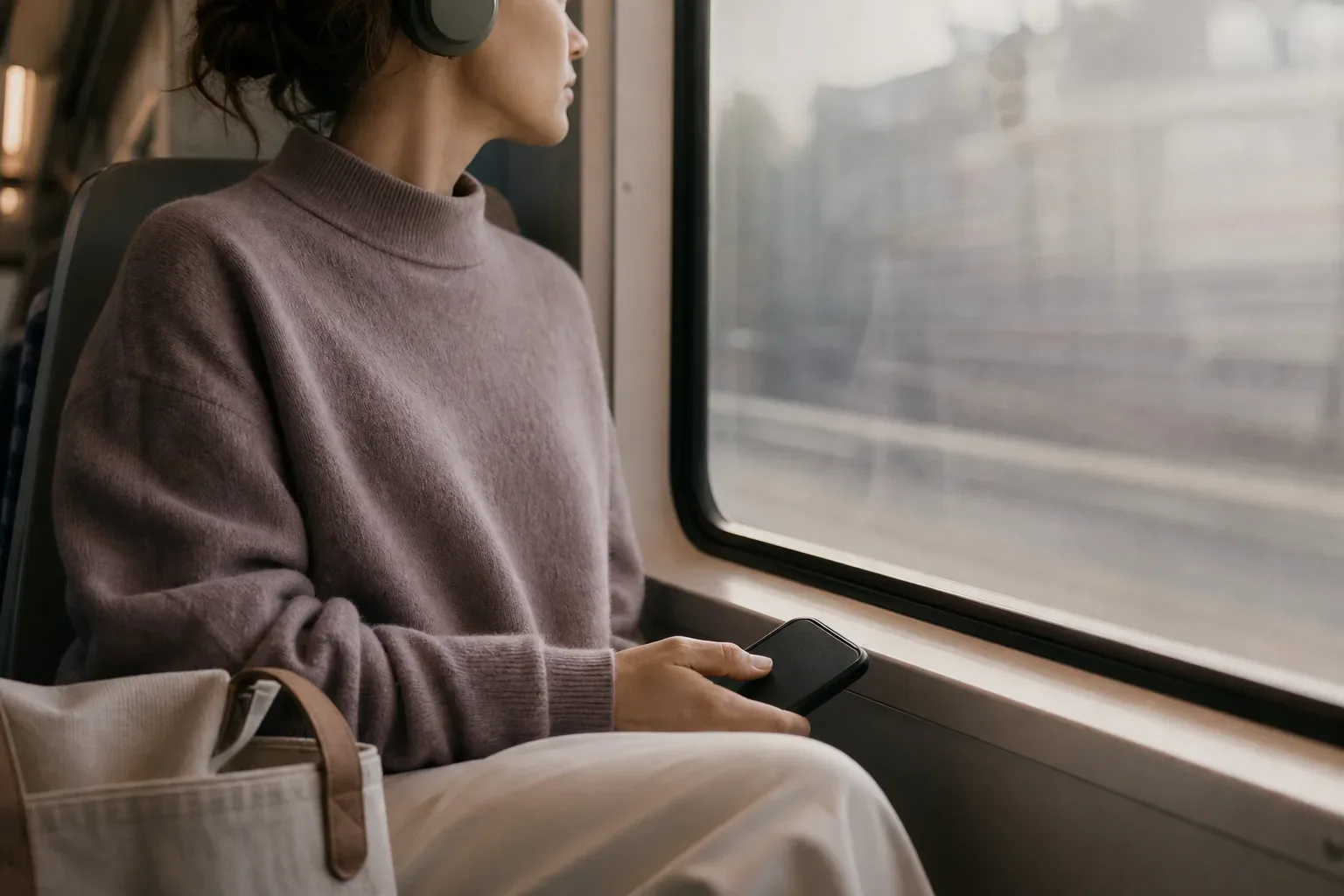
A bus window makes a small mirror at 7:42. Future self audio lets you use that already-owned time for manifestation by listening to a short recording from the person you’re becoming. You don’t need an earlier alarm. You need one safe cue, one clear recording, and repetition.
What is future self audio, really?
Future self audio is a short spoken recording that helps you rehearse identity, attention, and choice from the point of view of the life you’re practicing toward.
It isn’t background noise. It isn’t a lecture. It isn’t another item added to the morning. It is a voice you hear on purpose, usually for 3 to 12 minutes, while your ordinary life keeps moving. On the train. In the passenger seat. Walking the same three blocks between home and the tram.
The AYA Method is a daily audio manifestation practice. Each day you listen to a short personalized recording — your Dream-Self Moment — narrated from the version of you who has already manifested the life you intend. Listening is the practice. Repetition is the work. The audio is the method. You can read the full method here: the AYA Method.
This matters because the brain learns by rehearsal. Mental practice has been studied for decades in sport and clinical settings. A 1995 meta-analysis by Driskell, Copper, and Moran found that mental practice improved performance across many tasks, with stronger effects when the practice was specific and repeated. Future self audio gives that rehearsal a voice.
A sentence can become a place you return to. That is the small secret here.
If you’re new to this, start with the difference below:
| Practice | What you do | Best commute use |
|---|---|---|
| Future self audio | Listen to a narrated scene from your intended self | Train, bus, tram, walking route |
| Affirmations | Repeat a short sentence | Between stops or after the audio |
| Vision board | Look at chosen images and words | Before leaving or after arriving |
| Journaling | Write what you notice | Later, for 2 minutes |
The audio leads. The other pieces can support it. If you want the wider frame, the Manifestation pillar explains how attention, repetition, and belief can work together without making your day feel crowded.
Why does the commute make the practice easier?
The commute makes future self audio easier because it already has a time, place, and beginning.
Habits like a stable cue. Wendy Wood’s research on habit shows that repeated behavior in the same context becomes less dependent on mood or willpower. In one often-cited study of daily behavior, about 43 percent of actions were performed almost daily in the same setting, which is why context can quietly carry a practice when motivation is thin.
A commute is full of cues. The turnstile. The engine sound. The same bench. The crossing light that takes too long. You don’t have to create a ritual from nothing. You can attach the practice to a life pattern that already exists.
The average one-way commute in the United States was about 26.8 minutes in the 2023 American Community Survey. In the United Kingdom, the Office for National Statistics has often placed average commute time around the high twenties in minutes, depending on year and region. You don’t need all of that. Twelve minutes is enough. Three minutes is enough if you do it again tomorrow.
The best practice is not the one that impresses you. It is the one that returns.
There is also a mercy in using time that already feels in-between. You’re not yet at work. You’re not fully at home. Your identity is slightly loosened. Many people scroll during this gap; Pew Research Center reported in 2024 that about 91 percent of U.S. adults own a smartphone. The device is already in your hand. The question is whether it will scatter you or help you remember.
Try this for one week:
- Choose the same part of the commute.
- Put your phone on Do Not Disturb if you can.
- Press play before checking messages.
- Listen once.
- Take one breath when it ends.
- Continue your day without proving anything.
The commute is not wasted time. It is unclaimed attention.
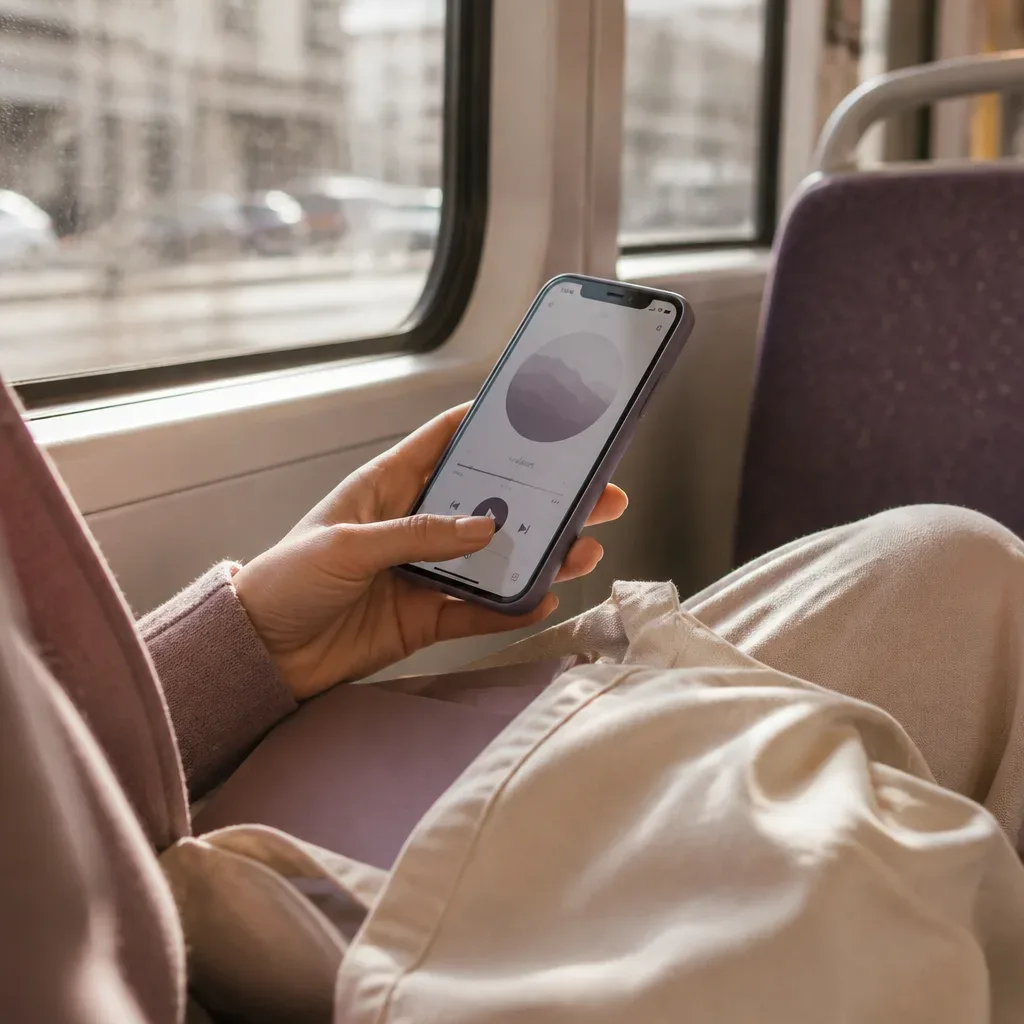
How do you listen without losing safety or presence?
You listen safely by keeping the practice simple, low-demand, and appropriate to how you’re traveling.
If you’re driving, safety comes first. The National Highway Traffic Safety Administration has reported thousands of deaths each year in crashes involving distracted driving; in 2022, distracted driving was linked to 3,308 deaths in the United States. Future self audio should never ask you to close your eyes, write, tap through menus, or drift away from the road.
For drivers, use a short recording before you start the car, after you park, or as a calm spoken track at low volume while your full attention stays on driving. No visualization that pulls you inward. No breathwork that changes alertness. No headphones in both ears if local law forbids it. Your life is not a metaphor. It is real.
For public transit, you have more room. You can close your eyes if it feels safe. You can look at one fixed point. You can let one sentence repeat under the noise. A 2010 review in Psychological Bulletin by Gollwitzer and Sheeran found that implementation intentions, the simple if-then plans people make in advance, had a medium-to-large effect on goal progress across 94 studies. So make the plan plain: “If I sit down on the train, then I press play.”
For walking, keep the volume low enough to hear traffic. The World Health Organization has warned about unsafe listening levels, especially with long headphone use; many phones now include decibel warnings for this reason. Your practice should make you more here, not less here.
Use these safety rules:
- If you’re crossing streets, pause the audio.
- If you’re driving, don’t close your eyes or follow complex prompts.
- If you’re on public transit, keep awareness of stops and belongings.
- If your body feels anxious, lower the volume and open your eyes.
- If the recording asks too much, make it shorter.
Manifestation that asks you to abandon the present is not mature practice. A true future can bear the weight of now.
What should your commute future-self audio say?
Your commute future-self audio should say what is specific, believable, and close enough for your nervous system to recognize.
A good recording does not need grand claims. It needs details. Where are you standing? What have you stopped doing? What are you choosing without drama? Neville Goddard called this living from the end, meaning the inner act of assuming the fulfilled state. Whether you take him literally or poetically, the useful instruction is the same: make the scene particular.
Joe Dispenza often speaks about rehearsing a future so often that the body starts to recognize it as familiar. You don’t have to adopt every claim to use the practical part. Repetition changes salience. What you rehearse becomes easier to notice. In cognitive science, attention is not neutral; it filters. A short recording can train the filter.
Here is a quiet structure you can use for a 5-minute script:
- Arrival: “I am sitting here, already steady.”
- Identity: “I am the person who answers slowly and clearly.”
- Evidence: “My calendar has space because I stopped saying yes too quickly.”
- Choice: “Today I choose the next honest action.”
- Return: “I don’t need to rush to be real.”
Keep the language clean. The Affirmations pillar can help if you want to shape one sentence that supports the recording after it ends. But the sentence is a complement. The daily listening is the main act.
In behavior research, specificity matters. A 2002 British Journal of Health Psychology study by Milne, Orbell, and Sheeran found that people who made a specific exercise plan were much more likely to follow through than those who only read motivational material. The same lesson fits here. “I am calm” may help. “I pause before I answer the 9:15 meeting question” may help more.
Use the smallest true version. If your recording says, “Everything is perfect,” and your body rejects it, soften it. Say, “I can take the next clean step.” Belief often begins as less resistance, not certainty.
How do you make it fit a 12-minute commute?
You make it fit by giving each minute one job and leaving space at the end.
A commute practice fails when it becomes too elaborate. There is a bag on your shoulder. Someone is coughing. The train is late by 6 minutes. Your recording has to survive real life. The 12-minute version below is enough because it has a beginning, a middle, and an ending you can remember without looking at a screen.
| Minute | What happens | Why it helps |
|---|---|---|
| 0-1 | Settle, open the audio, soften your jaw | Marks the cue |
| 1-8 | Listen to the Dream-Self Moment | Gives the mind a clear rehearsal |
| 8-10 | Let one line repeat | Strengthens recall |
| 10-11 | Take one slow breath | Closes the practice |
| 11-12 | Name one next action | Brings it into the day |
Dr. Andrew Huberman has often discussed the value of brief, repeated nervous system practices, especially when tied to consistent timing. You don’t need to make neuroscience ornate. Consistency teaches the body what to expect. A daily cue lowers the friction.
The habit timeline is also humbling. In a 2009 European Journal of Social Psychology study, Phillippa Lally and colleagues found that habit formation took 66 days on average, with a wide range from 18 to 254 days. So if your first week feels ordinary, nothing has gone wrong. Ordinary is where repetition lives.
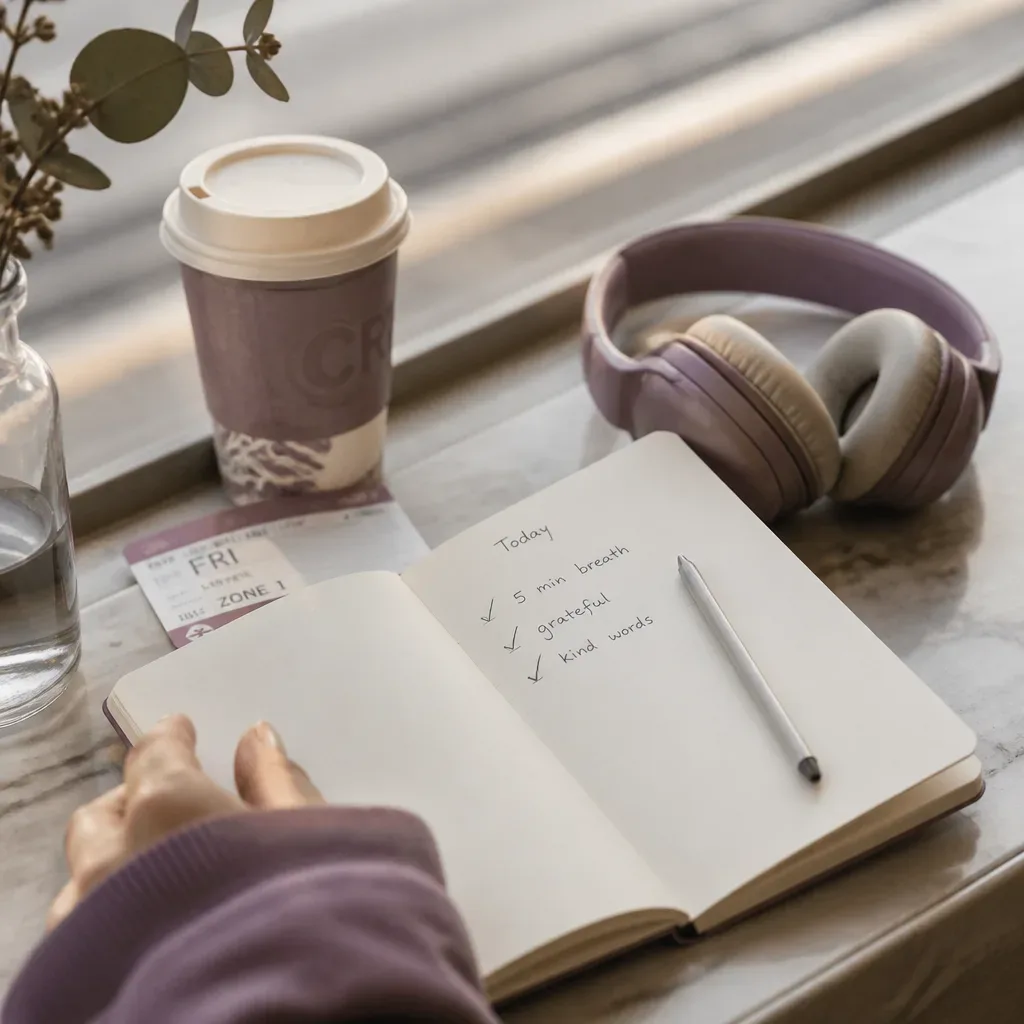
If your commute is shorter, use this:
- 3 minutes: listen to the most important section only.
- 5 minutes: listen once, then repeat one sentence.
- 8 minutes: listen and breathe for 30 seconds after.
- 20 minutes: listen once, then sit in quiet instead of replaying endlessly.
More is not always truer. Sometimes more is just avoidance with better lighting.
What if your mind wanders while you listen?
If your mind wanders, you return to one sentence without judging the wandering.
Mind wandering is not failure. It is normal cognition. A 2010 Science paper by Killingsworth and Gilbert found that people reported mind wandering during about 47 percent of sampled moments, though the number varies by task. So if you lose the thread between stops, you’re not uniquely undisciplined. You’re human on a moving vehicle.
The answer is not to grip harder. Choose an anchor line before you press play. It might be, “I answer from steadiness,” or “I already know the next honest step.” When you notice you’ve drifted into email, errands, or the small theater of someone else’s shoes, come back to that line.
This is where audio manifestation becomes practical rather than decorative. Audio gives you a track to return to. You don’t have to invent the practice from scratch each morning. You press play, listen, and come back when you leave.
A useful rule: if you remember the recording 3 times during the day, it worked. Not because 3 is magic. Because recall is evidence. Memory researchers often describe retrieval as strengthening learning; every time you bring a cue back, you make it easier to bring back again.
You can also make a very small note after arrival:
- One line I heard.
- One feeling in my body.
- One action for today.
This takes under 90 seconds. In library terms, it is a catalog card, not a memoir. You are giving the mind a place to shelve what it heard.
How do you know the practice is working?
You know future self audio is working when your choices begin to echo the recording in ordinary moments.
Do not measure it only by mood. Mood changes with sleep, weather, hormones, workload, and whether the person beside you is eating something loud at 8 a.m. Measure by recall and behavior. Did you pause before the meeting answer? Did you choose the cleaner sentence in the text message? Did you notice the old pattern sooner?
Small studies on self-affirmation, including work associated with Claude Steele’s theory and later health behavior research, suggest that affirming valued identity can reduce defensiveness and support better choices under stress. This does not prove every manifestation claim. It does support a modest truth: identity language can shape how you meet pressure.
You can track the practice for 7 days with three marks:
| Day | Listened? | One line remembered? | One action matched? |
|---|---|---|---|
| Monday | Yes / No | Yes / No | Yes / No |
| Tuesday | Yes / No | Yes / No | Yes / No |
| Wednesday | Yes / No | Yes / No | Yes / No |
| Thursday | Yes / No | Yes / No | Yes / No |
| Friday | Yes / No | Yes / No | Yes / No |
| Saturday | Yes / No | Yes / No | Yes / No |
| Sunday | Yes / No | Yes / No | Yes / No |
If you like symbolic timing, the Astrology and manifestation guide can help you choose days for reflection. Keep it supportive. The commute practice itself stays simple: press play, listen, return.
The Princeton Global Consciousness Project and earlier Princeton Engineering Anomalies Research are often mentioned in manifestation circles. They are debated and should not be treated as settled proof. I name them only because they show a long public curiosity about intention and attention. For daily life, your strongest evidence is still quieter: repeated listening, clearer choice, less forgetting.
A practice is working when it makes you more honest with the next minute.
How do you keep future self audio from becoming another task?
You keep it from becoming another task by making the practice smaller than your resistance.
Start with seven commutes, not a new personality. Use the same recording for a week. Don’t redesign it every morning. Don’t grade your listening. Don’t turn the Manifestation Board into homework before breakfast. The app can include visual and affirmation supports, but the method remains the audio. The daily affirmation and Manifestation Board are complements.
A 2023 Gallup report found that a large share of workers report stress during the day; in some global reports, around 44 percent of employees said they felt a lot of stress the previous day. People do not need a heavier morning. They need a practice that can live inside a real one.
Here is the smallest version I trust:
- Press play at the same cue.
- Listen until one sentence lands.
- Stop when the recording ends.
- Carry the sentence into one ordinary choice.
If you miss a day, don’t repair the streak with punishment. Behavioral research on habit lapse is clear in spirit even when methods differ: missing once matters less than returning quickly. Lally’s 2009 study also found that one missed opportunity did not erase habit formation. This is kind news. You can simply begin again at the next stop.
For a broader practice library, keep the AYA Method close and use manifestation basics when you want more context. If you’re shaping the words around your recording, return to affirmations as a quiet tool, not a second job.
Your commute does not need to become sacred to matter. It can stay ordinary. Wet umbrella. Delayed train. One earbud. One sentence. You, remembering.
The door opens, and you step out as someone who has already begun.