aya method deep dive
Manifestation Questionnaire: Aya's 28-Step Intake
See how Aya's manifestation questionnaire turns 28 quiet answers into a personal Dream-Self Moment you can listen to each day.
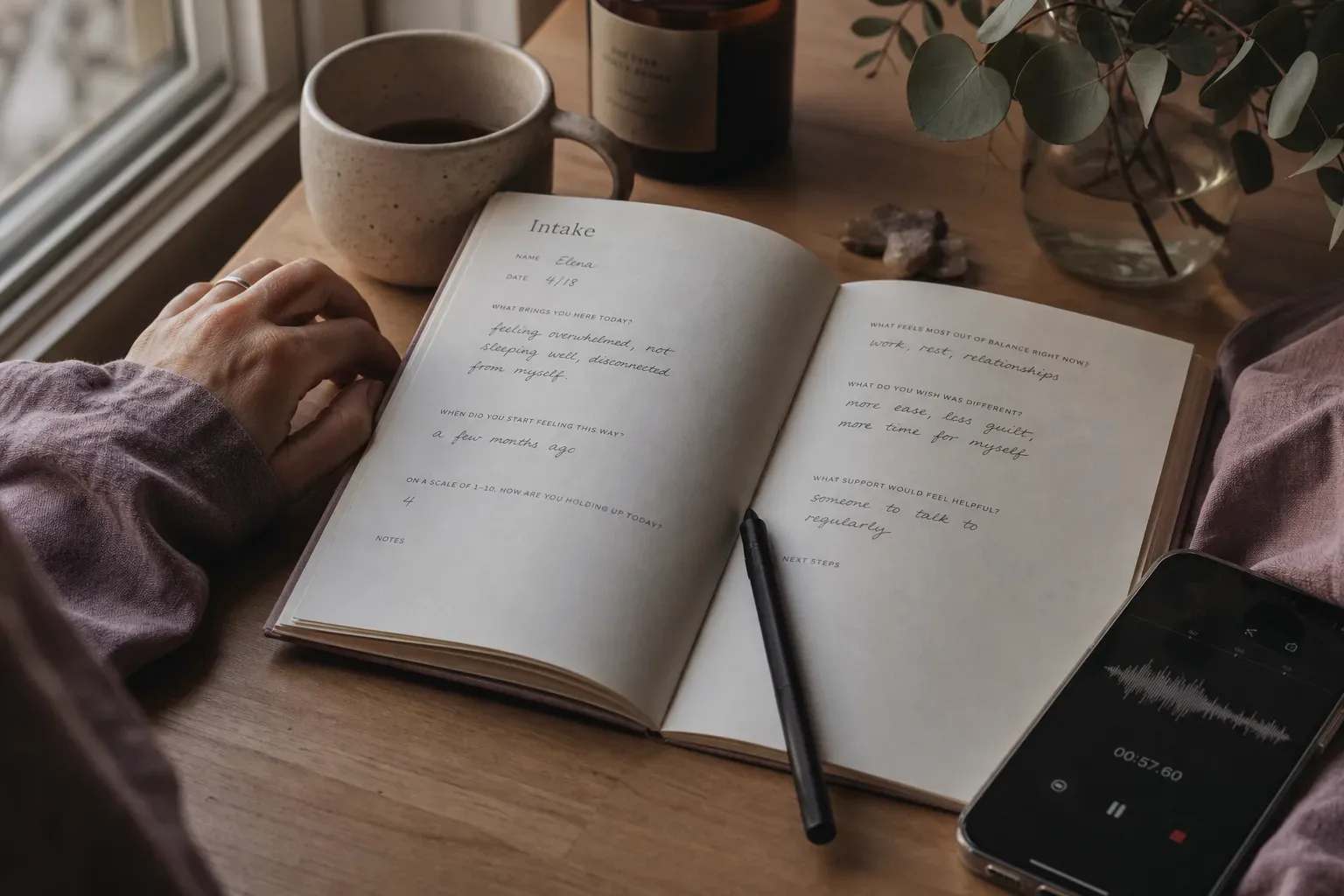
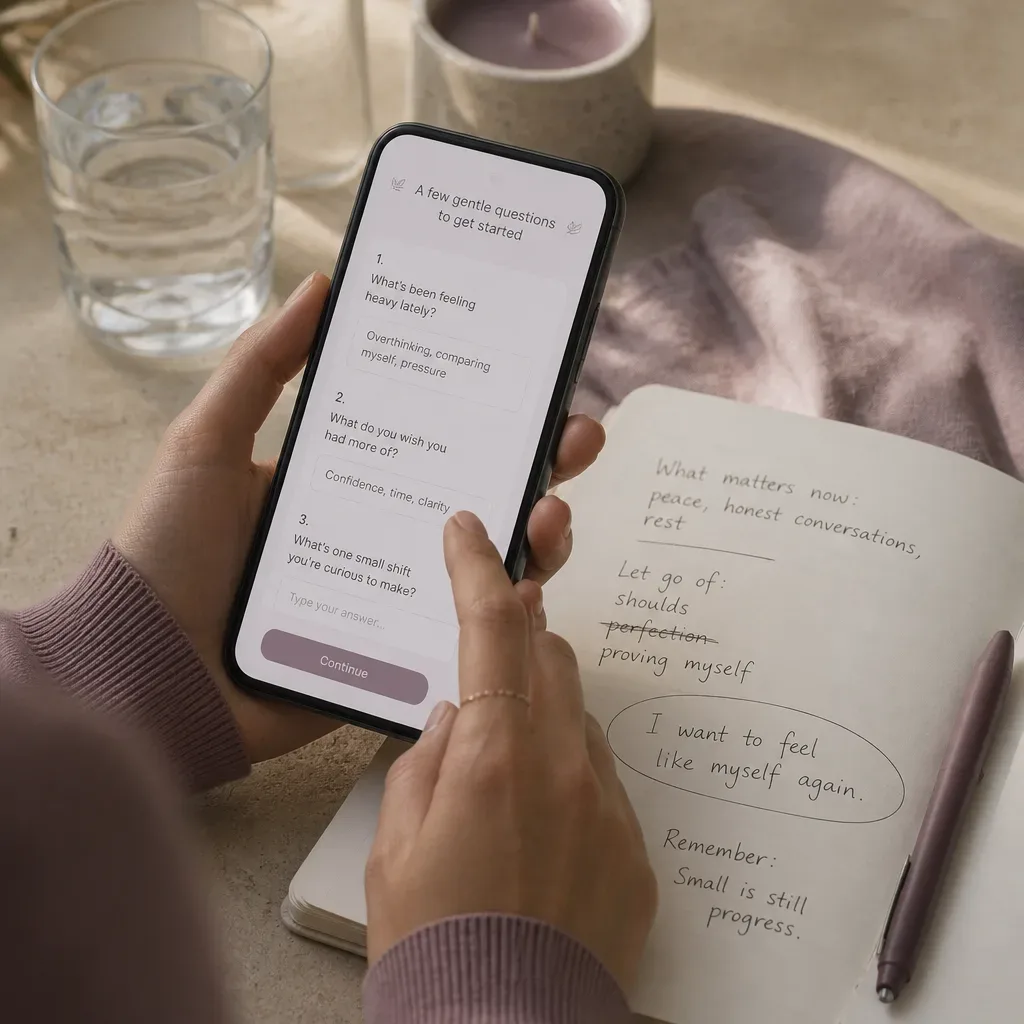
A quiet screen asks one question at a time. Aya’s manifestation questionnaire uses 28 answers to build your Dream-Self Moment: a short personal audio narrated from the life you intend. You name the desire, the scene, the tone, and the proof. Aya turns that into something you can hear daily.
What does a manifestation questionnaire actually collect?
A manifestation questionnaire collects the details that make a future feel specific enough to hear.
Most people start with a sentence that is too wide. I want love. I want money. I want peace. Those are real, but they are not yet speakable as a moment. The intake narrows the field. It asks what kind of love, what money changes in an ordinary Tuesday, what peace sounds like when you wake. In goal-setting research, specificity matters: Locke and Latham’s work across more than 400 studies found that specific, challenging goals tend to improve performance more than vague intentions.
Aya’s intake is built around the same quiet principle. Not force. Clarity. A desire becomes easier to return to when it has a place, a body, a sentence, and a texture. The questionnaire gathers those pieces before the audio is written. It is less like filling out a form and more like giving your future self a voice memo to work from.
The manifestation pillar explains the broader practice of directing attention toward an intended life. The intake is the close-up version. It asks for the evidence of that life. A kitchen. A calendar. A bank notification. A calm reply you do not regret sending. According to a 2019 Pew Research Center report, 62% of U.S. adults say they hold at least one New Age belief, including spiritual or mind-body ideas. That number does not prove manifestation works. It does show that many people are looking for language that helps them relate to unseen change.
A good intake does not ask you to pretend. It asks you to notice what already feels true enough to repeat.
Your answers usually fall into five kinds of material:
- Desire: what you want, plainly.
- Context: where this desire lives in your life.
- Emotion: how it feels when it is no longer missing.
- Resistance: what thought or fear still speaks up.
- Voice: the words that sound like you.
The future becomes easier to practice when it stops sounding like a slogan.
Why does Aya use 28 steps instead of one open prompt?
Aya uses 28 steps because a personal audio needs structure, not a single wish dropped into a blank field.
One open prompt often brings out the polished answer. The one you think you should want. Twenty-eight smaller questions are harder to perform through. They catch more truthful details: the room you miss, the kind of workday you want, the sentence you wish someone had said to you earlier. In psychology, implementation intention research by Peter Gollwitzer found that if-then planning can significantly increase follow-through by connecting intention to a specific cue. The pattern is simple: when this happens, I do that.
Aya is not asking for an if-then plan in the strict research sense. Still, the structure borrows the wisdom of cues. When will you listen? What scene should the audio return to? What doubt should it answer? What proof already exists? A 28-step intake gives the Dream-Self Moment enough coordinates to sound close instead of generic.
Here is the quiet map behind the intake:
| Intake part | What it gives the audio | Example |
|---|---|---|
| Desire | Direction | I want to feel steady in my work |
| Scene | Imagery | I open my laptop without dread |
| Feeling | Emotional target | Clear, rested, respected |
| Obstacle | Human truth | I keep expecting criticism |
| Proof | Believability | I have handled hard seasons before |
| Tone | Voice | Gentle, plain, not dramatic |
There is another reason for 28 steps. Attention gets tired. A Stanford-related review on behavior design often points back to making actions small enough to repeat; BJ Fogg’s model names ability as a key factor in whether behavior happens. Twenty-eight questions sound like many, but each one is small. You do not need a manifesto. You need one honest answer, then another.
The number also protects the method from becoming decorative. A pretty board can inspire you for a day. A vague script can feel distant by morning. A detailed intake gives the audio something solid to hold. The daily affirmation and Manifestation Board in Aya can support the practice, especially if you use affirmations as short reminders. But they are not the center. The audio is.
How do the 28 intake steps build your Dream-Self Moment?
The steps build your Dream-Self Moment by moving from outer facts to inner recognition.
The first questions are plain. What part of life are you speaking to? What do you want? What time frame feels honest? This matters because the brain treats near and distant goals differently. Research on temporal construal, including work by Trope and Liberman, shows that distant outcomes are often thought about abstractly, while near outcomes invite concrete detail. Aya needs both: the meaning and the morning.
Then the intake moves toward scene. A future self is not only a title or achievement. It is a lived moment. You might describe the light on your desk, the way your shoulders drop after sending an invoice, or the sound of your child’s footsteps while you are not checking your phone. These are not decorations. They are retrieval cues. Memory research has shown for decades that cues help bring states and associations back into awareness. The more precise the cue, the easier it is to return.
After that, Aya asks about doubt. This is important. A Dream-Self Moment that ignores fear can sound false. If you tell the intake, part of me thinks I always ruin good things, the audio can answer that with care. Not by arguing. By speaking from the version of you who has already lived through the old thought and does not obey it anymore.
The 28 steps can be read in four movements:
- Name the desire. Make the direction clear.
- Enter the scene. Give the future ordinary details.
- Meet the resistance. Let the old thought be heard.
- Choose the voice. Make sure the audio sounds like home.
Dr. Andrew Huberman has often explained that repetition changes the brain partly through attention and salience; in neuroscience terms, repeated focus can strengthen certain pathways over time. That does not mean a recording magically replaces action. It means a repeated cue can help you rehearse identity, attention, and choice.
The AYA Method is a daily audio manifestation practice. Each day you listen to a short personalized recording — your Dream-Self Moment — narrated from the version of you who has already manifested the life you intend. Listening is the practice. Repetition is the work. The audio is the method.
A script tells you what to say. A Dream-Self Moment lets you hear who you are practicing becoming.
What should you answer if you do not feel certain yet?
You should answer with the truest next thing, not with certainty you do not have.
Many people wait for a clean desire before they begin. But desire often arrives blurry. You may know you are tired before you know what kind of life would make you rested. You may know you want to stop shrinking before you know the room where your voice returns. That is enough for the manifestation questionnaire. A 2022 American Psychological Association survey reported that 76% of adults experienced health impacts from stress in the prior month, including headache, fatigue, or feeling overwhelmed. Uncertainty is not a failure of intention. It is often the condition you are practicing from.
If you are unsure, answer in contrasts. I do not want to feel rushed every morning. I do want a slower start. I do not want love that makes me monitor every word. I do want love where my body can rest. Contrast can be a clean doorway. The intake can use it because it reveals what your system is moving away from and what it is quietly asking to know.
You can also answer with scale. Instead of I am rich, you might write, I open my banking app and do not brace. Instead of I am healed, you might write, I pause before replying. Small wording is often more believable. A 2009 study in Psychological Science by Wood, Perunovic, and Lee found that very positive self-statements could make some people with low self-esteem feel worse. The lesson is not to avoid hope. The lesson is to choose sentences your body does not reject.
Try these when certainty is missing:
- If the goal feels too big: write the first visible sign.
- If the emotion feels hard to name: describe your body.
- If the future feels far away: choose one ordinary scene.
- If the words feel fake: use your own plain speech.
- If fear is loud: let it be part of the intake.
The astrology and manifestation guide offers another lens for timing and reflection, if that language feels familiar to you. But the intake does not require a belief system. It requires attention.
Not certainty. Contact.
How does Aya keep the audio personal without making it too polished?
Aya keeps the audio personal by using your own language, your ordinary details, and your stated limits.
There is a kind of manifestation writing that sounds like it belongs to nobody. Big phrases. Bright promises. A voice that never coughs, doubts, or has to pay rent. Aya’s intake moves away from that. It asks for words you like and words you do not want to hear. It asks what would feel too much. It asks what feels real. In personalization research, even small custom details can increase perceived relevance; McKinsey reported in 2021 that 71% of consumers expect personalized interactions from brands. A spiritual practice is not a consumer transaction, but relevance still matters. You listen longer to what recognizes you.
Personal does not mean messy without shape. The intake gives Aya raw material, then the Dream-Self Moment turns it into a short recording with a beginning, a felt scene, a steady middle, and a closing line. The aim is not literary beauty. It is recognition. When you press play, the audio should feel like someone has been listening carefully.
That is also why the intake makes room for resistance. If you are manifesting calm work but your body expects urgency, the audio should not pretend urgency never existed. It might say, You used to rush to prove you were safe. Now you move with care, and the work still gets done. That sentence is more useful than a perfect declaration that your life has no friction.
Neville Goddard often taught the imaginal act as something assumed from the end, not begged for from lack. Joe Dispenza speaks often about rehearsing a future state until it becomes familiar to the body. You do not have to accept every claim from either teacher to see the shared practice: repetition gives the mind a place to return. Aya makes that return audible.
For more on the wider language of practice, the manifestation guide can hold the larger frame. Here, the intake keeps the frame intimate. It asks: what would your future self sound like if she were not trying to impress anyone?
The most believable future is often spoken in the smallest words.
How should you complete the manifestation questionnaire in 18 minutes?
You should complete it quickly enough to stay honest and slowly enough to notice your body.
Eighteen minutes is a useful container. It is long enough for detail and short enough to avoid over-editing. The average adult reads roughly 200 to 250 words per minute, according to common literacy estimates used in education research, but self-reflection is slower. Give yourself less than a minute for most answers. If one prompt catches in your throat, star it and keep moving. The first pass is not a final exam.
Before you begin, remove the pressure to be impressive. Put your phone on quiet if you are not already using it for Aya. Sit somewhere ordinary. Water glass. Bed edge. Kitchen table. The place does not need to be sacred. The attention does.
Use this rhythm:
- Minutes 0–2: breathe, choose the life area, write the plain desire.
- Minutes 3–6: answer the why, the time frame, and the first visible sign.
- Minutes 7–10: describe the future scene with sensory detail.
- Minutes 11–13: name doubt, old patterns, and one proof.
- Minutes 14–16: choose tone, words to use, and words to avoid.
- Minutes 17–18: review for truth, not perfection.
If you use other practices, keep them in their proper place. A daily affirmation can help you remember one sentence. A Manifestation Board can help you see symbols and images. The affirmations pillar is useful for that shorter form. But in Aya, listening is the method. The questionnaire exists to make the listening more personal.
A small study area in the Journal of Behavioral Medicine has linked relaxation and guided imagery practices with stress-related benefits in some populations, though results depend on method and sample size. Aya’s audio is not medical care, and it should not be treated as treatment. It is a daily practice of attention, identity, and repetition.
When you finish, do not keep improving every sentence. A too-polished answer can become a mask. Leave one line a little raw. That may be the line the audio needs most.
What happens after you submit your answers?
After you submit your answers, Aya turns them into a Dream-Self Moment designed for daily listening.
The recording is not a generic meditation with your name added at the top. It is built from the intake: your desire, your scene, your doubt, your tone, your proof, your closing feeling. It speaks from the future you described as if it is already lived. That is the important tense. Not wishing. Not begging. Remembering forward.
The next part is repetition. In habit research, a 2009 study by Lally and colleagues found that habit formation took a median of 66 days, with wide variation from 18 to 254 days depending on the behavior and person. That number is often misquoted as a fixed rule, but the real finding is softer and more useful: repetition over time matters, and people vary. Aya gives the repetition a sound.
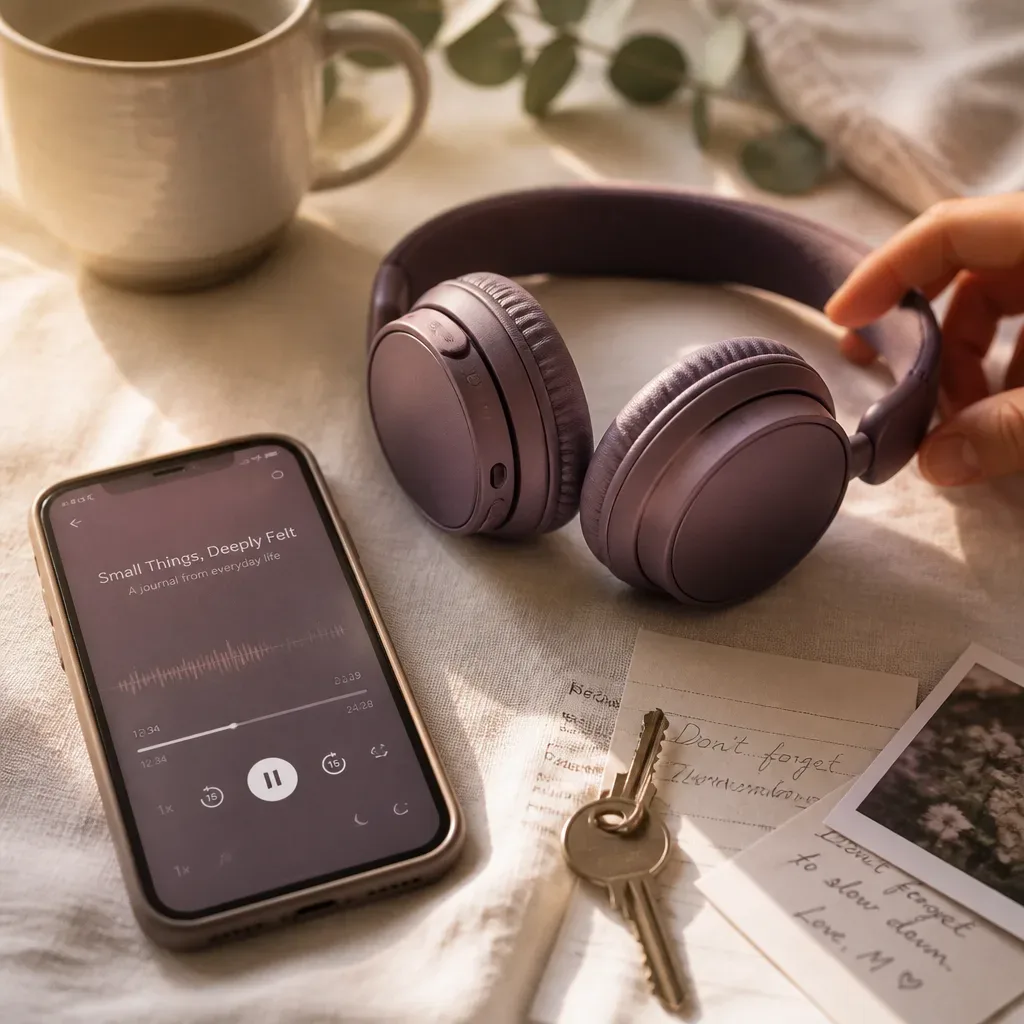
You can listen in the morning, before sleep, on a walk, or in the small private space before you open messages. Keep the cue simple. Same chair. Same headphones. Same minute after brushing your teeth. If you miss a day, return without drama. The practice is not made pure by never missing. It is made real by coming back.
The app may also give you a daily affirmation or let you collect images on a Manifestation Board. Let those be companions. The center remains your Dream-Self Moment. If you want the full method frame, return to the AYA Method. If you want to see how visual timing, symbols, or birth-chart language can support reflection, read astrology and manifestation after you have listened.
Princeton Engineering Anomalies Research, often called PEAR, studied intention and random systems for nearly 30 years before closing in 2007. Its findings remain debated, and they should be named carefully. What is less disputed is that human attention changes human behavior. When you rehearse a self, you notice different choices. You answer differently. You begin again sooner.
The audio does not live your life for you. It helps you recognize the life you are practicing.
Leave the last answer simple enough to hear tomorrow.