aya method deep dive
Manifest When You Don't Know: Start With Audio
Learn how to manifest when you don't know what you want by using short daily audio, nervous-system cues, and one true next image at a time, today.

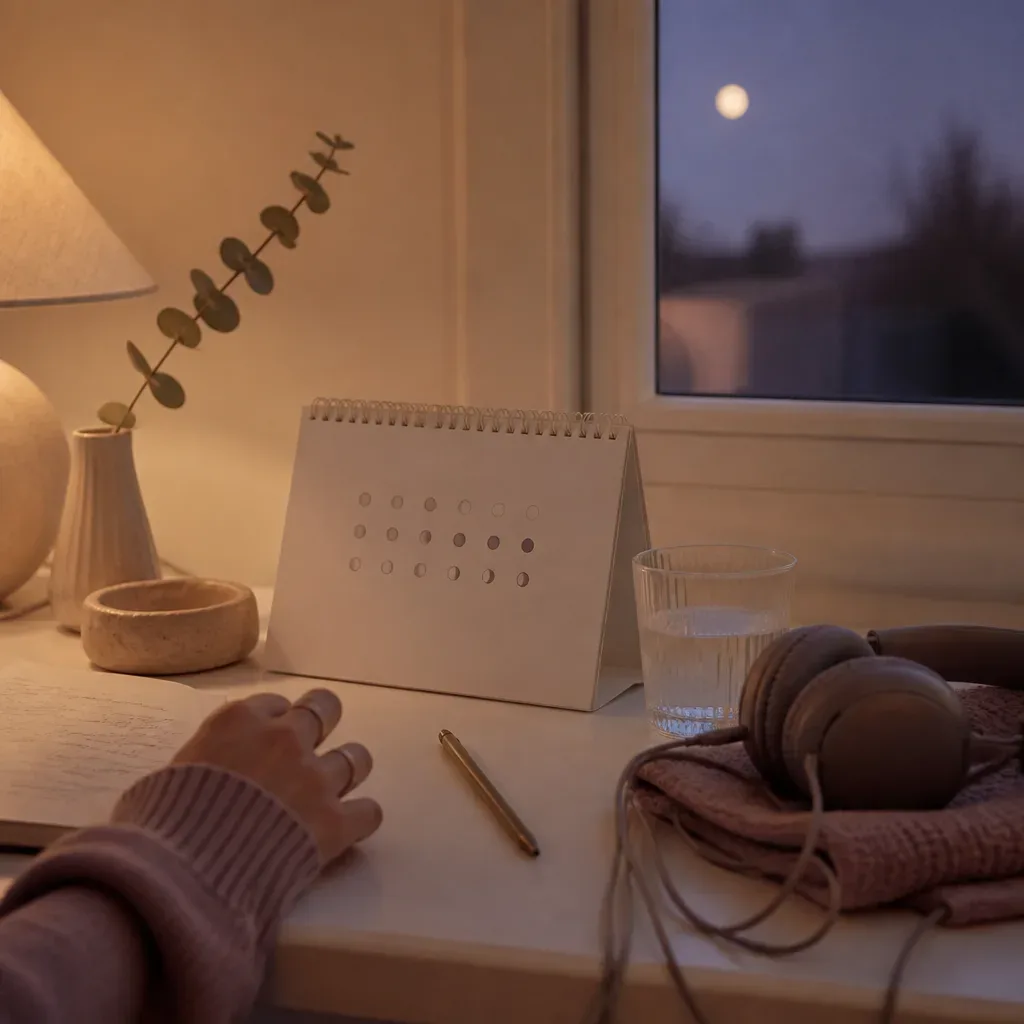
A cup sits beside the bed. The notebook is open, but the page is blank. To manifest when you don’t know what you want, don’t start with a perfect goal. Start with audio: one small future-self scene you can hear, repeat, and gently test against what feels true.
What do you do when the want is not clear?
You begin with the nearest honest direction, not the final shape.
Not knowing is information. It may mean you’re tired. It may mean you’ve spent years being praised for wanting what other people could understand. It may mean the desire is still under old noise. The American Psychological Association reported in 2023 that 27% of U.S. adults said most days they were so stressed they couldn’t function. A stressed mind is not always a good architect. It draws survival rooms first.
So make the room smaller. Instead of asking, What do I want for my whole life, ask: What would feel 3% more true by Friday? A steadier morning. A less performative love. Work that doesn’t make your jaw tighten. A home where your things have places. Fog is not failure. Fog is the mind asking for a gentler question.
This is still manifestation, but without theater. You are giving attention to a possible life and watching what in you answers. In goal-setting research, vague goals tend to produce vague action; Locke and Latham’s work over decades links specific goals with better performance, especially when the person has feedback. Specific doesn’t have to mean grand. It can mean one scene.
Try this first sentence: I don’t know the whole desire yet, but I know I want to feel more at home in my own days. That is enough to begin. Desire often arrives as a temperature before it becomes a plan.
Why start with audio before words on a board?
Audio works first because listening asks less of the editing mind.
When you write a list, you can start performing. You choose the clean sentence, the impressive title, the number that sounds adult. When you listen, the body gets a vote. You hear pacing. You hear tenderness. You hear whether the scene feels possible or fake. Neuroscience research on auditory processing shows that the brain responds to voice with social and emotional detail quickly; a familiar human voice can change arousal and attention within seconds.
The AYA Method is a daily audio manifestation practice. Each day you listen to a short personalized recording — your Dream-Self Moment — narrated from the version of you who has already manifested the life you intend. Listening is the practice. Repetition is the work. The audio is the method.
This matters most when you’re unclear. A Manifestation Board can help later because it gives the eye something to return to. The app also includes a daily affirmation, which can steady one line of thought. But the listening comes first. Audio is the method because audio can hold nuance before language gets too rigid.
Lally and colleagues found in a 2009 European Journal of Social Psychology study that new habits took 18 to 254 days to become automatic, with an average of 66 days. That range is kind. It says repetition is personal. It also says you don’t need a dramatic mood to practice. You need a cue, a short action, and enough return.

How do you make the first recording simple enough to trust?
You make the first recording by choosing one ordinary future scene and removing every line your body rejects.
Begin at the scale of a room. As a former architect, I trust rooms. A building can begin with one line on tracing paper, and a new self can begin with one scene that doesn’t lie. George Miller’s classic 1956 paper suggested that working memory holds around 7 items, plus or minus 2, though later research often argues for fewer. Either way, too many desires crowd the inner room.
Use this four-part draft:
- Place: Where are you in the future scene?
- Proof: What small detail shows something has changed?
- Body: What do you feel in your chest, breath, hands, or face?
- Next act: What do you do calmly because this is now true?
A first Dream-Self Moment might say: I am standing in my kitchen at 7:20. The counter is clear. My phone is still across the room. I can feel space behind my ribs. I make tea before I check anything. I know my day belongs to me first.
That is not a fantasy palace. It is a door. Peter Gollwitzer’s work on implementation intentions, including a 2006 meta-analysis with Paschal Sheeran covering 94 studies, found that if-then planning had a medium-to-large effect on goal achievement. Your audio isn’t the same as an if-then plan, but it uses a similar mercy: it gives the mind a scene to recognize.
Keep it under 90 seconds at first. If one word feels false, change it. Say steady instead of radiant. Say I answer one message instead of I run the company. The truest sentence is often the quietest one.
What should you do when your mind argues back?
You should treat resistance as feedback, then make the statement smaller.
The mind may say, This isn’t real. Good. Thank it for trying to protect you from humiliation. Then ask what size of future it could tolerate today. If I am loved feels impossible, try I let one safe person be kind to me. If I know exactly what I want feels false, try I notice what I keep returning to.
Research gives you a reason to be gentle. In a 2009 Psychological Science study, Joanne Wood, W. Q. Elaine Perunovic, and John Lee found that highly positive self-statements could make some people with low self-esteem feel worse. The problem wasn’t hope. The problem was a sentence too far from the listener’s current belief. Believability is not weakness. It’s the bridge.
Here is a simple way to edit the line:
| If the audio says | And your body says | Try this instead |
|---|---|---|
| I know my purpose | Too much | I notice what feels worth my care |
| I am completely confident | Not true | I take one clear breath before I speak |
| My life is fixed | False | One part of my day is becoming easier |
| I receive love easily | Unsafe | I let kindness stay for one more second |
For more on choosing one sentence that doesn’t fight you, read the affirmations guide. Just remember the order. In Aya, the affirmation supports the audio. It is not a pillar beside it. The Dream-Self Moment remains the daily practice.
A sentence that cannot be believed cannot become a home. Make it smaller until some part of you says, maybe.
How can astrology, timing, or signs help without taking over?
They can help if they give you reflection, not permission.
Some people come to desire through timing. A birthday. A new moon. A hard transit. A date that makes the body remember. The Moon’s cycle is about 29.5 days, and many people use that rhythm as a way to review intentions. That can be beautiful if it makes you listen more closely. It becomes less helpful when you stop trusting your own response.
Astrology can be a mirror for asking better questions: What am I tired of repeating? Where am I being too loud because I’m afraid to be honest? What kind of care does this season ask for? If you like that kind of reflection, the piece on astrology and manifestation keeps the practice grounded.
There is also a reason to stay awake. In 1949, psychologist Bertram Forer gave students a personality description they thought was individual, though everyone received the same text. They rated it as highly accurate, with an average score of 4.26 out of 5. The Forer effect reminds you that meaning can feel personal even when it is broad.
So let timing support the audio, not replace it. If a sign makes you calmer and clearer, write one line. If a sign makes you frantic, step away. Your life is not a puzzle you must solve before you’re allowed to begin.
What does a seven-day practice look like?
It looks like listening once a day, writing one word after, and refusing to make it complicated.
Seven days is long enough to notice a pattern and short enough that the mind doesn’t make a ceremony out of it. Behavioral scientist BJ Fogg often teaches that tiny habits work because they are small enough to do even on a bad day. You are not trying to become a new person by Sunday. You are giving your attention the same quiet place to land.
Use this rhythm:
- Day 1: Name the fog. Write one sentence you know is true.
- Day 2: Record a 45-to-90-second Dream-Self Moment.
- Day 3: Listen after waking or before sleep. Note one body word.
- Day 4: Remove any line that feels like performance.
- Day 5: Add one detail you can see, touch, or hear.
- Day 6: Take one small action that matches the scene.
- Day 7: Decide whether to keep, soften, or rewrite the recording.
A 2006 Duke University study by Wood, Quinn, and Kashy found that about 40% of daily actions in their sample were habits rather than active decisions. This is why the cue matters. Same chair. Same headphones. Same short audio. The practice becomes easier when the setting remembers for you.
If you need a broader foundation, return to the AYA Method and then read more about manifestation when you’re ready for language around desire. But don’t confuse reading with practicing. One listen is more honest than another hour of trying to name the perfect want.
How do you know the desire is becoming yours?
You know because your choices begin to change before your life has finished changing.
Clarity often arrives quietly. You don’t always get a thunderclap. You may notice you no longer say yes as quickly. You may move your phone out of the bedroom. You may admit a job title looks good but costs too much of your face. In small self-affirmation studies reviewed by Cohen and Sherman in 2014, reflecting on values helped people respond with more steadiness under threat. Values can become behavior when they are revisited.
Watch for three signs. First, repetition feels less strange. Second, the future scene gets more specific without being forced. Third, your body offers a calmer no. These are not guarantees. They are signals. The desire is not trying to impress you. It is trying to be recognized.
If nothing changes after seven days, don’t punish the practice. Change the scale. Maybe your first recording was too polished. Maybe it named an outcome your family respects, not one you actually want. Maybe you need rest before desire can speak. In sleep research, adults are commonly advised to get at least 7 hours a night; tiredness can flatten preference until everything sounds equally distant.
Start again with a smaller room. One cup. One email. One honest breath before you answer.
Stay near the sound.