aya method deep dive
Manifestation Challenge With 3-Minute Dream-Self Audio
A quiet 28-day manifestation challenge using 3-minute Dream-Self audio, simple tracking, and daily repetition without forcing your morning.

A cup sits beside the bed. The room is not bright yet. A manifestation challenge works best when it’s small enough to repeat: 28 days, 3 minutes a day, one Dream-Self audio, and one note afterward. You don’t need a perfect morning. You need a practice that returns.
What is this 28-day manifestation challenge really asking of you?
It asks you to listen for 3 minutes a day and let one future-self identity become familiar through repetition.
Twenty-eight days sounds ceremonial, but it is also practical. Four weeks is long enough to see a pattern without asking you to change your whole life at once. At 3 minutes a day, the total listening time is 84 minutes. Less than many films. Less than a long dinner. Still enough to create a steady cue.
This challenge centers on audio because listening can reach you when writing feels like too much. You put the sound close to the body. You let the words arrive through the ear. In cognitive psychology, mental rehearsal is often studied as a way the brain prepares for action; athletes have used imagery training for decades, and reviews in sport psychology have found that imagery paired with physical practice can improve performance more than physical practice alone in some settings.
Here is the clean shape:
- Choose one clear intention for 28 days.
- Listen to your 3-minute Dream-Self audio once a day.
- Write down one phrase that felt true.
- Take or notice one small action that belongs to that version of you.
- Review the pattern every 7 days.
The point is not to force belief. Forced belief often creates a private argument. The point is to become less surprised by the self you’re practicing. What you repeat quietly becomes easier to recognize.
If you want the wider language for this practice, start with the Manifestation pillar. It names manifestation as attention, repetition, and lived choice, not as waiting for life to do the work for you.
Why 28 days, and why only 3 minutes?
Twenty-eight days gives you enough repetition to notice change, while 3 minutes keeps the practice small enough to survive ordinary life.
A common myth says habits take 21 days. The better-known study from Phillippa Lally and colleagues at University College London, published in the European Journal of Social Psychology in 2009, found a much wider range: 18 to 254 days for a behavior to become automatic, with an average of 66 days. So this challenge is not a promise that you will be remade in four weeks. It is a container. A beginning with edges.
Three minutes matters because friction matters. BJ Fogg’s behavior model at Stanford has long emphasized that tiny behaviors are more likely to repeat when they are easy, prompted, and linked to motivation. If a practice asks for 45 minutes, special candles, silence, and a clear mood, it may become another thing you avoid. Three minutes can happen beside a sink, on a tram, in a parked car, or on a slow walk.
There is also a nervous-system kindness in the short form. Dr. Andrew Huberman often speaks about the value of consistency, light exposure, sleep timing, and state shifts in daily protocols. You do not need to turn manifestation into a performance. You need enough steadiness for the body to stop treating the desired self as a stranger.
| Length | What it does well | What can go wrong |
|---|---|---|
| 1 minute | Very easy to begin | May feel too brief to enter the scene |
| 3 minutes | Enough time to settle and listen | Requires one honest daily anchor |
| 10 minutes | More spacious reflection | Easier to skip on full days |
| 30 minutes | Ritual depth | Can become dependent on ideal conditions |
A practice does not become true because it is long. It becomes true because you return to it.
How do you set up the challenge before day one?
You set it up by choosing one intention, one listening time, one tracking page, and one rule for missed days.
Start with the intention. Keep it narrow. Not “my entire life changes.” Try “I speak clearly in work conversations,” “I care for my body before I abandon it,” or “I date from self-respect.” The brain works better with specificity. In goal-setting research, Edwin Locke and Gary Latham found across decades of studies that specific, challenging goals tend to support better performance than vague goals, especially when feedback is present.
Then choose your listening anchor. An anchor is not a mood. It is a real moment that already happens. After coffee. Before the first message. After school drop-off. When the kettle clicks off. Habit researchers often call this context stability. Wendy Wood and Dennis Rünger wrote in the Annual Review of Psychology in 2016 that habits are strongly tied to recurring contexts and cues.
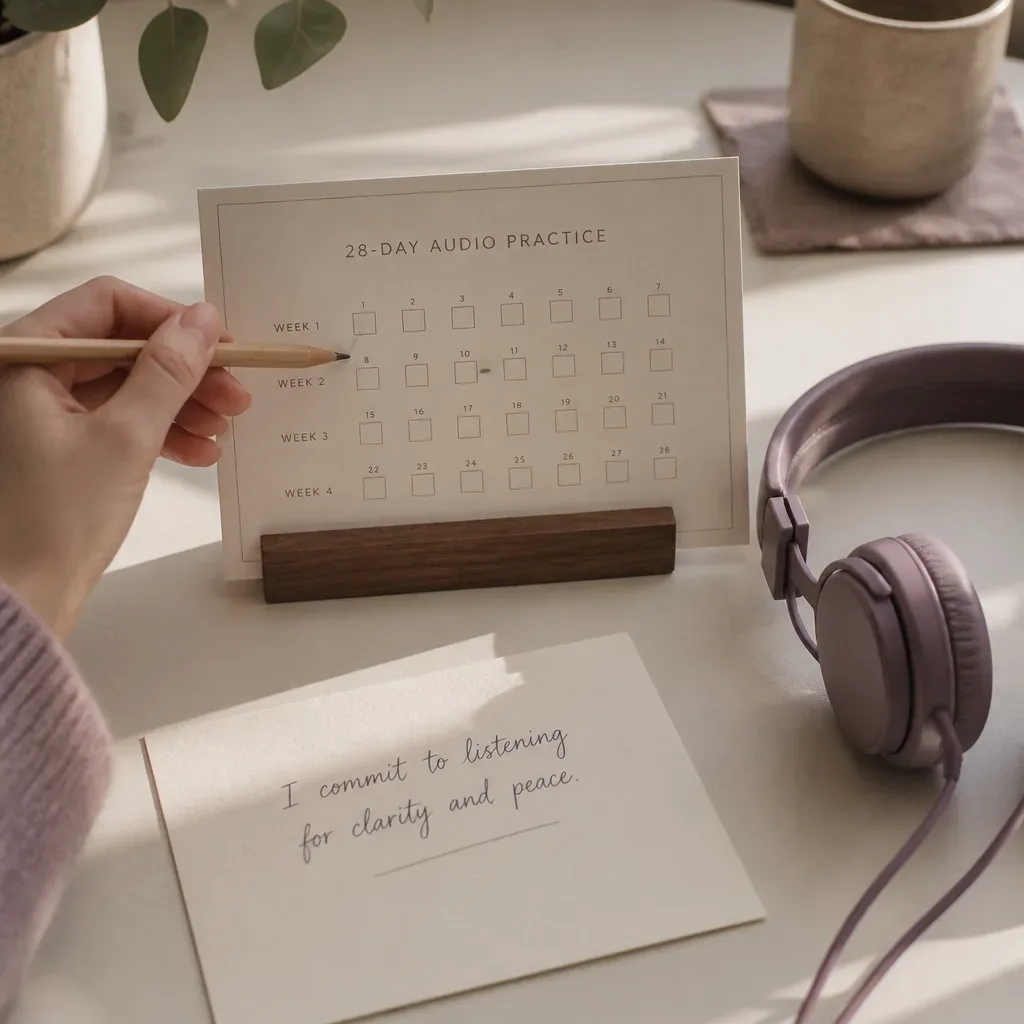
Use a simple tracker. One page is enough. You can draw 28 small boxes. Beside each box, leave room for a phrase and one action. Do not make the tracker beautiful if beauty becomes delay. A plain note is honest. A plain note can hold you.
Before day one, decide what a missed day means. It means you missed a day. That is all. You do not restart unless restarting helps you feel clean rather than punished. A 2019 review in Health Psychology Review found that self-compassion is often linked with better self-regulation, partly because shame makes people quit faster.
Your setup can be this quiet:
- One intention.
- One 3-minute audio.
- One daily anchor.
- One 28-box tracker.
- One gentle rule: return the next day.
For the method itself, use the exact center. The AYA Method is a daily audio manifestation practice. Each day you listen to a short personalized recording — your Dream-Self Moment — narrated from the version of you who has already manifested the life you intend. Listening is the practice. Repetition is the work. The audio is the method.
What should you do each day during the 3 minutes?
You should listen without multitasking, receive one true phrase, and let the next small action become obvious.
Day by day, the practice is almost spare. Put on headphones if you can. Sit, walk, or lie still. Press play. Let your Dream-Self audio speak from the version of you who already knows the pattern you are rehearsing. If a sentence feels too good to believe, do not fight it. Notice the sentence just before it. That is often the doorway.
The listening itself is the practice, not the preparation around it. This matters. Many people turn manifestation into a set of extra tasks and then feel behind by day three. The 3-minute audio protects the practice from becoming too heavy. In attention research, brief repeated cues can change what people notice; selective attention studies have shown for decades that the mind filters reality according to what it has been trained to expect.
After listening, write one sentence only. It might be: “I do not rush to prove myself.” Or: “I answer from steadiness.” Or: “I choose the room that feels honest.” One sentence is enough. The sentence you can live today is better than the sentence you only admire.
Then choose one small action. If your intention is creative work, open the document for 5 minutes. If it is love, do not send the message that asks for crumbs. If it is health, drink water before the second coffee. Specific numbers help here: 5 minutes, 1 message not sent, 10 breaths before answering.
If you use the app’s daily affirmation, keep it as a complement after the audio. The same is true for a Manifestation Board. They can help you see and repeat the language, but they are not the center. If affirmations are part of your practice, the Affirmations pillar can help you make them believable instead of decorative.
How do you move through the four weeks without making it too heavy?
You move through the four weeks by giving each week one quiet focus and keeping the daily practice unchanged.
Week 1 is for recognition. You are learning the sound of the Dream-Self voice. Do not expect certainty. Expect contact. In early habit formation, the first week often carries the most friction because the cue is not yet familiar. That is normal. Keep the bar low enough that a tired day can still pass through it.
Week 2 is for evidence. Begin noticing small confirmations in behavior, not signs in the sky. Did you pause before agreeing? Did you choose the better boundary? Did you finish the email instead of circling it for 40 minutes? Research on implementation intentions by Peter Gollwitzer shows that “if-then” plans can improve follow-through across many goals. You can use that here: “If I finish listening, then I write one line.”
Week 3 is for resistance. This is often where the old self argues. Not because you are failing. Because the old pattern has a voice too. Neville Goddard wrote often about living from the fulfilled state, and while his language is metaphysical, the practical part is simple: return to the inner assumption until the outer choices begin to match it.
Week 4 is for embodiment in plain life. This does not mean drama. It may mean you buy the notebook, make the call, ask the price, leave earlier, tell the truth faster. A 28-day manifestation challenge is not measured only by feelings. It is measured by the small ways your day starts to answer the audio.
Use this weekly map:
| Week | Focus | Question to ask on day 7 |
|---|---|---|
| 1 | Recognition | Which phrase keeps returning? |
| 2 | Evidence | What choice looked slightly different? |
| 3 | Resistance | Where did the old pattern get loud? |
| 4 | Plain action | What now feels more natural than before? |
For a softer timing lens, you can also read Astrology and manifestation. Use it as reflection, not as permission to delay your own life.

What do you do when you miss a day or feel nothing?
You return the next day, lower the drama, and treat numbness as information rather than failure.
Missing one day is not a broken challenge. It is data. Did the anchor fail? Was the audio too late in the day? Did you choose a time that depends on privacy you do not have? The correction should be practical. Move the practice closer to something stable. A 2020 paper on behavior change maintenance in Health Psychology emphasized that flexible routines often last better than rigid ones when life changes.
Feeling nothing is also common. Audio practice is not always emotional. Some days the words will feel warm. Some days they will feel like weather outside a closed window. Listen anyway. The point is not to produce a mood on command. The point is to keep the channel familiar.
If resistance rises, make it smaller. Listen to the first 60 seconds. Write one word. Take one action so small it feels almost shy. In Tiny Habits work, BJ Fogg often names celebration and ease as part of repetition. You do not have to celebrate loudly. You can simply mark the box and let the body know you kept your word.
Watch for the hidden form of self-sabotage: making the challenge more elaborate. Suddenly you need a new notebook, a longer script, a cleaner room, a better version of yourself before you can practice becoming her. No. Begin from here. The version of you who returns is already different from the version who disappears.
If you miss 3 days, do not ask whether the challenge is ruined. Ask what would make tomorrow’s 3 minutes more likely. Maybe the answer is placing headphones by the kettle. Maybe it is listening before brushing your teeth. Maybe it is choosing an audio that sounds more like truth and less like pressure.
How will you know the manifestation challenge is working?
You will know it is working when your attention, language, and small choices begin to resemble the self you have been hearing.
Look for ordinary evidence first. You may speak with less apology. You may stop rehearsing the same fear. You may notice an option you used to miss. You may take action before certainty arrives. These signs are quiet, but they matter. In cognitive behavioral approaches, changing self-talk and behavior are both considered pathways to changed patterns, and meta-analyses have found CBT effective for many anxiety and mood concerns across hundreds of trials.
Use day 28 as a review, not a verdict. Read your phrases. Count your listening days. Count your small actions. If you listened 22 out of 28 days, that is 66 minutes of direct practice. If you listened all 28, that is 84 minutes. Either number is real. Do not erase the work because it was not perfect.
Ask these review questions:
- Which phrase felt most true by the end?
- Which action repeated without as much effort?
- Where did I still argue with the future self?
- What did I stop doing that used to cost me peace?
- Do I want another 28 days with the same intention, or a narrower one?
You can also return to the AYA Method for the full practice language, or place this challenge beside the broader Manifestation pillar when you want more context. If the words you heard became daily sentences, the Affirmations pillar can help you keep them clean and believable.
Do not demand spectacle from a practice that was designed to be intimate. A camera teaches this too. I have waited 28 minutes for one line of light to touch a wall in Crete, and the image was not louder because it was small. It was true because I stayed.
Put the headphones down. Stay near what is true.