vision boards
Vision Board Ideas That Don't Add More Pressure
Gentle vision board ideas for people who want a softer way to name desire, reduce pressure, and keep manifestation close to real life.
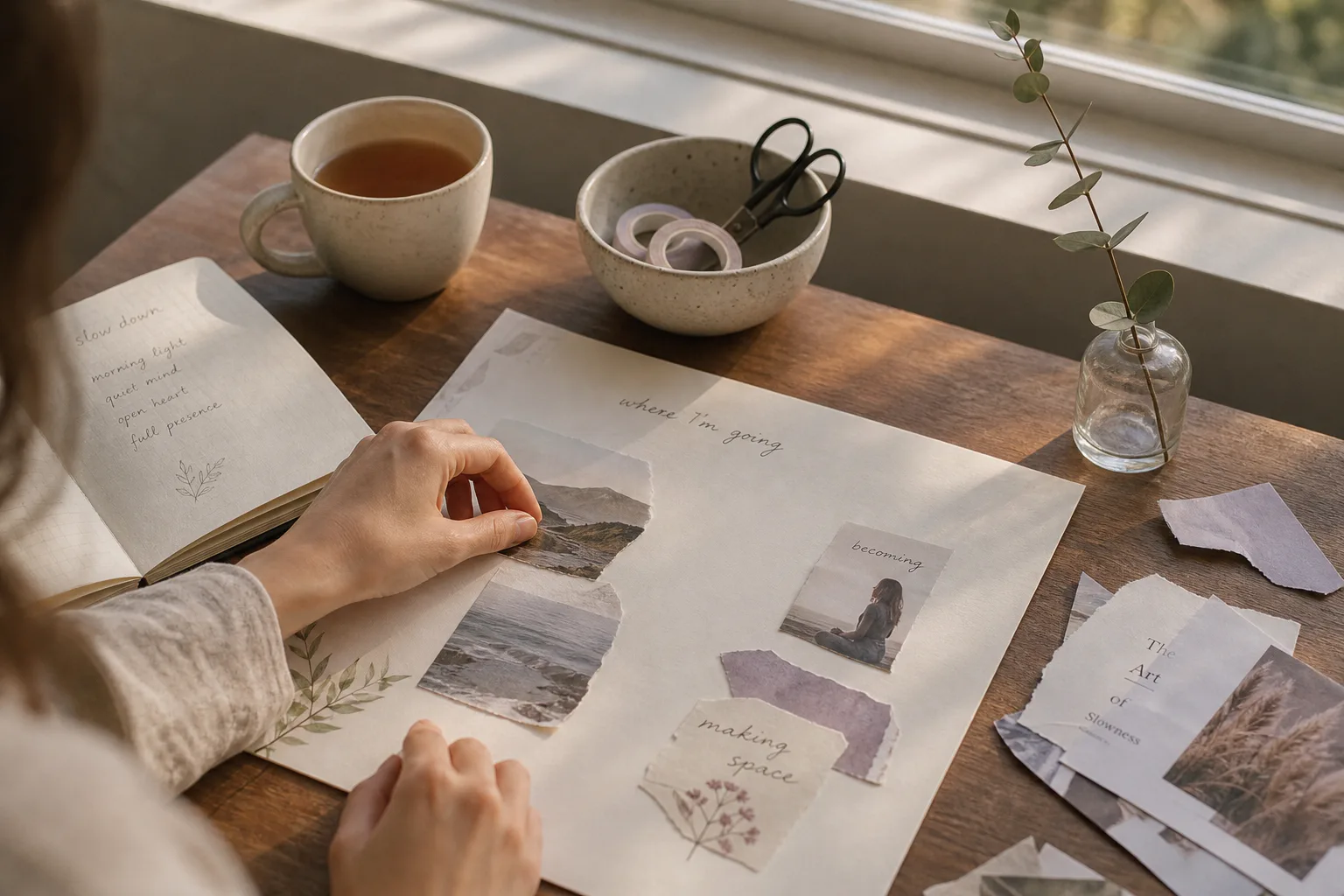
A vision board can be small, plain, and still enough. The best vision board ideas for pressure-sensitive people are not about wanting more. They are about seeing what is already quietly true, then giving it a place to sit where you’ll remember it without being chased by it.
What if your vision board only had to lower pressure?
A low-pressure vision board works when it helps your nervous system recognize desire without treating it like a deadline.
Most boards fail quietly because they are made from comparison. The images look expensive. The words sound like someone else’s voice. You stand in front of them and feel behind before you’ve even begun. In a 2023 American Psychological Association report, 27% of U.S. adults said most days were so stressful they couldn’t function well. A board that adds pressure is not a practice. It’s another room to clean.
A softer board begins with one question: what would feel like relief to see every day? Not what would impress a friend. Not what would prove that you’re becoming someone better. Relief is specific. It might be a kitchen table with morning light. A spine at rest. A calendar with white space. Three paid invoices. A hand on clay. A closed laptop at 6:10 p.m.
Desire does not have to shout to be real.
This is where manifestation becomes less theatrical and more honest. If you are new to the wider practice, the Manifestation pillar names manifestation as attention, repetition, and lived evidence. A board belongs inside that. It is not a spell pasted to cardboard. It is a visual cue, repeated gently.
Try these first rules:
- Use 5 to 12 pieces, not 50.
- Leave at least 30% blank space.
- Choose images that soften your jaw.
- Avoid words that sound like a command.
- Change anything that makes you feel watched.
A board is allowed to be quiet. In small studies on mental imagery, people often respond better to images that feel personally believable than to images chosen only for status. Believability matters because the body votes early. If your chest tightens, listen.
Which vision board ideas feel soft instead of demanding?
The softest boards organize desire by felt sense, not by achievement.
Here are 9 vision board ideas that do not need more pressure from you. Each one can fit on one sheet of paper, one saved folder, or a small corner of the AYA app’s Manifestation Board if you use it as a visual complement. Keep the board near your daily audio practice, but do not make it the center.
- The relief board. Collect images of what would make life 10% easier. A repaired shoe. A tidy drawer. A quiet train ride.
- The body-safety board. Choose images that tell your body it is safe now. Warm socks. Soup. A low lamp.
- The one-word board. Pick one word for 30 days. Enough. Home. Slow. Paid. Known.
- The evidence board. Add proof that the future has already begun. Receipts, screenshots, kind messages, small wins.
- The no-more board. Name what you are no longer available for. Overbooking. Replying at midnight. Saying yes with your shoulders raised.
- The devotion board. Show what you want to tend. A plant. A manuscript. A body. A marriage.
- The ordinary life board. Use images of the day-to-day version of your desire, not the announcement version.
- The texture board. Fabric, paper, color, and surface. This helps when words feel too sharp.
- The 90-day board. Only include what could be lived within 3 months.
The number matters. Nine choices are enough to start, but not so many that the mind turns the page into a test. Cognitive load research has often pointed to working memory limits around 4 to 7 items, with later research showing the number depends on context. Your board can respect that. Your attention is not a machine.
| Board type | Best for | Keep it gentle by |
|---|---|---|
| Relief board | Overwhelmed seasons | Choosing ease over status |
| Evidence board | Doubt-heavy days | Adding proof once a week |
| One-word board | Scattered attention | Repeating one word for 30 days |
| 90-day board | Big desire | Keeping time close and real |
A future that harms your body on the way there is not the one you asked for.
How do you choose images when everything online feels too loud?
Choose images by bodily recognition first and aesthetic pleasure second.
When you scroll for board images, your eyes can start borrowing other people’s hunger. That is not failure. It is design. A 2022 Pew Research Center report found that 31% of U.S. adults say they are online almost constantly. When you gather images from that much noise, you need a filter that is quieter than the feed.
Use a 3-second body check. Open an image. Notice your breath. If your shoulders lift, skip it. If your face softens, keep it. This sounds small because it is. Small is the point. Lior, the ceramicist in me, trusts the hand before the explanation. Clay knows when it is being pushed too hard. So do you.
For boards about love, choose images of daily kindness, not only weddings. For money, choose images of enoughness in practice: paid rent, clear bookkeeping, a full fridge, a calm call with your accountant. For work, show the room where work happens, not only the applause. If you want more structure around words, the Affirmations pillar can help you phrase desire without turning it into a demand.
A useful image test has 4 questions:
- Does this image feel like mine?
- Does my body stay soft when I look at it?
- Can I name one real action connected to it?
- Would I still want this if no one saw it?
If an image passes 3 of 4, it can stay. If it fails, thank it and remove it. You are not curating a museum. You are making a place for attention to return.
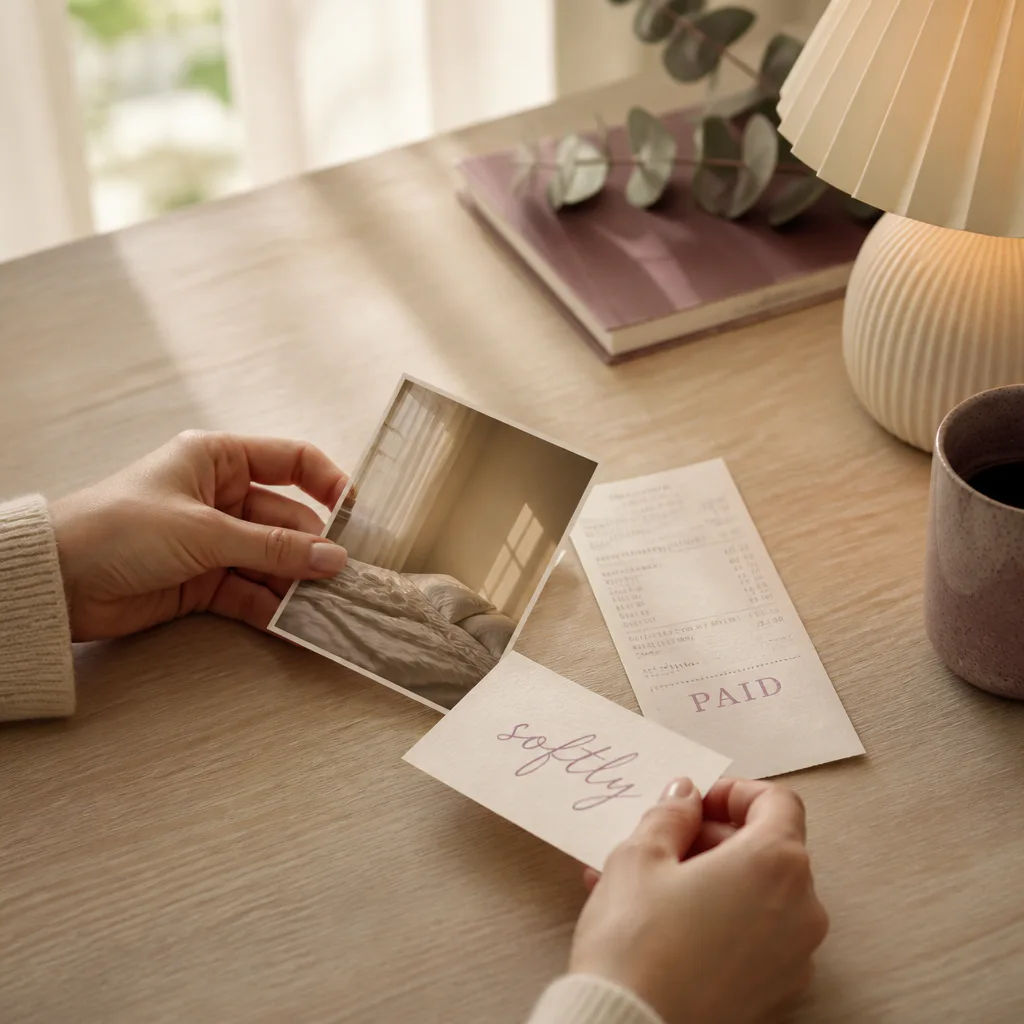
Can a vision board be about what you already have?
Yes, and an already-here board may be the kindest place to begin.
The mind often treats manifestation as reaching. But attention also needs evidence. An already-here board gathers signs that some part of the life you want has already arrived. It may include a photo of your current bed because you want rest. A text from a friend because you want love. A bank notification because you want steadiness. This is not pretending. It is noticing.
In behavioral psychology, cue-based habits work because the cue makes the behavior easier to remember. James Clear popularized this in habit writing, but the research is older than any one book. The cue does not do the work for you. It reduces the friction of remembering. A board of evidence says: look, you have begun.
This matters for people who feel pressure quickly. If every image points to a distant finish line, your system may read the board as proof of lack. If half the board shows what is already present, your body has somewhere to stand. Neville Goddard often wrote about assuming the feeling of the wish fulfilled. For many people, that feeling is easier to access through evidence than fantasy.
You don’t have to become a stranger to receive the life you want.
Try a 50/50 board. Half is evidence. Half is invitation. Evidence might be the first paying client, the calmer morning, the day you did not apologize for resting. Invitation might be the next room, the next relationship pattern, the next clean yes. Review it weekly for 2 minutes. Add one proof. Remove one pressure image.
If astrology is part of how you listen to timing, you can keep it simple. The Astrology and manifestation guide can help you use dates and seasons as reflective prompts, not as something that decides your worth.
Where does the AYA Method fit with a vision board?
A vision board is a visual complement; the daily audio is the practice.
The the AYA Method is a daily audio manifestation practice. Each day you listen to a short personalized recording — your Dream-Self Moment — narrated from the version of you who has already manifested the life you intend. Listening is the practice. Repetition is the work. The audio is the method.
That distinction protects you. A board can become another surface for self-judgment if it tries to carry the whole practice. In AYA, your ears lead. The Dream-Self Moment lets you hear the future as if it is being remembered from inside you. The board simply gives your eyes a place to rest afterward. Thirty seconds is enough.
Dr. Andrew Huberman has often spoken about the brain’s use of visualization and goal cues, while also noting that action and state matter. The research is not a promise machine. It suggests that repeated cues can shape attention and behavior. Listening daily creates one kind of cue. Seeing a board creates another. They do not need to compete.
A simple pairing looks like this:
- Listen to your Dream-Self Moment.
- Look at one image on your board for 30 seconds.
- Ask: what is one small true action today?
- Stop before it becomes performance.
The app also includes a daily affirmation and a Manifestation Board. They can support the listening, especially if your mind likes words and images. But they are complements. If you only do one thing, listen.
What should you put on a board for money, love, body, and work?
Put the lived texture of the desire on the board, not only the trophy version.
For money, avoid only luxury symbols if they make you feel far away from your own life. Add the ordinary signs of care: an emergency fund line, a paid bill, a wallet without panic, a calm grocery receipt. A 2024 Bankrate survey reported that 59% of U.S. adults were uncomfortable with their level of emergency savings. Money boards should make steadiness visible, not shame louder.
For love, include the pattern, not only the person. A shared breakfast. Two mugs. A boundary spoken kindly. A walk after a hard conversation. If you want repair, show repair. If you want tenderness, show tenderness. Your board should not flatten love into being chosen. Love is also how you return to yourself after contact.
For the body, be careful. Many body boards are just old punishment in prettier paper. Choose function, sensation, and care: strong feet, soft belly breathing, a medical appointment made, sunlight on arms, lunch eaten without negotiation. The World Health Organization recommends adults get 150 to 300 minutes of moderate aerobic activity weekly, but your board does not need to start with numbers. It can start with listening.
For work, show the hours you want to live, not only the title. A clean desk at 4:55 p.m. A sentence drafted. A studio sink. A calendar with open space. If your work desire includes recognition, include it. But put the daily life beside it. Recognition without a livable day can become another cage.
Here are quiet prompts by theme:
- Money: What would make my nervous system trust the month?
- Love: What pattern do I want to practice receiving?
- Body: What care would I stop postponing?
- Work: What rhythm would let me keep myself?
- Home: What corner would make me exhale?
The Manifestation pillar can help you keep these categories rooted in practice rather than pressure. Desire becomes steadier when it is specific.
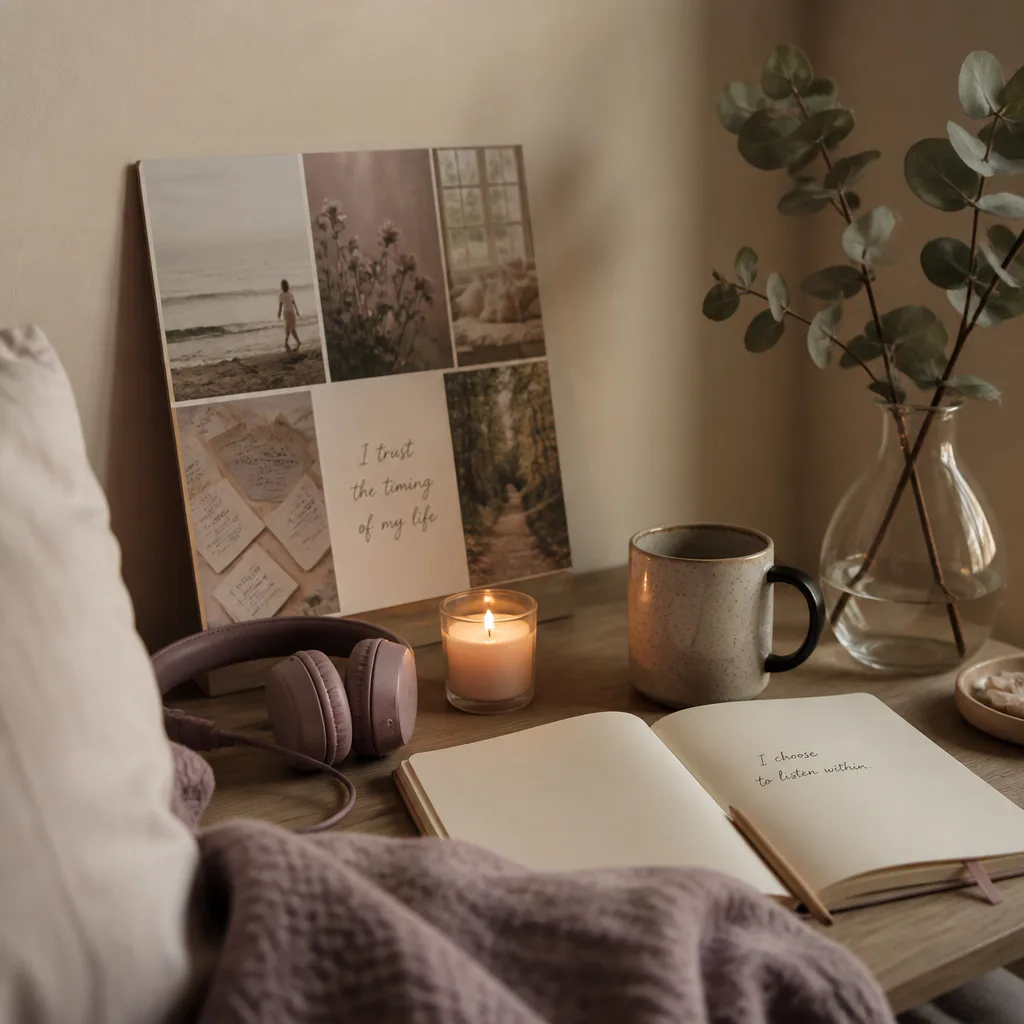
How do you keep your vision board from becoming another obligation?
Keep the board small, seasonal, and easy to change.
A board becomes pressure when it freezes you. You made it in January, and by April it feels like a witness for the prosecution. You are allowed to revise. In fact, revision is a sign that you are listening. A 12-week or 90-day board is often kinder than a year-long board because it stays close to the life you can actually touch.
Set a review ritual that takes less than 10 minutes. Put it on the first Sunday of the month or the night before a new month begins. Look at the board. Remove anything that makes you brace. Add one image of evidence. Add one image of invitation. Then stop. The stop is part of the care.
There is also the option of a hidden board. Not every desire wants to be on your wall. You can keep it inside a notebook, in a folder, or in the AYA Manifestation Board if privacy helps. Public display is not proof of commitment. Sometimes the truest thing grows better in the dark.
Privacy can be a form of devotion.
If your board starts to feel sharp, try a 7-day rest. Turn it around. Close the folder. Keep listening to your audio if you use AYA. Desire will not disappear because you stopped staring at it. In Princeton Engineering Anomalies Research writing, the Global Consciousness Project was careful about patterns and interpretation; not every signal is instruction. Let your own signals be handled with the same humility.
A board should never need daily obedience. It should offer daily remembering. That is the difference between a tool and a taskmaster.
What is the simplest board to make tonight?
The simplest board is a 6-piece relief board made from what you already have.
You do not need a craft store. Use a notes app, a blank page, an envelope, or the back of a receipt. Set a timer for 20 minutes. Choose 3 pieces of evidence and 3 pieces of invitation. Evidence says, this is already here. Invitation says, this is next. The balance keeps you from turning desire into distance.
Here is the exact version:
- Write one sentence at the top: I am allowed to want this softly.
- Add 3 signs of what is already true.
- Add 3 images or words for what is asking to grow.
- Circle the one that feels most alive today.
- Choose one action under 15 minutes.
- Put the board where you will see it once, not all day.
A Dominican University study often cited in goal-setting discussions found that people who wrote goals and shared accountability updates completed more than those who only thought about goals; reports place the difference at about 33% for some groups. The lesson is not to make your board public. The lesson is that written, repeated cues can matter.
If you want a digital version, use 6 images in a folder named now. If you want paper, tape them loosely so removal is easy. If you want no images, use 6 words. A vision board is not more real because it is beautiful. It is more useful when you can return to it without shrinking.
One last quiet check: if the board makes you kinder to your next hour, keep it. If it makes you cruel to your current life, change it.
Let it be small enough to tell the truth.