vision boards
Vision Board Examples for Future-Self Audio
Vision board examples for pairing images with future-self audio, so your visual practice stays simple, specific, and rooted in daily listening.
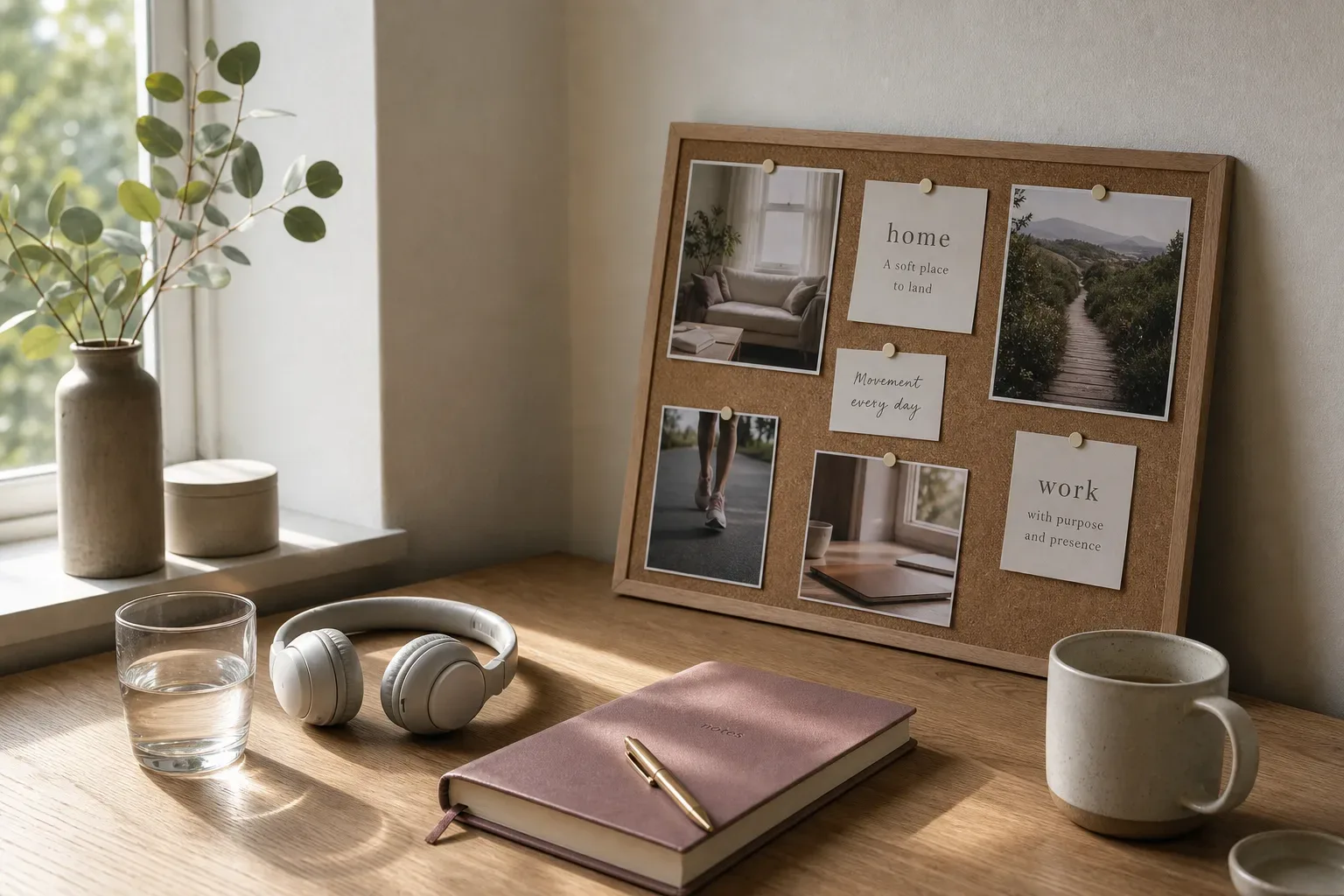
A cork board above a desk can pair with future-self audio when every image points to the same lived moment. The best vision board examples are not crowded collages. They’re small visual cues that help you hear your Dream-Self Moment more clearly, then choose one true action today.
What makes a vision board work with future-self audio?
A vision board works with future-self audio when the image gives your attention a place to land before the listening begins.
The board is not the method. The listening is. The AYA Method is a daily audio manifestation practice. Each day you listen to a short personalized recording — your Dream-Self Moment — narrated from the version of you who has already manifested the life you intend. Listening is the practice. Repetition is the work. The audio is the method.
A board becomes useful when it supports that repetition. It gives the eyes a simple way in. One chair. One morning cup. One bank statement without panic. One pair of running shoes by the door. Cognitive psychology has long shown that cues shape recall; in a 1975 study by Godden and Baddeley, people remembered more when the context of learning and recall matched. Your board is a chosen context.
The mistake is making the board perform too much. If it tries to hold every wish, it becomes noise. A visual practice that cannot be remembered in 10 seconds is usually asking too much of the nervous system. The body trusts what it can recognize.
So the first rule is simple: one board, one audio theme, one daily return. If your Dream-Self Moment is about feeling steady in your home, don’t fill the board with career images, travel images, and five different body goals. Let it stay close. Let it become familiar.
A vision board is not proof that life will change. It is a quiet rehearsal of what you’re willing to keep noticing.
Which vision board examples pair best with a Dream-Self Moment?
The best examples are boards that show a scene you can hear inside the audio.
Below are seven vision board examples that pair well with future-self audio. Use them as starting points, not rules. A 2022 Pew Research Center report found that 31% of U.S. adults said they use some form of meditation, prayer, or spiritual reflection weekly; visual cues can make that reflection less abstract. The board gives the practice a room, a texture, a time of day.
| Vision board example | What to place on it | Best audio focus |
|---|---|---|
| Home board | A calm room, clean counter, key bowl, soft light | I live inside a home that feels safe |
| Body board | Walking shoes, water glass, stretched fabric, open window | I keep promises to my body |
| Work rhythm board | Desk, calendar block, finished page, closed laptop | I work with clarity and stop on time |
| Relationship board | Two cups, shared table, honest message, hand on heart | I speak clearly and receive care |
| Money clarity board | Simple budget page, paid bill, grocery list, savings note | I look at money without leaving myself |
| Creative board | Notebook, rehearsal room, paint mark, empty chair | I make the work before I judge it |
| Weekly identity board | Three images for the week, one word, one tiny task | I practice being this self today |
Notice how ordinary these images are. They don’t need to be glossy. In small studies on implementation intentions, psychologist Peter Gollwitzer found that if-then planning can raise follow-through because the cue and behavior are linked in advance. Your board can do that gently: if I see the shoes, then I take the walk.
If you want the wider frame for how this fits inside manifestation, keep it grounded. The board shows a life in detail. The audio lets you hear yourself already living there. The daily action makes it real enough for the body to believe again tomorrow.
How do I choose images that don’t feel fake?
Choose images that your body can almost recognize, even if your life hasn’t caught up yet.
A fake-feeling image often asks you to leap too far. A mansion when what you want is rest. A stage when what you want is the courage to send the email. A couple laughing in linen when what you want is one honest conversation. The nervous system is specific. It knows when you’re performing for an idea.
Try the 70 percent rule. Pick images that feel about 70 percent believable and 30 percent stretching. That’s not a formal clinical measure, but it’s a useful somatic check. If your shoulders rise, your jaw grips, or you feel a little embarrassed, the image may be too far away. If your breath drops, even slightly, keep it.
Research on mental contrasting by Gabriele Oettingen suggests that people do better when they pair desired outcomes with present obstacles, rather than only fantasizing about the desired future. This matters here. Put one honest image on the board too: the unopened notebook, the laundry chair, the unpaid bill. Not as shame. As truth.
A board becomes stronger when it can hold both the future and the current room. That is where change begins to feel less theatrical. You are not trying to trick yourself. You’re learning to listen without leaving.
Use this small sequence when choosing images:
- Name the scene your audio describes in one sentence.
- Choose 5 to 12 images that belong inside that scene.
- Remove any image you wouldn’t want to look at on a tired Tuesday.
- Add one present-tense cue that shows where you actually are.
- Place one next action beside the board.
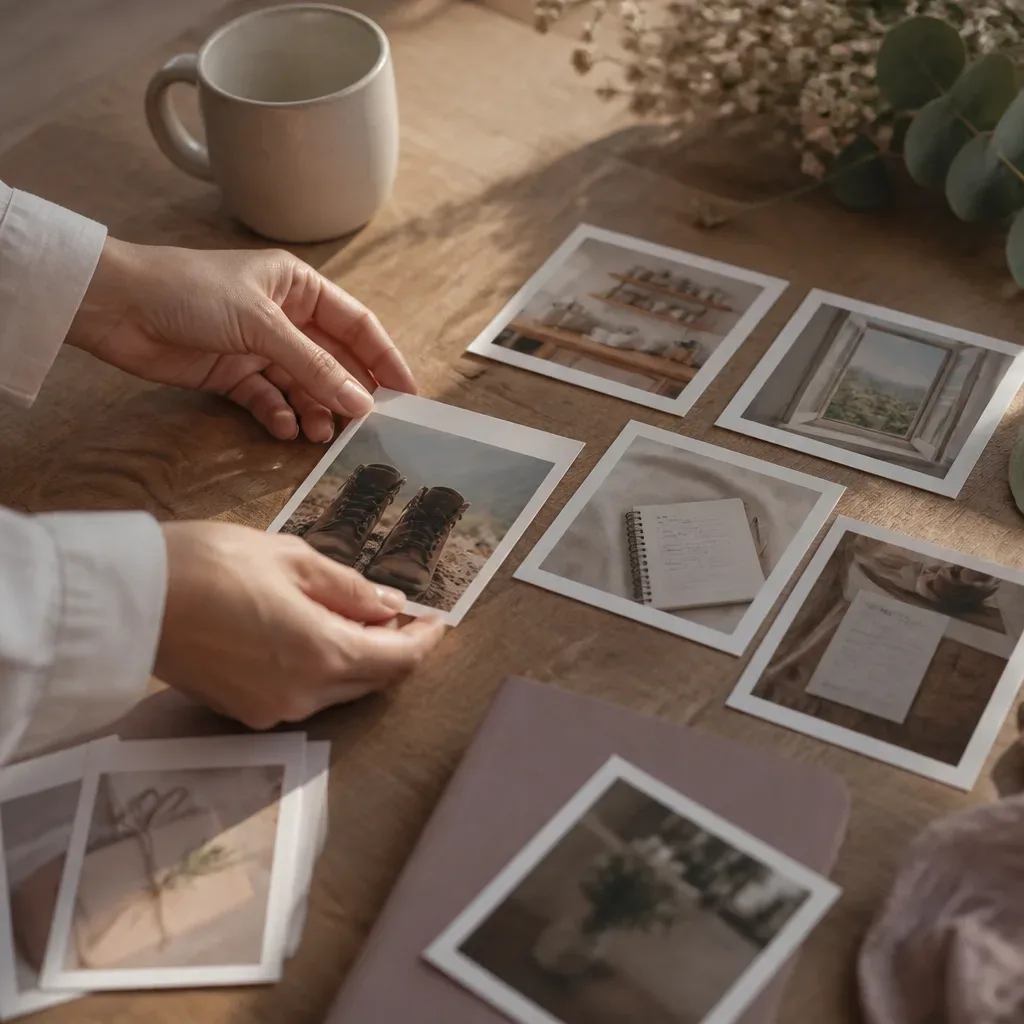
What words should I place beside the images?
Use very few words, and make them sound like something you’d actually say.
Words on a vision board can become a bridge between the eye and the ear. They don’t need to be grand. In fact, grand language can pull you out of the body. You might write: I come back. I answer the message. I walk after lunch. I tell the truth softly. I finish the page.
This is where affirmations can help, as long as they stay in their right place. In AYA, a daily affirmation is a complement to the audio, not a second pillar. It can sit beside the board like a small note left by your future self. The main practice is still listening.
A 2016 paper in Social Cognitive and Affective Neuroscience reported that self-affirmation activated brain regions linked with self-related processing and future valuation. That doesn’t mean every phrase works. It means words can matter when they feel personally tied to action. A sentence that your body rejects will not become truer by being louder.
Try these board phrases:
- I know what the next right step is.
- My body gets to come with me.
- I don’t rush what is becoming real.
- I can be seen without leaving myself.
- One quiet promise kept today is enough.
The right words don’t inflate you. They return you.
Keep the text to one corner if you can. Let the board breathe. If every space is filled, your attention has nowhere to rest.
How often should I look at the board while the audio plays?
Look briefly before and after listening, then let the audio carry the practice.
A good rhythm is simple. Look at the board for 20 to 60 seconds. Notice one image. Press play. Close your eyes if that feels safe. Listen to the Dream-Self Moment without managing it. When it ends, look back at the board and choose one small action that belongs to the same life.
Dr. Andrew Huberman has spoken often about visual focus and attention, especially how where the eyes go can affect state and readiness. You don’t need to turn that into a strict protocol. Just remember that your eyes are part of your attention. A board can settle the gaze before sound settles the mind.
You might practice once a day for 3 to 7 minutes. That is enough for most people because repetition matters more than length. Habit researchers often point to daily cues, not heroic effort, as the thing that keeps behavior alive. In a 2009 study from University College London, habit formation averaged 66 days, with wide variation from 18 to 254 days.
Here is a quiet listening pattern:
- Stand or sit where you can see the board.
- Let your eyes choose one image without forcing it.
- Listen to the audio once.
- Put one hand somewhere steady: chest, belly, thigh, table.
- Name one action you can take in under 10 minutes.
The board is not there to be worshiped. It is there to be used.
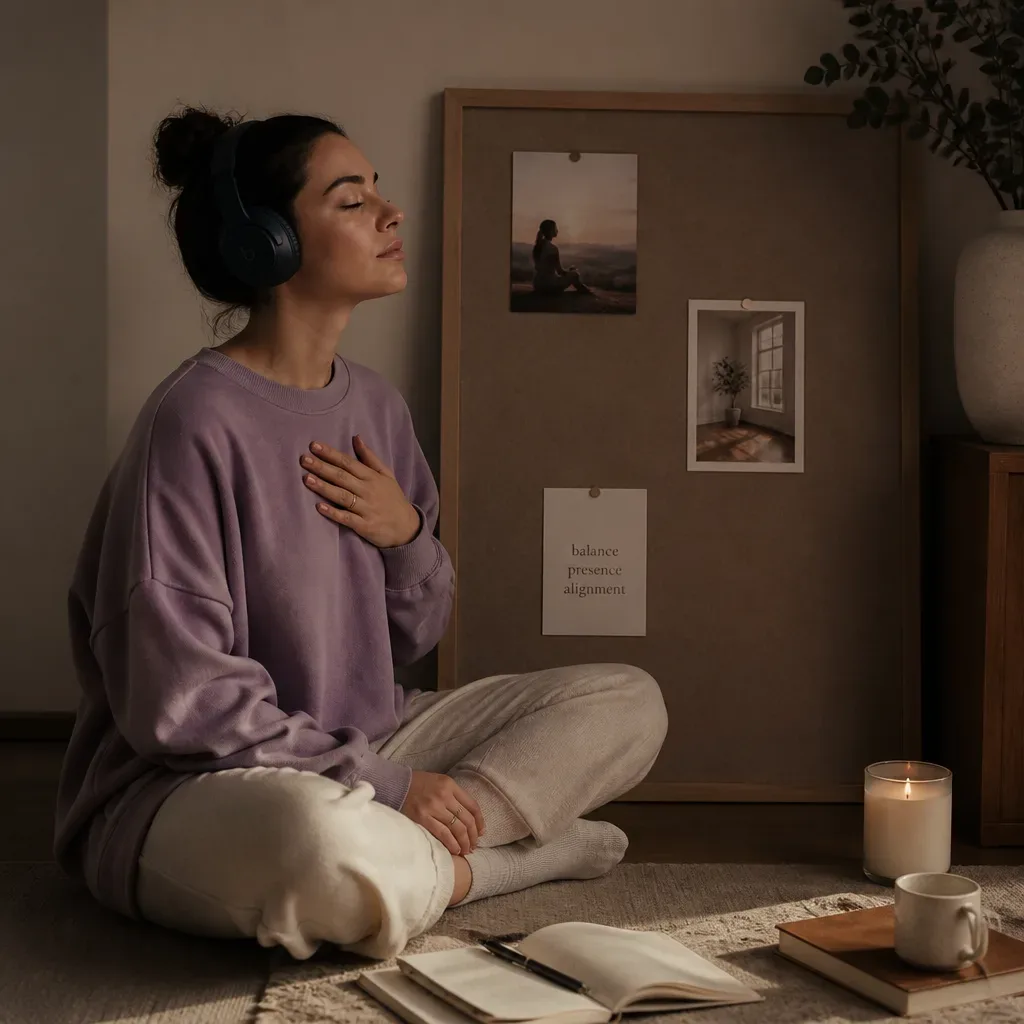
What if astrology, timing, or rituals are part of my practice?
You can include timing and ritual if they make the board more honest, not more complicated.
Some people like to begin a board on a new moon, a birthday, or the first Sunday of the month. Some people choose images after looking at their chart. If that speaks to you, keep it tender and practical. Astrology and manifestation can be a reflective frame, but it doesn’t replace listening, repetition, or action.
One useful way to work with timing is to make smaller boards. A 30-day board can be less intimidating than a whole-life board. A lunar cycle is about 29.5 days, which gives you a natural container if you like the moon as a clock. You don’t need to wait for perfect timing. You need a time you will actually return to.
Ritual can be very simple:
- Light one candle.
- Put your phone on do not disturb.
- Look at one image.
- Listen once.
- Write one sentence after.
That is enough. More is not always deeper. As a somatic practitioner, I watch people soften when the practice gets smaller. The body often says yes to what the mind almost dismissed.
If you use astrology, let it ask better questions. What kind of care does this season require? What part of me is ready to be seen? What can I stop forcing? Then build a board that answers in images, not noise.
A ritual is working when it helps you return, not when it makes you perform.
How do I keep the board quiet enough to last?
Keep it quiet by editing it monthly and letting it serve the audio, not compete with it.
A board that lasts is allowed to change. At the end of each month, remove what has gone flat. Keep what still makes the body soften. Add what has become newly true. This is not failure. This is attention doing its work.
The most useful vision board examples are often the least decorative. One client in a workshop once made a board with only six images: a sink, a bus seat, a blue notebook, a bowl of soup, a pay stub, and her own front door. It looked plain. But she used it for 90 days because every image belonged to the life she was practicing.
If you want a simple rule, try this: no image stays unless it changes the way you listen. That one test will clear half the board. It will also protect you from comparison, which is one of the quickest ways to leave your own practice. In a 2023 Pew report, about 4 in 10 U.S. adults said social media had at least some negative effect on mental health; your board doesn’t need to borrow that pressure.
Return to the larger manifestation practice when you need context, and return to the audio when you need contact. The image helps you see. The sound helps you know. The small action helps you remember that your life is already answering.
Before you finish the board, ask:
- Can I understand this board in 10 seconds?
- Does it match the Dream-Self Moment I hear each day?
- Is there one action here I can take today?
- Would I still want this if no one saw it?
- Does my body get quieter when I look?
Keep the yes. Release the rest.
The board waits where you can see it, and the voice meets you here.