vision boards
Pinterest Vision Board vs Future-Self Audio
A pinterest vision board helps you see a desire; future-self audio helps you rehearse it daily. Learn what compounds through repeated attention.
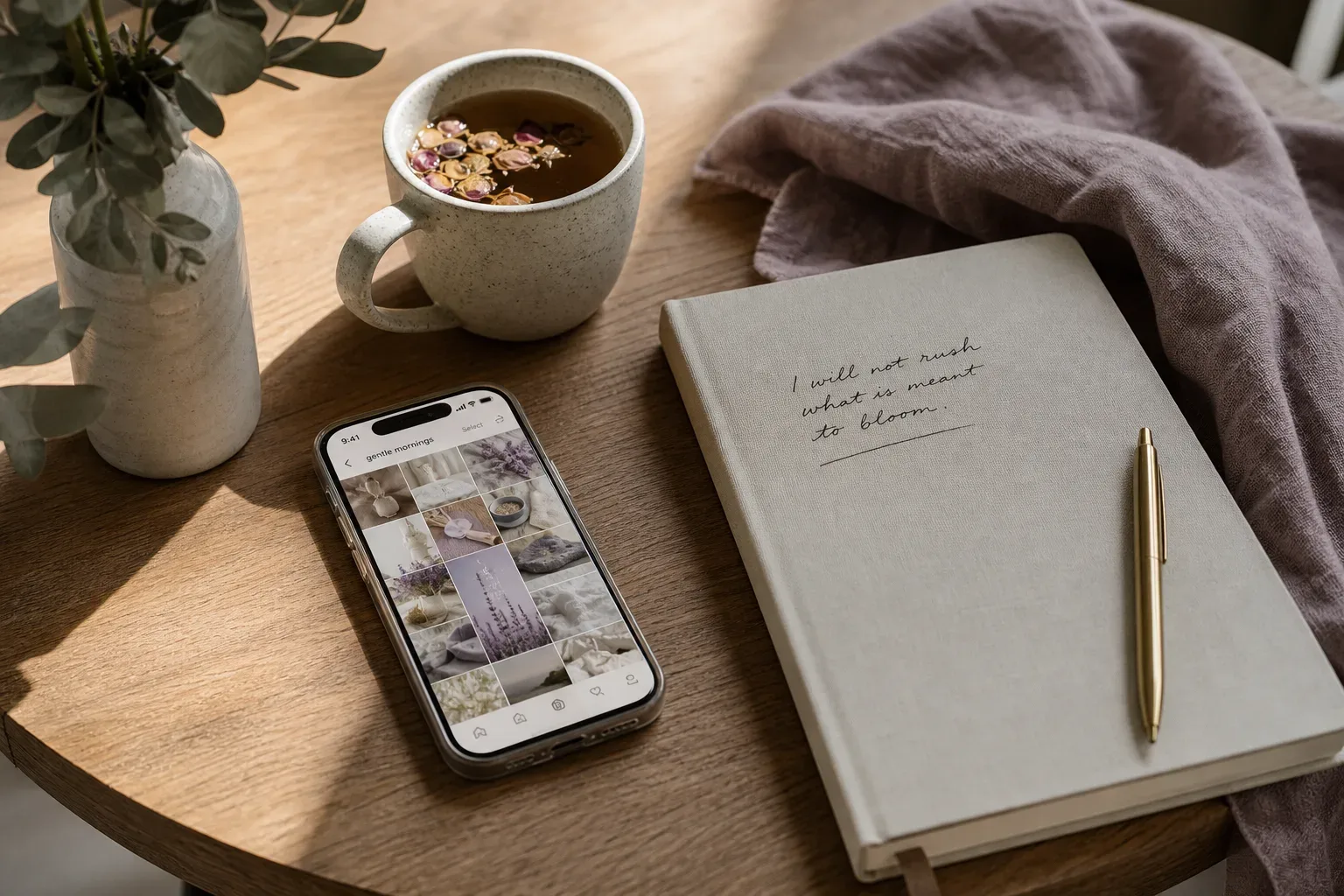
A phone glows beside the kettle. A pinterest vision board can clarify what you want to see, but future-self audio usually compounds more because it repeats identity, attention, and behavior daily. The board gives you images. The recording gives you a voice to return to.
What does a Pinterest vision board actually do well?
A Pinterest vision board works best as a visual sorting ritual.
It helps you notice the shape of a desire before you can explain it. You save the kitchen because it feels like quiet. You save the linen shirt because it feels like less pretending. Pinterest reported 570 million monthly active users in Q1 2025, which means the platform is not a small corner of the internet. It’s a huge visual search engine, and that matters. You can find symbols faster there than almost anywhere else.
A board also reveals repetition. If you pin 30 images and 18 of them show morning light, you know something. If you keep choosing empty desks, open windows, old stone, citrus trees, or women walking alone without hurry, that’s data. Not scientific data. Personal data. Still useful. A vision board is a mirror. It is not a metronome.
The risk is confusing recognition with practice. Seeing a life that feels yours can bring relief, but relief is not the same as rehearsal. In Gabriele Oettingen’s work on positive fantasies and mental contrasting, pleasant images alone were often less useful than pairing desire with present reality and a plan. Her WOOP research has been studied across education, health, and behavior change for more than 20 years.
This is why I like visual boards as beginnings. They name the weather inside you. They can sit near a journal, beside the tea, or inside the app you already open. If you want a wider frame for how desire and attention work together, the Manifestation pillar is a steadier place to start.
What does future-self audio do that an image board can’t?
Future-self audio gives your desire a living voice and asks you to rehearse it.
The AYA Method is a daily audio manifestation practice. Each day you listen to a short personalized recording — your Dream-Self Moment — narrated from the version of you who has already manifested the life you intend. Listening is the practice. Repetition is the work. The audio is the method. You can read more about the AYA Method when you want the clean definition without decoration.
Audio enters differently than images. You don’t just look at it. You receive sequence, tone, breath, and timing. In a 1994 meta-analysis, Driskell, Copper, and Moran found that mental practice improved performance, with stronger effects when tasks had cognitive elements. Future-self audio is not a sports drill, and it shouldn’t be sold as one. But it shares a principle: repeated rehearsal gives the mind a route to practice before the moment arrives.
A board can remind you what you want; a voice can rehearse who you are being.
This matters on ordinary mornings. You may not have the patience to study your board. You may not want to think. You press play while water warms. Ten minutes becomes small enough to do, which is why it can become real. Lally and colleagues found in a 2010 study in the European Journal of Social Psychology that habit automaticity took a median of 66 days, with wide variation from 18 to 254 days. Repetition needs a form you can stand.
Future-self audio can hold:
- the exact tone of your desired self-state
- one believable next behavior
- a memory of what already feels true
- a phrase you can carry into the day
- a softer relationship with delay
What compounds is not the pin. It is the return.
Which practice compounds better over 30 days?
Future-self audio usually compounds better over 30 days because it creates a repeatable cue, while a board often becomes static after the first rush.
Here is the plain comparison. Not as a verdict against beauty. As a way to see what each practice is being asked to do.
| Practice | Best use | What compounds | Common failure point |
|---|---|---|---|
| Pinterest vision board | Visual clarity and desire sorting | Pattern recognition | It becomes decoration |
| Future-self audio | Daily identity rehearsal | Attention, language, and behavior cues | You skip it when it feels too honest |
| Written affirmation | One sentence of focus | Self-talk through repetition | It becomes mechanical |
| Manifestation Board in-app | Keeping true images nearby | Visual memory plus editing | Too many images, not enough listening |
The word “compounds” matters. One strong evening of pinning can feel meaningful, but a single evening rarely changes your Tuesday. A 30-day practice does something different. It gives you 30 exposures to the same inner instruction. Behavioral research often separates intention from action because the gap is real. A 2006 meta-analysis by Gollwitzer and Sheeran found that implementation intentions had a medium-to-large effect on goal attainment across 94 studies.
Future-self audio can carry an implementation cue inside the story. Not just “I am calm.” More like, “When the email arrives, I read it once, breathe, and answer from the version of me who doesn’t abandon herself.” That is still manifestation language, but it touches behavior. It gives the future a place to land.
A pinterest vision board can compound when you revisit and edit it weekly. If you never look again, it gives you one signal. If you review it every Sunday for 15 minutes and remove what no longer feels true, it becomes more alive. Still, most boards don’t speak back. They wait.
The image names the door. The audio practices walking through it.
Where does a Pinterest vision board become too thin?
A Pinterest vision board becomes too thin when it shows an outcome but never asks who you are when the outcome is normal.
This is the quiet problem with beautiful boards. They can gather houses, partners, travel, skin, kitchens, books, clothing, and bodies into one glowing surface. But the surface may skip the part where you become someone who can receive, maintain, and choose. Pew Research Center reported in 2024 that nearly half of U.S. adults said they use social media at least sometimes for information. That means many people are not just being inspired online. They’re being taught what to want.
When a board gets too thin, you may feel it in the body:
- You scroll for an hour and feel less clear.
- You pin homes but avoid opening your bank account.
- You save calm images while speaking harshly to yourself.
- You choose someone else’s symbols because they look more convincing.
- You keep adding, but never practicing.
There is no shame in this. The eye is hungry. The eye also tires. Research on choice overload, including Iyengar and Lepper’s well-known 2000 jam study, suggests that more options can sometimes reduce follow-through. Pinterest can be a beautiful room with too many doors.
This is where a daily audio practice has a different honesty. It can’t hide in aesthetics for long. If the recording says, “I keep my promises to myself,” you know by noon whether that sentence has met your life. It becomes less about liking the image and more about staying near the truth.
If visual symbolism is part of your spiritual timing, you might also like astrology and manifestation. Just keep the order clean. Timing can support attention. It cannot replace listening.
How can you use both without making the board the practice?
Use the board as a visual doorway, then let audio become the daily repetition.
I keep a small board the way my grandmother kept herbs drying from string: not every plant, only the ones she meant to use. A good board is edited. It doesn’t need 400 pins. Try 12 to 24 images for one season. That number is small enough to remember and large enough to show a pattern. In cognitive psychology, working memory is limited; Miller’s older “7 plus or minus 2” rule has been revised, but the point remains. Too much visual material turns into fog.
Try this order for 7 days:
- Choose 12 images that feel true without needing applause.
- Write one sentence beneath the board: “This is the life I am practicing now.”
- Listen to your future-self audio once each morning.
- Pick one behavior from the recording before noon.
- Remove one image at the end of the week if it feels borrowed.
The app also includes a daily affirmation and a Manifestation Board, but they are complements. The audio stays central. If your affirmation helps, let it be a small thread tied around your wrist. If your board helps, let it be a window. Neither has to carry the whole house.
For sentence-based practice, the Affirmations pillar gives more care to how words are built and repeated. A phrase works best when it is believable enough to enter the day. Too grand, and the mind rejects it. Too vague, and the body has nothing to do.
What should you choose if you only have ten minutes?
If you only have ten minutes, choose future-self audio first and let the Pinterest board wait.
Ten minutes of listening is not a grand ritual. It is small enough to survive real life. Tea takes about 4 to 7 minutes to steep well, depending on the leaf. A short walk around one block may take 8 minutes. The practice fits inside those human measures. That is part of its strength. The nervous system trusts what returns quietly.
Pinterest can still have its place. Use it when you need to see. Use it when the desire is wordless. Use it on a Sunday afternoon, not as a substitute for the morning anchor. If you want to build a board with more care, this related guide to a manifestation board can help you keep the images specific and not merely pretty.
Here is the choice in plain terms: if you’re unclear, make the board. If you’re avoiding repetition, press play. If you’re collecting images but not changing your day, press play. If the future feels far away, listen to the voice that speaks from there as if it is already home.
A 2014 review by Cohen and Sherman in Annual Review of Psychology found that self-affirmation can reduce defensiveness and support adaptive behavior, especially when it connects to core values. Future-self audio can hold that same value memory in a fuller form: not just “I am enough,” but a lived scene where enoughness has a voice, a room, and a next step.
The board is allowed to be beautiful. It just doesn’t have to be the altar.
Listen once. Then go make the tea.