aya method deep dive
Manifestation Intake Before Dream-Self Audio
A manifestation intake helps you name what is true before Dream-Self Audio, so your daily listening stays specific, grounded, and easy to repeat.

The notebook is still closed. The headphones are beside it. A manifestation intake is the short, honest check-in you do before Dream-Self Audio, so the recording speaks to what you actually want, not what sounded impressive yesterday. It makes your listening specific. Then the audio does the work.
What is a manifestation intake, really?
A manifestation intake is a brief set of questions that gathers truth before you listen.
It is not a second practice. It is not a test of devotion. It is a little librarian at the desk, asking for the right title before sending you to the shelf. You name what you want. You name what has changed. You name what feels hard to believe. Then you listen.
The AYA Method is a daily audio manifestation practice. Each day you listen to a short personalized recording — your Dream-Self Moment — narrated from the version of you who has already manifested the life you intend. Listening is the practice. Repetition is the work. The audio is the method.
That last sentence matters. The manifestation intake serves the audio. It does not compete with it. A daily affirmation can help you remember one sentence during the day, and a Manifestation Board can help you see a few images clearly, but they are complements. The listening remains the center.
In habit research, smallness keeps appearing like a quiet witness. Phillippa Lally and colleagues, writing in the European Journal of Social Psychology in 2009, found that new habits took anywhere from 18 to 254 days to become automatic, with a median of 66 days. A practice has to survive ordinary mornings.
A good intake is not impressive. It is finishable. That is the first mercy.
Why do the intake before Dream-Self Audio?
You do the intake first because the mind hears more clearly when it has already named what is asking to be heard.
Most people begin manifestation practice with a polished desire. More money. A loving partner. A calmer home. A healthier body. These may be true, but they are too large to hear at close range. The intake brings the desire down to the size of one scene. One email sent. One hand resting on a kitchen counter. One walk home where you do not rehearse old fear.
This is close to what psychologist Peter Gollwitzer called implementation intentions. In a 2006 meta-analysis with Paschal Sheeran, implementation intentions showed a medium-to-large effect on goal achievement across 94 independent tests. The structure was simple: when situation X happens, I will do response Y. Specific cues help behavior find its doorway.
Before Dream-Self Audio, the cue is not only practical. It is also intimate. You are telling the recording where to meet you. If you are using manifestation as a daily practice, not a wish made once and abandoned, this matters. The scene has to be close enough that your body does not flinch from it.
A manifestation intake also catches stale language. Yesterday you may have wanted proof. Today you may need steadiness. Last month you may have wanted a new job. This morning you may need to hear yourself closing the laptop at 5:30 without guilt. Specificity is kindness. It stops you from asking one old sentence to carry a changing life.
Your future self should not sound like a poster. She should sound like someone who knows where you keep the mugs.
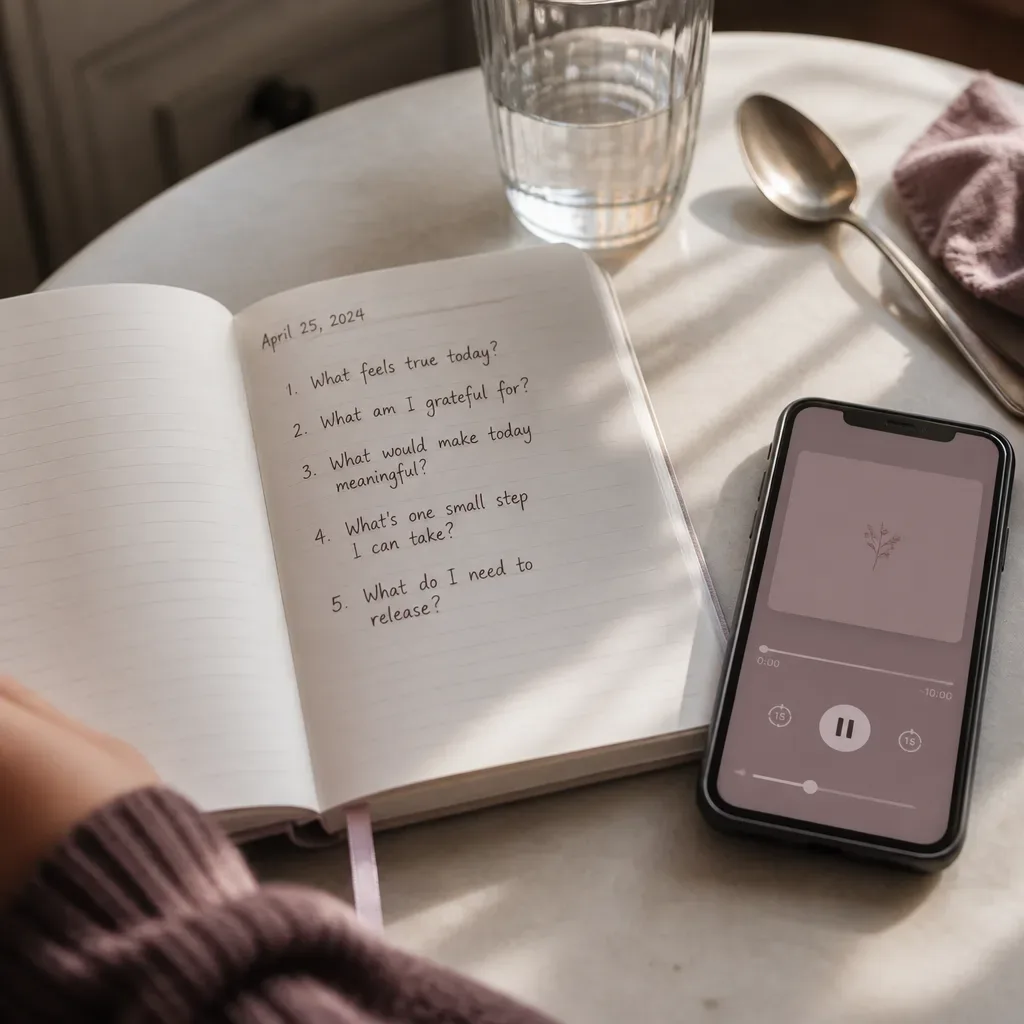
How do you write a manifestation intake in ten minutes?
You write it by answering five small prompts, then stopping before it turns into analysis.
Set a timer if that helps. Ten minutes is not a spiritual number. It is just short enough that you can do it before a bus, a child waking, or the first message of the day. In expressive writing studies, James Pennebaker often used 15 to 20 minute writing sessions over several days. That is useful for emotional processing. A manifestation intake is lighter. It is a note to the audio, not a memoir.
Use this order:
- Date the page. Write the day and time. This reminds you that desire lives in a real Tuesday.
- Name the desire. One sentence. No grand language. I want to feel at home in my work again.
- Name the current truth. Three facts. I am tired. I sent two applications. I keep checking my phone.
- Name the Dream-Self Moment. One small scene. I hear myself thanking a colleague for clear terms.
- Name the friction. One honest doubt. I am afraid I will choose safety and call it wisdom.
- Choose the cue phrase. Five to eight words. I can be steady and specific.
If you work with affirmations, the cue phrase may become your daily affirmation. Keep it plain. A sentence you can believe 3 percent is often better than a sentence you reject completely. In clinical self-talk research, Ethan Kross and colleagues found in 2014 that using your own name or second-person language can improve emotional regulation under stress. Distance can soften the grip.
Here is the rule I use in the library and on the page: if you would be embarrassed to say it to someone kind, make it smaller.
What should you include, and what should you leave out?
Include what makes the audio true, and leave out anything that makes you perform for the page.
A manifestation intake works best when it has enough detail to guide listening and enough restraint to stay repeatable. You are not trying to document the whole life. You are setting the table for one short audio practice. The difference is not small. In a 2011 review in Psychological Science, positive fantasy alone was linked by Gabriele Oettingen and colleagues to lower effort in some goal contexts. The missing piece was contact with reality.
That is why your intake needs both desire and friction. You are not ruining the practice by naming doubt. You are letting the audio speak to the room you are actually sitting in.
| Include | Leave out | Why it matters |
|---|---|---|
| One current desire | Ten competing desires | Attention gets less scattered |
| Three present facts | A full emotional history | The audio can meet today |
| One sensory scene | A vague future identity | The mind can picture a moment |
| One honest friction | Self-criticism as ritual | Truth helps; punishment does not |
| One cue phrase | A paragraph to memorize | Repetition needs simplicity |
You can also note timing. If you use the Dream-Self Audio in the morning, the intake may carry the softness of sleep. If you listen at night, it may hold the day’s evidence. Dr. Andrew Huberman has often described morning light exposure within the first hour after waking as a strong cue for circadian timing. Your intake can have a cue too: kettle on, headphones in, one page open.
The page should feel like a door, not a courtroom.
How does an intake shape a better Dream-Self Moment?
It shapes the Dream-Self Moment by turning a general wish into a scene your future self can narrate.
The Dream-Self Moment is not a lecture. It is a remembered moment from the life you intend, spoken as if it is already true. The intake helps you choose which moment deserves repetition. Neville Goddard taught the use of a short imaginal scene, repeated until it felt natural. You do not have to accept every claim around his work to see the practical wisdom: a scene is easier to return to than an abstraction.
If your intake says, I want confidence, the audio has to guess. If it says, I want to hear myself speaking slowly in the meeting and not apologizing before I begin, the audio has a place to stand. One is mist. One is a chair pulled out for you.
Small studies of mental rehearsal in sport and rehabilitation have suggested that imagery can support performance when paired with physical practice. A 2012 review in Frontiers in Human Neuroscience described motor imagery as activating overlapping brain networks with movement, though not as a replacement for action. This is a useful caution. Your Dream-Self Audio is not a substitute for sending the email, making the call, or resting when you are ill. It helps you practice identity with enough repetition that action has less argument to climb over.
This is also where astrology and manifestation can be kept modest. If you track lunar phases or personal timing, let it inform the intake gently. New moon, Monday morning, first day back after illness. These can be notes. They do not need to become commands.
The intake gives language to the audio. The audio gives repetition to the language.
What mistakes make a manifestation intake harder to keep?
The main mistake is making the intake so elaborate that you begin to avoid it.
I have watched this with library books for seven years. The ambitious stack comes back unread. The small book with bent corners comes back loved. Practices behave the same way. If your manifestation intake needs candles, forty minutes, perfect silence, and a better personality than the one who woke up, it will not last.
The second mistake is treating the intake like a confession. You do not have to list every fear before you are allowed to listen. Write one friction. One. In cognitive behavioral research, worry can become a loop when it is repeatedly rehearsed without problem-solving. A 2017 paper in Behaviour Research and Therapy found that repetitive negative thinking is linked across anxiety and depression symptoms. Your intake should touch the hard thing, not build a house inside it.
The third mistake is changing the Dream-Self Moment too often. Novelty feels useful, but repetition is the work. The AYA Method depends on daily listening to the Dream-Self Audio. If the intake rewrites your direction every morning, the audio cannot deepen. Try keeping one core scene for at least 7 days before you adjust it. A week is long enough to gather evidence and short enough not to feel trapped.
Watch for these signs that the intake has become too much:
- You skip listening because the page is not done.
- You write more about fear than desire.
- You change the goal whenever it begins to feel real.
- You need the intake to feel special before you trust it.
- You finish tired instead of quiet.
A ritual that needs ideal conditions is not a ritual yet. It is a guest.
How can you turn the intake into a repeatable daily rhythm?
You make it repeatable by attaching it to one ordinary cue and keeping the same tiny order each time.
Choose a cue that already exists. Coffee cooling. Shoes on. Train platform. Bedside lamp. According to a 2022 Statista report, many adults check a smartphone within minutes of waking, and surveys often place that number above half of respondents. If the phone is already in your hand, you can use it gently: open the audio, write five lines, listen before the noise begins.
The intake rhythm can be this simple:
- Open the same page or note.
- Write the date.
- Answer the five prompts.
- Start the Dream-Self Audio.
- Close the page without grading yourself.
If you use Aya, the app also includes a daily affirmation and Manifestation Board as complements. They can hold the cue phrase and the image that came from your intake. Still, do not let the visible parts become the center. The center is the short personalized recording. Return to the AYA Method when you forget: listening is the practice, repetition is the work, the audio is the method.
For weekly review, look back at 7 entries. Count only what matters. Did you listen? Did the scene stay true? Did one word keep returning? The Princeton Engineering Anomalies Research program, often called PEAR, reported tiny statistical deviations in intention experiments over many years, and the findings remain debated. I mention it carefully because the useful lesson is not spectacle. It is attention repeated under the same conditions.
You are allowed to make this almost laughably small. Especially then.
Keep it small enough to come home to.