evening rituals
Journaling Before Sleep vs Future-Self Audio
Journaling before sleep can calm the mind, while future-self audio may steady identity through repetition. Here’s how to choose your quiet nightly practice.
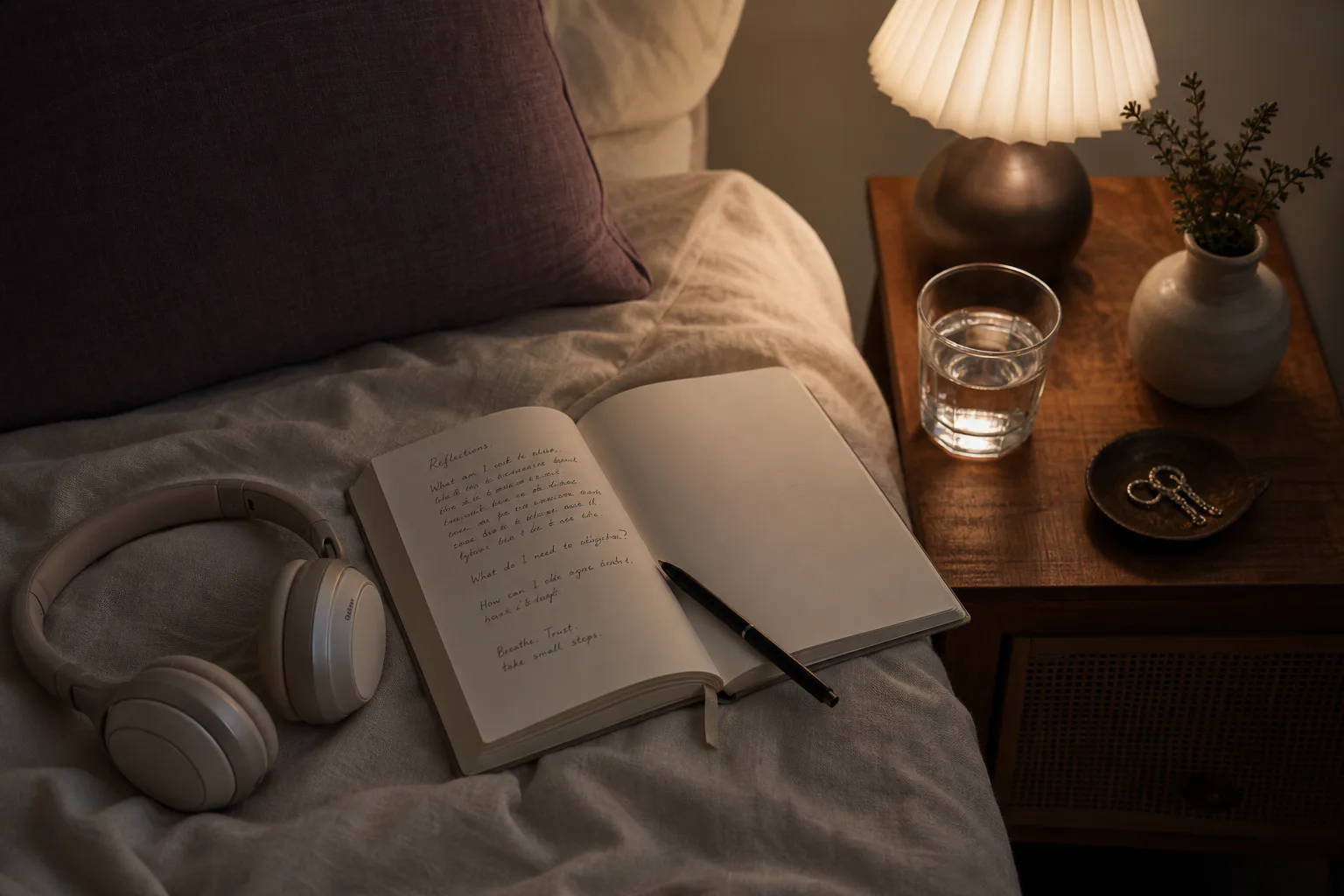
A notebook sits beside the bed. A pair of headphones waits next to it. Journaling before sleep helps you put the day down in words; future-self audio helps you hear the self you’re becoming. One clears the surface. The other repeats a remembered direction until it feels more familiar.
What does journaling before sleep actually do?
Journaling before sleep gives the mind a place to put unfinished thoughts before the body tries to rest.
The night can make small things louder. A message you didn’t answer. A bill. A sentence you said too sharply. Writing doesn’t solve all of it. It does something simpler. It gives thought a container. In sleep research, this matters because cognitive arousal is one of the common reasons people lie awake even when they’re tired. The American Academy of Sleep Medicine notes that adults need at least 7 hours of sleep per night for health, yet many people get less because the mind keeps working after the day ends.
A small study by Michael Scullin and colleagues, published in the Journal of Experimental Psychology in 2018, found that participants who wrote a specific to-do list for 5 minutes before bed fell asleep faster than those who wrote about completed tasks. The point wasn’t beauty. It was specificity. The mind relaxed more when tomorrow had been named.
That is the quiet strength of journaling before sleep. It asks for no belief. No perfect mood. No special sentence. You write what is here. You let the page hold a little of it.
There are several ways the practice can work:
- Brain dump: write every open loop for 3 to 7 minutes.
- To-do list: name tomorrow’s first 3 practical actions.
- Emotional naming: write one feeling and the event tied to it.
- Gratitude note: write 1 real thing, not 10 forced ones.
- Future sentence: write one line from the self you’re practicing becoming.
A page can be a small room. You enter, set something down, and leave.
What does future-self audio do differently?
Future-self audio works less like release and more like repetition, giving your mind a steady cue for who you’re practicing being.
In the AYA Method, the audio is not decoration. The AYA Method is a daily audio manifestation practice. Each day you listen to a short personalized recording — your Dream-Self Moment — narrated from the version of you who has already manifested the life you intend. Listening is the practice. Repetition is the work. The audio is the method.
That matters because hearing is intimate. Before you argue with an idea, you often receive the tone. A short recording can reach the tired mind more gently than another page of analysis. Dr. Andrew Huberman has often pointed to repetition and state-dependent learning in habit formation; the details differ by protocol, but the principle is simple enough to carry into night practice. What you repeat in a calm state becomes easier to return to later.
Future-self audio also reduces the number of choices. With journaling, you have to decide what to write. With audio, you press play and listen. For a tired person, that difference is not small. The National Sleep Foundation often recommends a wind-down window of about 30 to 60 minutes before sleep. In that window, fewer decisions can mean less friction.
This is where manifestation becomes less theatrical and more exact. You’re not asking the night to fix your life. You’re rehearsing the inner posture you want to know by heart. Neville Goddard called attention before sleep a fertile state for imaginal practice. You don’t have to accept every old term to notice the practical truth: the last thing you repeat often follows you.

Which practice is better for an anxious mind at night?
Journaling is usually better for active worry, while future-self audio is often better for repetitive self-doubt.
Anxious thought often arrives as a list. Not a clean list. A swarm of unfinished items. In that case, journaling before sleep can help because it turns vague threat into visible language. The 2018 to-do-list sleep study used only 5 minutes, which is important. You don’t need a long confession. You need a boundary.
But self-doubt has a different rhythm. It doesn’t always need more words from you. Sometimes more words become more courtroom. You prosecute yourself at 11:47 p.m. and call it reflection. Future-self audio can interrupt that by offering a rehearsed identity without inviting debate. A voice says, in effect: this is who you’re remembering. Listen again.
The distinction is quiet, but useful:
| Night state | Better first choice | Why it helps | Time to try |
|---|---|---|---|
| Racing tasks | Journaling before sleep | Externalizes open loops | 5 minutes |
| Heavy emotion | Journaling before sleep | Names what’s true | 7 to 12 minutes |
| Self-doubt | Future-self audio | Repeats a steadier self-image | 3 to 8 minutes |
| Decision fatigue | Future-self audio | Removes the need to generate words | 3 to 8 minutes |
| Restless hope | Either, in sequence | Clears noise, then rehearses direction | 10 to 15 minutes |
The American Psychological Association reported in its 2023 Stress in America findings that many adults described stress interfering with daily functioning. Night is when that interference can become private. So choose the practice that meets the actual pattern, not the one that looks more disciplined.
A true ritual doesn’t ask you to become impressive. It asks you to become honest.
How do the two compare for manifestation?
For manifestation, journaling clarifies desire; future-self audio helps you repeat the felt identity of the desire already lived.
Journaling gives you language. That can be necessary. Many people say they want a new life, but they haven’t named the shape of an ordinary Tuesday inside it. A journal can ask: What do I do first in the morning? Who do I answer to? What no longer gets my attention? Specificity has a long history in goal research. Edwin Locke and Gary Latham’s goal-setting theory, developed across decades, found that specific goals tend to guide behavior better than vague intentions.
Future-self audio does a different part of the work. It takes the clarified desire and lets you hear it as already familiar. That’s why affirmations can help when they’re precise and believable enough to repeat. But broad positive statements can backfire for some people. A 2009 Psychological Science paper by Joanne Wood and colleagues found that very positive self-statements made some people with low self-esteem feel worse. The wording has to meet the person honestly.
This is why audio needs care. If the Dream-Self Moment sounds too far from you, the body may reject it. If it sounds close enough to recognize, it becomes a bridge. Not a demand. A bridge.
You can compare them this way:
- Journaling asks, “What is true right now?”
- Future-self audio asks, “What truth am I practicing until it becomes natural?”
- Journaling reveals the pattern.
- Audio repeats the new pattern.
- Journaling can change every night.
- Audio often works because it stays the same long enough to be known.
If you track the moon, timing, or symbolic meaning, astrology and manifestation may give you another layer of reflection. Still, the night practice itself should remain small. Write. Listen. Sleep.
When should you choose journaling before sleep?
Choose journaling before sleep when your mind needs to empty, organize, confess, or decide what can wait.
There are nights when audio feels too smooth for the roughness of what happened. You need the scratch of a pen. You need to write, “I’m angry,” or “I don’t know what to do,” or “Tomorrow I will call at 10.” That is not a lesser practice. It is contact. James Pennebaker’s expressive writing research often used 15 to 20 minutes of writing across several sessions, and later studies have shown mixed but meaningful benefits depending on the person and context. The honest part is this: writing can help, but it isn’t magic.
Use journaling when the day still has hooks in you. Especially when the hooks are practical. If you have 9 things to remember, don’t ask your nervous system to hold them kindly all night. Put them somewhere. Paper is old technology, but it still works without a battery.
A simple structure can keep the page from becoming a spiral:
- One line for the body: “My body feels…”
- Three lines for the day: what happened, what hurt, what helped.
- Three tasks for tomorrow: no more than 3.
- One closing sentence: “For tonight, this is enough.”
Pew Research Center reported in 2024 that about 90% of U.S. adults own a smartphone. That means many bedside rituals now compete with messages, feeds, and blue light. A paper journal can create a cleaner edge. No tabs. No alerts. No hidden door into everyone else’s life.
The page doesn’t need to be wise. It needs to be willing.
When should you choose future-self audio instead?
Choose future-self audio when you’re too tired to write or when you need to hear the same loving direction again.
Some nights, writing asks too much. You pick up the pen and feel the weight of explaining yourself. This is where audio can be merciful. A short future-self recording lets the practice come toward you. You lie still. You listen. The work is repetition, not invention.
Audio may also help when your evening pattern is self-erasure. You spend the day responding to other people. By night, you can barely hear your own wanting. Future-self audio gives that wanting a voice before sleep. Not loud. Not grand. Specific. The Dream-Self Moment is personal enough to feel like yours, which separates it from generic motivation clips or someone else’s script.
There is also a memory reason. Research on auditory learning shows that repeated sound cues can become associated with states and tasks over time; clinical uses vary, and sleep learning claims are often overstated. So keep the claim grounded. Future-self audio doesn’t reprogram you while you’re unconscious. It gives your waking mind a repeated cue before rest. That is already enough.
If you use an evening manifestation routine, place the audio near the end. Do the practical clearing first. Then listen when the room is quiet and the body has fewer demands. The app may also include a daily affirmation and a Manifestation Board, but those are complements. The audio is the method.
Future-self audio is most useful when:
- you’re too tired to generate new words;
- you’ve already journaled and don’t need more analysis;
- you’re practicing one clear identity shift for at least 7 to 30 days;
- you want the final cue of the night to be steady and familiar.
A voice repeated gently can become a room you know how to enter.
Can you combine them without making bedtime too complicated?
Yes, but the combined ritual should stay short enough that you’ll still do it on an ordinary night.
The common mistake is turning rest into a project. You add journaling, breathwork, stretching, tea, skin care, tracking, reading, and then wonder why sleep feels like an appointment. Behavioral sleep medicine often favors consistency over intensity. A practice you can repeat 5 nights a week is usually more useful than a beautiful ritual you abandon after 2.
Try a 12-minute version. Set a timer. For the first 5 minutes, write the open loops: tasks, feelings, one thing you don’t want to carry into bed. For the next 5 minutes, listen to your future-self audio. Use the last 2 minutes for lights, water, and stillness. If you need more than 12 minutes, that’s fine. But don’t let the ritual become another place where you fail yourself.
You can also alternate. Journal on nights with practical noise. Listen on nights with identity noise. Do both on Sundays or before a hard week. A 2020 review in the Journal of Behavioral Medicine noted that self-monitoring and structured reflection can support behavior change, but only when the method fits the person’s life. Fit matters.
Here is the simplest decision rule:
| Ask yourself | If yes | If no |
|---|---|---|
| Do I have tasks circling? | Write them down | Don’t force a list |
| Am I emotionally full? | Journal for 7 minutes | Keep it brief |
| Am I attacking myself? | Listen to future-self audio | Write only if kind |
| Am I sleepy already? | Choose audio | Keep the lights low |
For a wider base, read the Manifestation pillar and then keep the night practice plain. Knowledge can guide you. Repetition is what makes it yours.
The page can close; the voice can stay.