evening rituals
Evening Manifestation Ritual for Overthinkers
A quiet evening manifestation ritual for overthinkers: stop replaying the day, listen to your Dream-Self Moment, and sleep with less strain.

The kettle clicks off. You do not need another page of thoughts. An evening manifestation ritual for overthinkers works best when it gives the mind less to produce and more to hear: a dim room, one short audio, one quiet return to the self you’re practicing becoming.
Why does an overthinker need an evening manifestation ritual that listens first?
An overthinker needs a listening-first ritual because bedtime is already full of language.
By evening, the mind has rehearsed the same three sentences too many times. The meeting. The message. The thing you said with the wrong tone. Rumination is not reflection. Susan Nolen-Hoeksema’s work on ruminative response styles, published across the 1990s and 2000s, linked repetitive negative thinking with longer and more severe low mood. The problem is not that you think. The problem is that the thinking has no ending.
Journaling can help many people. James Pennebaker’s expressive writing research often used 15 to 20 minutes of writing across 3 or 4 days, and studies have found modest benefits for stress and health markers. But timing matters. If your notebook becomes a courtroom at 10:47 p.m., it may not be the right tool for that hour. A pen can become a second brain that refuses to sleep.
Listening changes the shape of the ritual. It moves you from generating language to receiving it. The mind still wanders, because minds do that. In a 2010 Science study, Killingsworth and Gilbert reported that people were mind-wandering 46.9% of the time. The point is not perfect focus. The point is returning without making a scene.
A quiet ritual does not silence the mind. It teaches the mind where to come home.
This is why the AYA Method begins with audio. The AYA Method is a daily audio manifestation practice. Each day you listen to a short personalized recording — your Dream-Self Moment — narrated from the version of you who has already manifested the life you intend. Listening is the practice. Repetition is the work. The audio is the method.
What should you do before pressing play?
You should make the room easier for your nervous system to believe.
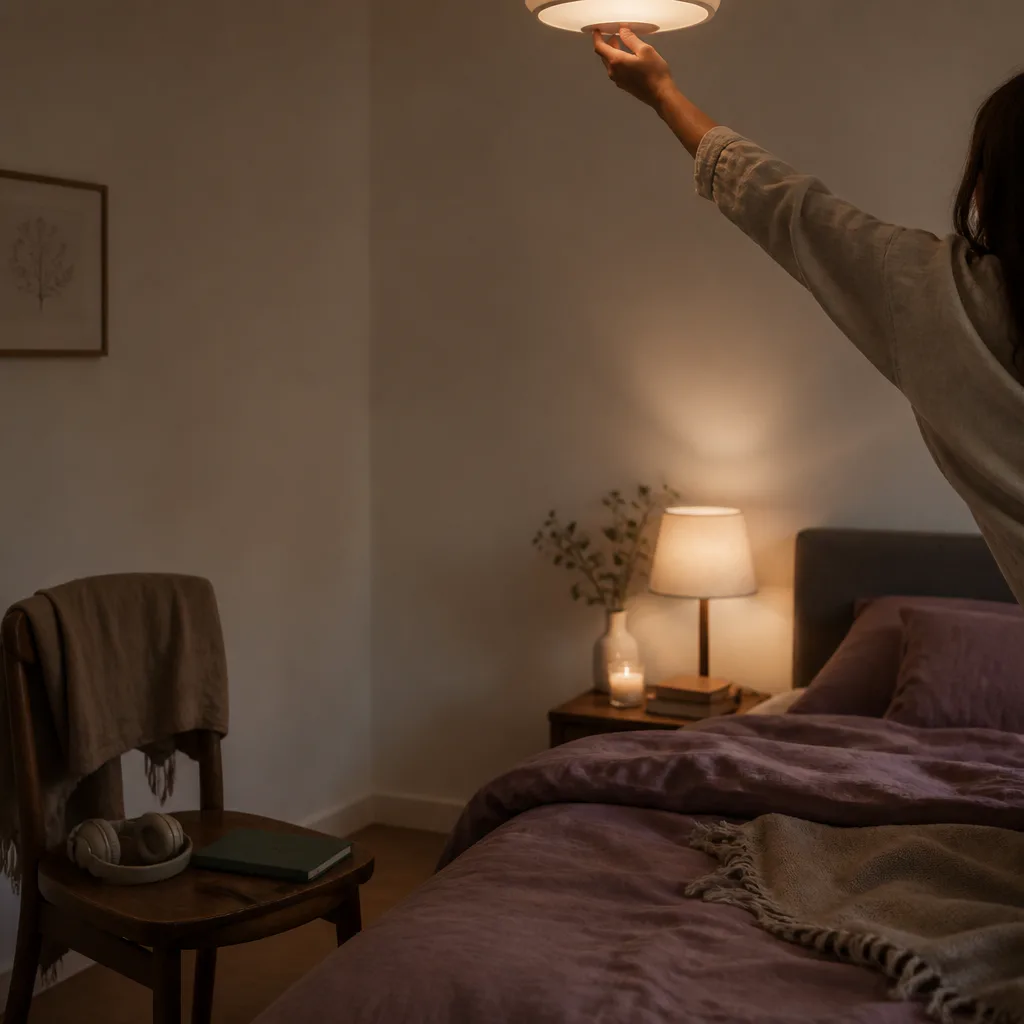
Do not build a ceremony so elaborate that you start judging yourself for doing it wrong. I like one lamp, one cup of tea, one place to sit or lie down. In my greenhouse, I tell people to treat evening like steeping leaves: too much heat, and the plant turns bitter. The American Academy of Sleep Medicine recommends at least 7 hours of sleep for most adults, so the ritual must not become a thief. Twelve minutes is enough.
Start with the senses. The room teaches before the words arrive. Lower the light. Put the phone on Do Not Disturb if you can. A 2022 Sleep Foundation survey reported that many adults use screens close to bed; other sleep research consistently links bright light at night with later sleep timing. You do not have to become strict. You only need fewer signals asking you to stay alert.
Use this small order:
- Put water on, or take one sip if tea is already near you.
- Turn off the brightest light.
- Place your notebook out of reach.
- Sit where your back is supported.
- Take 3 slow breaths, longer on the exhale.
- Press play once.
The number 3 matters only because it is easy to remember. Dr. Andrew Huberman often discusses the role of longer exhales in downshifting arousal; the mechanism is not magic, just physiology. Breathing slower tells the body that nothing needs to be solved this second.
Here is the quiet rule: prepare enough to listen, not enough to perform.
How do you practice the evening manifestation ritual step by step?
You practice it by giving the mind one track to follow and refusing every extra assignment.
This is the 12-minute version I use when the day has been noisy. It is also the version I give to people who tell me they cannot journal without spiraling. The practice is simple by design. In behavior science, simplicity matters. B. J. Fogg’s Tiny Habits model argues that small behaviors attach more easily to existing routines; the same idea shows up in implementation intention research from Peter Gollwitzer, where a clear if-then plan improves follow-through.
| Minute | What you do | Why it helps |
|---|---|---|
| 0–1 | Dim the room and set the phone down | Fewer cues, less checking |
| 1–2 | Breathe slowly and feel the bed or chair | The body gets a beginning |
| 2–9 | Listen to your Dream-Self Moment | The mind receives a future-self script |
| 9–10 | Let the last sentence land | No immediate analysis |
| 10–11 | Say one affirmation if it feels true | A single verbal anchor |
| 11–12 | Turn toward sleep | The ritual ends cleanly |
If you’re new to manifestation, think of it here as attention practice plus identity rehearsal. You are not forcing life to obey you. You are training perception, choice, and self-recognition. Athletes have used mental rehearsal for decades; a 2012 review in Frontiers in Human Neuroscience described motor imagery as activating some of the same neural systems involved in movement. Evening audio uses a softer version of that truth. You hear yourself before you have fully become her.
The affirmation, if you use one, should be quiet enough to pass the body’s honesty test. The affirmations that hold at night are rarely grand. Try: I can leave this here. Or: I already know the next small step. Say it once. More is not always deeper. Sometimes more is just more noise.
The ritual is not a way to control tomorrow. It is a way to stop abandoning yourself tonight.
Why not journal when your thoughts feel loud?
You do not have to journal at night if writing turns thought into more thought.
There is no moral hierarchy here. A notebook is a good tool when it helps you see. It is not a good tool when it asks you to prosecute yourself. In clinical writing studies, the timing, topic, and container matter. Pennebaker’s expressive writing instructions usually have limits: a set topic, a set duration, and a small number of sessions. Overthinkers often remove the limits. They write until the nervous system is wide awake.
The brain loves open loops. The Zeigarnik effect, first described in the 1920s, names the tendency to remember unfinished tasks more than finished ones. A bedtime journal can accidentally create 9 new unfinished tasks: apologize, decide, answer, plan, research, compare, confess, fix, prove. None of these belong under the pillow.
Listening gives you a closed container. The recording begins. The recording ends. You do not need to generate a thesis about the day. You do not need to find the lesson before sleeping. This is especially useful if your thinking has a compulsive feel. Research on worry often distinguishes problem-solving from repetitive concern; the first moves, the second circles.
Use this test:
- If writing makes your breath slower, write.
- If writing makes your jaw tighter, listen.
- If writing leads to one next step, write it down in 1 sentence.
- If writing leads to 30 next steps, close the book.
- If you’re tired enough to be unkind to yourself, do not take dictation from that mind.
You can still keep a morning notebook. You can still make a practical list earlier in the evening. But the last practice before sleep should not require you to become your own analyst. For some nights, the kinder ritual is to be spoken to by the self who remembers what is true.
What should the audio say to help you believe it?
The audio should speak from the life you’re practicing as if it is already familiar, specific, and steady.
Specificity calms suspicion. The mind resists vague sentences because they sound like decoration. It can receive small real images: your hand on the kitchen counter, your calendar with white space, your voice answering slowly, your body not bracing before a message. Neville Goddard called this living from the end; in quieter terms, it means rehearsing the felt reality of the self you intend before the outer details have fully caught up.
Joe Dispenza often writes about mentally rehearsing a new state before the day begins. I prefer the evening version for overthinkers because it asks less. You are not trying to become bright and productive at night. You are letting the nervous system hear a finished sentence. A 2018 review in Nature Reviews Neuroscience noted that sleep supports memory consolidation; what you place near sleep is not trivial.
Good evening manifestation audio has 4 qualities:
- It is short enough that you will actually repeat it.
- It uses your real desires, not borrowed ones.
- It speaks in completed identity, not frantic wishing.
- It leaves space for the body to soften.
The Manifestation pillar goes wider, but tonight’s version is narrow on purpose. One recording. One future-self scene. One return. If you use timing, lunar cycles, or symbolic dates, keep them gentle. Astrology and manifestation can give some people a beautiful container, but the practice still has to happen in your body, in your room, on an ordinary Tuesday.
Belief often begins as recognition, not certainty.

What if you keep thinking while the recording plays?
You keep listening anyway, because returning is the practice.
The mind will leave. It will remember laundry, taxes, the shape of someone’s face when they misunderstood you. That does not mean the ritual failed. In mindfulness research, attention training is often measured by noticing and returning, not by never drifting. A 2014 meta-analysis in JAMA Internal Medicine found moderate evidence that mindfulness meditation can improve anxiety, depression, and pain, though effects vary. The useful part for tonight is humble: notice, return, repeat.
Do not scold the mind. Scolding is more thinking wearing a stern coat. Instead, choose a physical cue. Thumb to fingertip. Hand on chest. Tongue resting low in the mouth. The cue should be small enough that you can do it half-asleep. Each time you notice you have left the audio, touch the cue and listen for the next word.
If the thought is genuinely important, use a 1-line parking note before the ritual begins. Not a journal entry. Not a paragraph. One line on paper: Call Mara tomorrow. Then the paper closes. Cognitive offloading research suggests that writing a task down can reduce the load of keeping it in mind; the key is to offload, not expand.
You can also let the recording play twice, but only if repetition feels soft. Do not turn it into punishment. In the AYA Method, repetition is the work because the nervous system learns through safe return. The daily affirmation and Manifestation Board can support the practice, but the audio remains the center. Listening is not passive. It is consent to be taught by the self you’re becoming.
Here is the sentence I use when the mind wanders: I heard enough to return.
How do you know the ritual is working?
You know it is working when your evenings become less argumentative, not when every thought disappears.
Look for small signs over 7 nights. Sleep researchers often recommend tracking sleep patterns for at least 1 to 2 weeks before drawing conclusions, because one night can be misleading. The same patience belongs here. Do not ask whether the ritual changed your life by Thursday. Ask whether you fought yourself 5% less. Ask whether you reached for the notebook less often. Ask whether the room felt kinder.
A useful ritual makes itself repeatable. If you avoid it, it may be too long, too dramatic, or too demanding. Cut it in half. Use a shorter recording. Remove the candle if the candle has become another thing to manage. The body trusts what it can survive doing again.
Track only 3 things if you need evidence:
- Did I listen tonight? Yes or no.
- Did I journal after listening? Yes or no.
- Did I fall asleep with less argument in me? 0 to 5.
That is enough data. In habit research, consistency often beats intensity because it creates identity evidence. You become the kind of person who returns at night. Not perfectly. Regularly. The AYA app’s daily audio supports that kind of repetition; the extras are there to hold the edges, not to replace the listening.
If you want a full map of the practice, keep the AYA Method close. If you want a wider primer, read the Manifestation pillar. If your words need tending, the Affirmations pillar can help you choose sentences that do not bruise the body. And if timing comforts you, the piece on astrology and manifestation may give the night a softer frame.
Put the pen down. Listen.