money manifestation
Abundance Mindset Shift Before Asking for Money
A quiet abundance mindset shift to make before asking for more money, with a 10-minute practice for steadier words, body, and timing.

A cup cools beside the notebook. An abundance mindset shift before asking for more money means you stop asking from apology and start asking from fair exchange. You prepare your number, steady your body, and speak as someone whose needs are allowed to have edges.
What needs to change before you ask for more money?
The shift is from “Will they still approve of me?” to “Is this exchange true?”
Money asks often feel like character tests. They are not. They are conversations about value, timing, scope, and need. In a 2023 Pew Research Center report, 60% of U.S. workers said they had not asked for higher pay in their current job. Many were not waiting because the math was unclear. They were waiting because the body had learned that asking is dangerous.
Before you ask, you need to notice the sentence underneath the ask. It may be, “I should be grateful.” It may be, “They’ll think I’m difficult.” It may be, “If I were better, they’d offer first.” That sentence will shape your tone more than your script. A quiet abundance mindset shift begins when you stop letting the oldest sentence choose the newest number.
This is not about pretending there is always more money available. Sometimes the answer is no. Sometimes the budget is real. Sometimes a client is not your client. The shift is smaller and more useful: you do not make yourself smaller to protect someone else from discomfort. The Journal of Behavioral Medicine has published repeated findings linking stress regulation practices with improved coping and decision-making; even when the outer facts do not change, the nervous system can change the way you meet them.
Here is the first practice. Write the ask as one plain sentence. No decoration.
- “I’m asking for a salary of $82,000.”
- “My project fee for this scope is $4,500.”
- “I’d like to raise my monthly retainer to $1,200.”
Then sit with the sentence for 60 seconds. Do not improve it. Do not defend it. Just see what rises. The first truth is often physical: throat tight, shoulders lifted, stomach braced. The ask begins there, not in the calendar invite.
A clean ask is not a demand. It is a sentence that has stopped hiding.
Why does the body matter in a money conversation?
Your body matters because it decides whether your prepared words come out as truth, apology, or speed.
A money ask is not only a thought. It is breath, jaw, pulse, and pace. Dr. Andrew Huberman has often discussed the relationship between respiration and arousal, including the way longer exhales can help downshift the nervous system. Clinical breathing studies vary in size, but many use 5 minutes of slow breathing and show measurable changes in heart rate variability, a marker associated with regulation.
When you ask for more money with a braced body, you may over-explain. You may discount before the other person answers. You may fill silence with cheaper terms. This is why the abundance mindset shift is not only mental. It is somatic. You are teaching your body that a number can be spoken without immediate repair.
Try this before you write the email or enter the meeting:
- Put both feet on the floor.
- Inhale for 4 counts.
- Exhale for 6 counts.
- Repeat for 10 rounds.
- Say the number once, softly.
Ten rounds take about 2 minutes. That is not a full ritual. It is a doorway. In small studies on brief mindfulness, participants often report lower perceived stress after sessions under 15 minutes. You are not trying to become fearless. You are trying to become available to yourself.
The old habit says, “Ask quickly so it hurts less.” The new habit says, “Ask slowly so you can stay.” This matters in salary talks, client proposals, family money, and debt conversations. The category changes. The body pattern often stays the same.
I learned this from plants before I learned it from any book. Bitter tea asks you to slow down. You cannot gulp it without knowing. Money can be like that. It shows where the mouth wants to rush past truth.

How do you use audio to rehearse a different money identity?
Audio helps because you hear the future sentence before you need to speak it in public.
The AYA Method is a daily audio manifestation practice. Each day you listen to a short personalized recording — your Dream-Self Moment — narrated from the version of you who has already manifested the life you intend. Listening is the practice. Repetition is the work. The audio is the method.
For a money ask, the Dream-Self Moment is not a fantasy of being rescued. It is a rehearsal of being clean. You hear yourself after the ask has happened. Not frantic. Not proving. Already home in your own voice. Neville Goddard wrote often about assuming the feeling of the wish fulfilled; in this practice, the assumption is made audible and repeated daily.
Repetition matters. A 2009 study in the European Journal of Social Psychology found that habit formation took 66 days on average, with wide variation from 18 to 254 days depending on the behavior and person. You do not need 66 days before asking for a raise, but the number is a useful mercy. One listen can soothe. Repeated listening can make a new sentence feel less foreign.
Use audio in this order:
- Listen once without multitasking.
- Notice the line that makes your chest soften.
- Write that line by hand.
- Say your money ask after the audio ends.
- Stop before you start defending.
The app also includes a daily affirmation and a Manifestation Board, but they are complements. The audio is the method. If you only have 6 minutes, listen. If you have 10, listen and then write the ask. If you have 15, listen, write, and say it out loud.
You can read more about the wider practice at the Manifestation pillar, but keep this part simple. Before you ask for more money, hear the version of you who has already stopped abandoning herself.
What should you write before you ask?
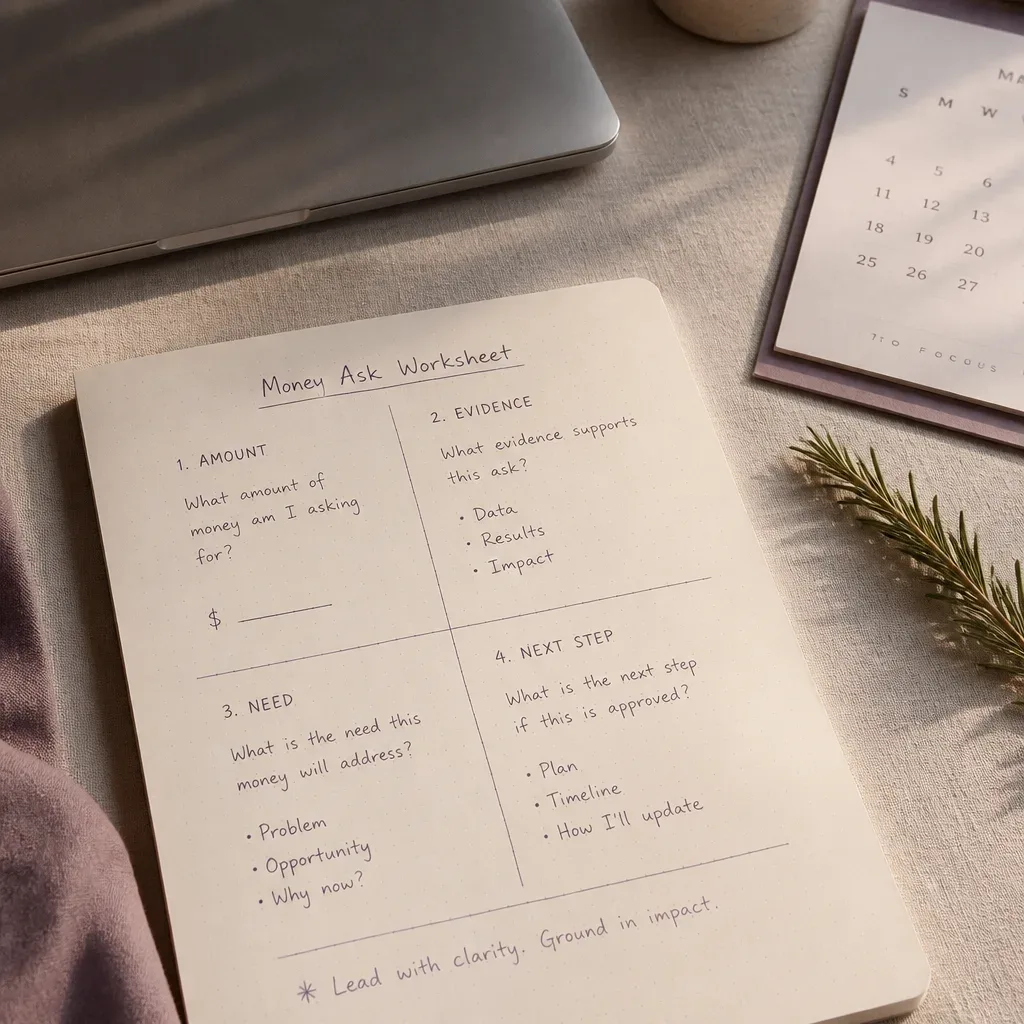
Write the true exchange: the number, the evidence, the need, and the clean next step.
A money ask becomes foggy when it tries to carry every feeling at once. The page can hold what the meeting cannot. Before you speak, make 4 small boxes on paper. In each box, write no more than 3 lines. This keeps the practice honest. A 2021 American Psychological Association survey reported that money is a significant source of stress for many adults; when stress is high, working memory can narrow. The page becomes a second set of hands.
| Box | What to write | Example |
|---|---|---|
| The ask | The exact amount or range | “$78,000 to $82,000” |
| The evidence | 2 or 3 facts | “I manage 14 accounts and increased renewals by 18%.” |
| The need | The honest reason, without confession | “This reflects the current scope.” |
| The next step | What you want after the ask | “Can we review this by Friday?” |
Notice the difference between evidence and apology. Evidence is clean. Apology tries to soften the other person’s discomfort by making you smaller. If you are negotiating salary, evidence might include market data from 3 comparable roles. If you are raising client fees, evidence might include deliverables, hours, outcomes, and the date of your last rate change.
For a fuller look at language patterns, the Affirmations pillar is useful, especially if your inner sentence tends to be harsh. An affirmation is not there to decorate the ask. It is there to interrupt the reflex that says, “I’m too much.”
Here are 3 sentences worth practicing:
- “This number reflects the scope of the work.”
- “I’m open to discussing structure, but the fee itself is firm.”
- “I’d like to be paid in a way that matches the responsibility I’m carrying.”
A fair number does not become unfair because your voice shakes.
How do you know whether your ask is grounded or avoidant?
A grounded ask includes evidence and a next step; an avoidant ask hides inside hints, resentment, or magical waiting.
There is a tender confusion in money manifestation. Sometimes you call it trust when it is actually avoidance. You light the candle, make the board, listen to the audio, and still do not send the email. Ritual can become a beautiful hiding place if it never leads to a true sentence.
This is why I like a plain test. After your practice, ask: “What is the next visible action?” If the answer is “research 5 salary comparisons,” do that. If the answer is “send the proposal,” do that. If the answer is “ask my partner to choose a time to talk,” do that. In behavioral science, implementation intentions, often phrased as “if-then” plans, have shown reliable effects across many studies. Peter Gollwitzer’s work on implementation intentions is often cited for this reason: a specific cue paired with an action helps behavior happen.
A grounded ask sounds like:
- “If my manager asks for a number, I’ll say $82,000.”
- “If the client says it is too high, I’ll ask which part of the scope they want to remove.”
- “If I start over-explaining, I’ll take one breath and return to the sentence.”
An avoidant ask sounds like:
- “They should just know.”
- “I’ll wait until I feel completely ready.”
- “If it’s meant for me, I won’t have to ask.”
Read that last one carefully. Sometimes life does meet you gently. Still, many money doors require a knock. Astrology and manifestation can help you reflect on timing and personal patterns, but timing is not a substitute for participation. A moon phase cannot name your fee for you.
What 10-minute practice should you do before asking?
Do a 10-minute practice that settles the body, rehearses the identity, and ends with one visible action.
Set a timer. Ten minutes is long enough to change state and short enough that you cannot make it precious. Many brief intervention studies use practices between 5 and 10 minutes because people will actually do them. Consistency beats drama. A practice you repeat 7 mornings in a row will teach more than a perfect 90-minute ceremony you avoid.
The 10-minute abundance mindset shift practice
- Minute 0 to 1: Name the ask. Write one sentence: “I’m asking for…” Include the number.
- Minute 1 to 3: Breathe down. Inhale for 4, exhale for 6. Keep your jaw soft.
- Minute 3 to 6: Listen. Play your Dream-Self Moment in the AYA Method. Let the audio carry the version of you who has already asked.
- Minute 6 to 8: Write the exchange. Add 2 facts that support the ask and 1 next step.
- Minute 8 to 9: Speak the number. Say it once without explanation.
- Minute 9 to 10: Choose the action. Send, schedule, research, or rehearse. Pick one.
This is how the daily affirmation can help, as a complement. Choose one line for the day, not 12. “I can ask without apologizing for having a need.” Say it after the audio, then return to the action. The Manifestation Board can hold the image of the signed contract, the paid invoice, the calmer bank account. Let it support your seeing. Do not let it replace your speaking.
Joe Dispenza often speaks about rehearsing a future self until the body begins to know it. You do not have to take every claim from every teacher as fact to use one useful principle: rehearsal changes familiarity. What is familiar is easier to choose under pressure.
The ask is not made by the loudest part of you. It is made by the part that can stay.
What do you do if the answer is no?
If the answer is no, stay with the exchange, ask for information, and decide what remains true.
A no is data. It may mean the budget is fixed. It may mean the timing is wrong. It may mean the other person values the work differently than you do. It does not automatically mean you asked badly. In negotiation research, one common recommendation is to prepare alternatives before the conversation; the Harvard Negotiation Project popularized the idea of BATNA, the best alternative to a negotiated agreement. Even a simple version helps: know your next move before the room gets tense.
Prepare 3 responses before you ask:
- “Can you tell me what would need to be true for this number to be possible?”
- “If the budget can’t move, which parts of the scope can we reduce?”
- “When can we revisit this, and what criteria will be used?”
These sentences protect you from collapse. They keep the conversation in reality. They also show whether there is a path forward or only a polite wall. A 2022 Pew report on job changes found that many workers who changed jobs saw pay increases, while those who stayed did not always see the same growth. Sometimes the next step is not more persuasion. Sometimes it is a different room.
After a no, do not rush to make the ask smaller inside your own mind. Return to the page. What evidence is still true? What number is still fair? What did you learn? The abundance mindset shift continues here. It says, “I can receive information without using it as proof against myself.”
If you need a wider frame for money and self-concept, return to the Manifestation pillar and notice what is asked of you there: repetition, attention, and lived action. Not performance. Not pretending.
Ask softly. Ask clearly. Stay near yourself.