money manifestation
Money Affirmations for Debt Anxiety Before Bills
Money affirmations for debt can steady your body before bills, helping you read numbers clearly, breathe slower, and choose the next small action.

The bill sits unopened beside your tea. Money affirmations for debt help most when you listen before you look at the numbers, not after panic has taken over. The point isn’t to deny debt. It’s to steady your body, name the truth, and choose one clean next step.
Why listen before you open the bill?
Listening first gives your nervous system a softer doorway into the facts.
Debt anxiety is rarely only about math. It’s often a body state. Your jaw tightens. Your chest lifts. Your eyes skip over numbers too quickly. The American Psychological Association reported in 2023 that 63% of U.S. adults named money as a significant source of stress. That number matters because stress changes how you read, choose, and remember.
When the body reads a bill as threat, it can move into fight, flight, freeze, or fawn. You might overpay in a rush and miss rent. You might ignore the email for 12 days. You might promise yourself a full budget reset, then avoid the bank app by dinner. A bill is a piece of paper. Your body may not know that yet.
A short listening practice creates a threshold. Before the screen. Before the envelope. Before the story. This is where money manifestation becomes practical. Not glitter. Not pretending. Just rehearsing the inner state from which you can act with less fear.
One useful sentence is this: Calm doesn’t pay the bill, but panic often makes the bill harder to pay.
Try treating the audio as a hand on the door. You don’t need 30 minutes. In many breath and relaxation studies, even 5 minutes can shift perceived stress. Dr. Andrew Huberman often points to longer exhales as a fast way to reduce arousal through the autonomic nervous system. Your affirmation can ride on that same body logic: slow first, numbers second.
How do money affirmations for debt work without lying?
They work when they name safety, agency, and the next honest action instead of making false claims.
Some affirmations fail because the body refuses them. If your credit card balance says 4,812 dollars, the phrase I am debt-free may not feel like medicine. It can feel like noise. The mind hears the sentence. The body hears the contradiction. Sherman and Cohen’s 2006 review of self-affirmation theory is clear on one point: affirmation is not fantasy. It helps when it restores a wider sense of self under threat.
So debt affirmations need to be true enough to enter. They can point toward the future, but they have to keep one foot in the room. The best lines are small. They speak to capacity.
Use language like:
- I can look at one number and stay here.
- I don’t have to solve every bill tonight.
- I can choose the next right payment.
- My worth is not the balance.
- I can ask for help without disappearing.
There is a quiet difference between denial and rehearsal. Denial says, Nothing is wrong. Rehearsal says, I can meet what is here. In a 2013 PLOS ONE study, Creswell and colleagues found that self-affirmation improved problem-solving under stress among participants with chronic stress. The exact setting wasn’t debt, but the pattern is useful: when threat softens, thinking can return.
If you use affirmations, keep them embodied. Say them at the speed of a person who believes they have time. Put one hand on the lower ribs. Let the exhale be longer than the inhale for 6 rounds. The sentence is not a spell. It is a cue.
A good debt affirmation doesn’t argue with reality. It makes reality bearable enough to touch.

What should you say before bills arrive?
Say words that lower shame, make the next step visible, and keep the debt separate from your identity.
Before you choose words, notice your most common debt response. There are usually patterns. Some people freeze. Some perform control. Some over-research. Some hide. According to the Federal Reserve Bank of New York, total U.S. household debt reached 17.69 trillion dollars in the first quarter of 2024. You are not strange for feeling the pressure. You are one body inside a very large money system.
Here is a simple way to choose your line:
| If your body does this | Try this affirmation | Then do this |
|---|---|---|
| Freezes before opening mail | I can open one thing slowly. | Open one bill only. |
| Rushes to fix everything | I don’t have to solve the whole month today. | Set a 10-minute timer. |
| Feels shame | My balance is information, not identity. | Write the number without adjectives. |
| Avoids calls | I can ask one clear question. | Call or message one creditor. |
| Spirals at night | I can pause until morning and return. | Put the bill in one visible place. |
A debt affirmation should sound like someone kind sitting beside you. Not a coach shouting across the room. Not a perfect future self scolding you for being human. If you like astrology, you can use timing as a soft ritual too, but keep it grounded. Astrology and manifestation can offer a symbolic container. It should not decide whether you pay the electric bill.
Try this 5-line script before bills:
- I am here with the truth.
- This number is information.
- I can breathe before I choose.
- I can take one small honest action.
- I am allowed to keep going.
Specificity helps. A 2021 FINRA report found that only 24% of Americans could answer 4 out of 5 basic financial literacy questions correctly. Many people were never taught how to read money without fear. Your affirmation can become the bridge between not knowing and learning.
How do you do the 7-minute listening practice?
You make the practice small enough to repeat on a hard day.
Seven minutes is long enough to shift state and short enough that avoidance has less room to negotiate. You can do this before a credit card statement, student loan notice, medical bill, tax letter, rent reminder, or debt collection email. The Consumer Financial Protection Bureau has reported that medical collections have affected millions of credit reports in recent years. If a bill makes your body go cold, that response has history.
Here is the practice:
- Minute 1: Put the bill nearby. Don’t open it yet. Let the body register that the bill is present and you are still safe.
- Minutes 2 to 4: Listen. Play your money affirmation or audio practice. Sit or stand. Keep both feet touching the floor.
- Minute 5: Open one thing. One envelope. One app. One email. No switching tabs.
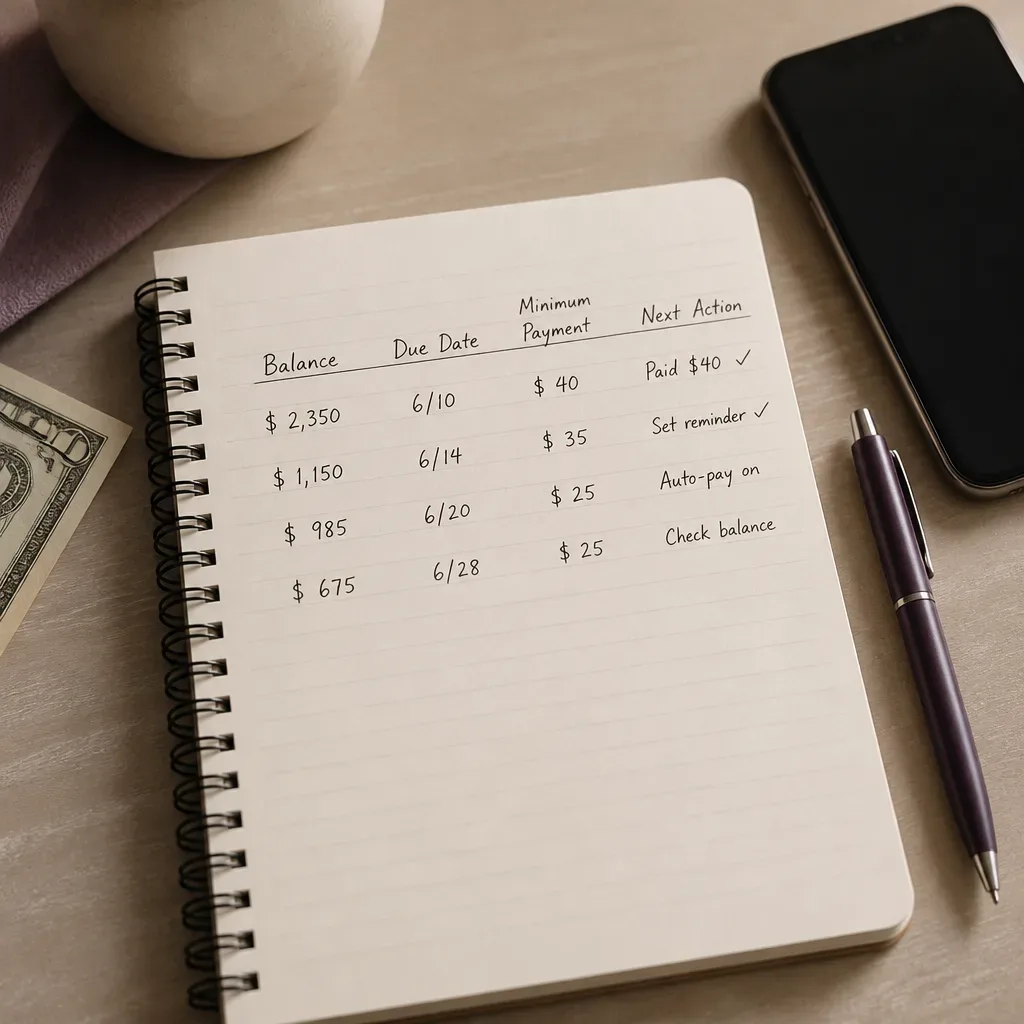
- Minute 6: Write four facts. Balance, due date, minimum payment, next possible action.
- Minute 7: Take one action or schedule it. Pay, call, message, calendar, or close with a chosen return time.
This is not a full financial plan. It is a regulated entry point. If you need debt counseling, legal advice, or a hardship plan, those are real supports. The National Foundation for Credit Counseling and nonprofit agencies can help with structured repayment questions. Affirmation prepares you to reach for that help without collapsing.
The closing line matters. Say: I touched the number and I stayed. That sentence is somatic evidence. In my own teaching rooms, I often remind people that the body believes repetition more than explanation. Once can feel accidental. Seven days begins to feel like a path you can find again.
The smallest paid bill is not small to the nervous system. It is proof of return.
Where does the AYA Method fit into debt anxiety?
The AYA Method fits as the daily audio practice you listen to before you ask your body to face money.
The AYA Method is a daily audio manifestation practice. Each day you listen to a short personalized recording — your Dream-Self Moment — narrated from the version of you who has already manifested the life you intend. Listening is the practice. Repetition is the work. The audio is the method.
For debt anxiety, the Dream-Self Moment can become a steady voice from the version of you who no longer disappears from bills. Not because every balance vanished overnight. Because you know how to open, read, decide, and return. The app also includes complements like a daily affirmation and Manifestation Board, but they support the listening. They are not the center.
This distinction matters. Audio enters differently than a written note. You can close your eyes. You can hear pacing, warmth, breath, and certainty. In small studies of guided audio relaxation, participants often report lower perceived stress after repeated listening. The mechanism may be simple: the body receives a repeated cue of safety.
If you’re building a manifestation practice, debt is a tender place to begin because it doesn’t tolerate vague language. The number is there. The due date is there. The practice has to meet it. A Dream-Self Moment might sound like: You open the statement. You breathe. You know your worth is not being decided here. You choose the next honest action.
Audio can become the room you enter before the hard room.
Use it daily if you can, and before bills when you need it. Repetition is not punishment. It is how a new response becomes familiar.
What if shame gets loud while you listen?
You don’t fight shame; you give it less authority over the next action.
Debt shame often speaks in total sentences. I ruined everything. I’m behind everyone. I should have known better. These sentences feel complete, but they are not facts. They are threat stories. Pew Research Center has reported that many households carry debt across income levels, and the New York Fed’s 2024 numbers show debt as a national pattern, not a private moral failure.
When shame gets loud, shorten the practice. Don’t try to believe 12 beautiful statements. Use one true line and one body cue. For example: This is hard, and I can stay. Then press your feet into the floor for 10 seconds. Look at one object in the room. Let your eyes move slowly. Your body needs proof of now.
You can also separate the voices:
- Shame says: You are the debt.
- Truth says: You have a debt.
- Shame says: Hide until you fix it.
- Truth says: Look at one piece.
- Shame says: You don’t deserve help.
- Truth says: Help is part of repair.
There is no virtue in being cruel to yourself before paying a bill. Cruelty drains the same attention you need for the numbers. If a creditor call scares you, write the first sentence before you dial. If the balance scares you, cover every line except the one you need. If the app scares you, set a timer for 3 minutes.
A 2018 review in Clinical Psychology Review linked self-compassion with lower anxiety and depression across many studies. Debt work often needs that softness. Not softness instead of responsibility. Softness so responsibility becomes possible.
What changes after 14 days of listening before bills?
You may not have less debt after 14 days, but you can have less avoidance.
Fourteen days is a useful container because it’s short enough to begin and long enough to reveal a pattern. Many habit studies are misquoted as 21 days, but research by Phillippa Lally and colleagues in 2009 found habit formation varied widely, with an average of 66 days. So don’t demand a new life in two weeks. Look for evidence of return.
Track only 3 things:
- Did I listen before opening the bill?
- Did I write down the real number?
- Did I take or schedule one next action?
That is enough data. You don’t need a perfect spreadsheet to build trust. You need visible contact with reality. If you miss a day, don’t dramatize it. Return the next time a bill appears. This is why the AYA Method can be useful for money work: the daily audio gives you a repeatable entrance, not a mood you have to manufacture.
After 14 days, you might notice smaller changes. You open emails sooner. You stop checking three accounts in a panic loop. You pay the minimum without calling yourself names. You ask for a payment plan. You read one article on affirmation practice and choose language that feels clean in your mouth.
You can keep the ritual plain:
- Same chair.
- Same 7 minutes.
- Same notebook.
- Same first line.
- Same closing breath.
A money practice becomes real when it survives an ordinary Tuesday.
The bill can be here, and you can be here too.