vision boards
Vision Board Checklist: Listen Before Adding Goals
A quiet vision board checklist for choosing goals that feel true, with listening prompts, image tests, and a softer way to edit your board.
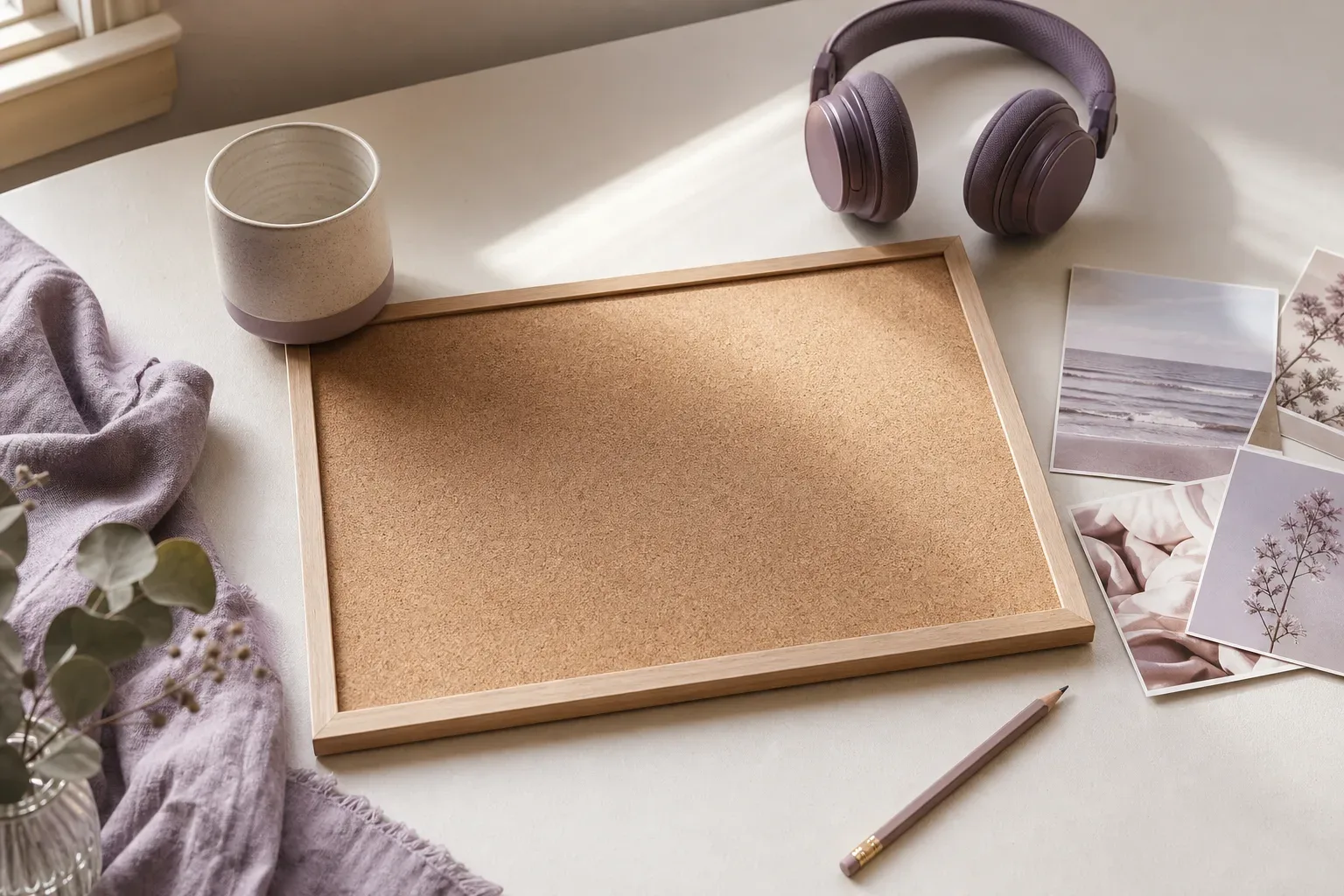
A blank board waits on the table. Your vision board checklist should slow you down before it fills up. Listen first, then add only the goals that feel specific, lived-in, and yours. The board is not proof that you want something. It is a quiet record of what you can return to.
What should a vision board checklist do before you choose images?
A vision board checklist should protect the board from becoming a place where every passing want gets a seat.
Most boards fail softly. Not because they are wrong. Because they are crowded. A 2015 Dominican University study led by Dr. Gail Matthews found that people who wrote down goals were 42 percent more likely to report achieving them than people who only thought about them. Writing helped. But writing everything down did not make everything sacred.
The first check is not aesthetic. It is attention. Before you choose a house, a body, a number, a city, or a sentence, ask whether the desire can survive five minutes of quiet. If it only exists when you are comparing, scrolling, or trying to be seen, leave it beside the board for now.
This is where the AYA Method enters without noise: The AYA Method is a daily audio manifestation practice. Each day you listen to a short personalized recording — your Dream-Self Moment — narrated from the version of you who has already manifested the life you intend. Listening is the practice. Repetition is the work. The audio is the method.
A vision board is not the engine. It is the surface where a listened-to life becomes visible. The app also includes a Manifestation Board, but it is a complement. The audio remains the method.
| Checklist question | If yes | If no |
|---|---|---|
| Can I say this goal in one sentence? | Add a clear image. | Clarify before adding. |
| Do I feel calmer when I imagine living it? | Keep listening. | Wait 24 hours. |
| Is there one action attached? | Make it visible. | Add the action first. |
| Is it mine, not borrowed? | Let it stay. | Remove it gently. |
A board gets stronger when it has fewer things to prove.
Which goals belong on the board, and which should wait?
The goals that belong are the ones you can name, feel, and practice in ordinary time.
Use this seven-part vision board checklist before you glue, pin, print, or save anything. It is simple enough to use in 10 minutes, which matters. Research on habit formation from Phillippa Lally and colleagues at University College London found that new behaviors took 18 to 254 days to become automatic, with an average of 66 days. Your board should support repetition, not demand a new self by Friday.
- Name it plainly. Write one sentence: I am building a calmer work life. Not a paragraph. Not a performance.
- Listen for the Dream-Self Moment. After audio, ask whether the goal feels familiar in your body.
- Choose one symbol. One image per goal is often enough.
- Attach one behavior. A board without behavior becomes decoration.
- Check the source. Did this desire come from you, fear, family, or a feed?
- Give it a time window. Is this for this season, this year, or later?
- Leave room. White space is part of the checklist.
In goal-setting research, specificity keeps returning. Locke and Latham’s work across decades found that specific, challenging goals often improve performance more than vague intentions, when people are committed and have feedback. That last part matters. Feedback is the quiet correction. It tells you whether the image is helping you live differently.
Use a waiting place too. A folder. A page. A small envelope. Not every desire needs to be thrown away. Some need to ripen.

How does listening change what you put on a vision board?
Listening changes the board by moving the question from what looks good to what feels true.
When you listen before choosing images, you give the nervous system a reference point. Dr. Andrew Huberman has often discussed how dopamine is tied to motivation, anticipation, and effort, not only reward. The point for a board is small but important: if the image only gives you a quick spike, it may not help you keep walking after the spike fades.
A Dream-Self Moment can make an intention less abstract. You hear the future self describe the ordinary details. The light in the room. The way your morning moves. The tone in your voice after the decision is made. Then the board becomes less like a wish list and more like a memory you have agreed to practice.
This is also why manifestation is quieter than force. It is not asking you to pretend. It is asking you to repeat contact with a chosen reality until your attention, choices, and self-image begin to move in the same direction. In mental contrasting research, psychologist Gabriele Oettingen found that pairing a desired future with present obstacles can improve follow-through more than fantasy alone.
After listening, ask:
- What detail from the audio stayed with me?
- Which image would remind me of that detail?
- What image now feels too loud?
- What goal became smaller, clearer, or more honest?
- What can I do this week that belongs to this future?
The right image does not shout. It recognizes you.
What are the signs your vision board has become too noisy?
Your board is too noisy when it makes you feel behind instead of returned.
Noise has tells. You avoid looking at the board. You keep adding images but do not take action. You feel a small collapse in your chest when you see it. You have ten life directions competing for one afternoon. Pew Research Center reported in 2024 that 31 percent of U.S. adults say they are online almost constantly. It is not strange that our wanting can become crowded.
A noisy board often has too many borrowed symbols. The kitchen that belongs to someone else’s apartment. The body that belongs to someone else’s genetics. The number that belongs to someone else’s public story. Desire gets blurry when it is always being witnessed.
Try this edit once a month. Remove, do not add. Set a timer for 12 minutes. Look at each image and ask what it asks of you. Some images ask for care. Some ask for performance. Some ask for punishment dressed as ambition. Your body usually knows the difference before your mind has finished explaining.
A simple removal checklist:
- Remove any image that makes you feel ashamed.
- Remove any goal with no next action.
- Remove duplicates unless repetition feels soothing.
- Remove symbols you chose only because they are pretty.
- Remove anything you would not want if no one else knew.
In small studies on self-compassion, including work by Kristin Neff and colleagues, kinder self-talk is linked with lower anxiety and more steady motivation. This matters here. A board should not become a wall of accusations.
If the board cannot be kind, it cannot be trusted with your becoming.
Where do affirmations, words, and dates fit in the checklist?
Affirmations, words, and dates belong on the board only when they make the image more livable.
A word can hold a season. Enough. Home. Steady. Begin. But too many words turn the board into a lecture. If you use affirmations, keep them short enough to breathe with. In Aya, the daily affirmation is a complement to listening, not a second method competing for your attention.
The best affirmation on a board sounds like something your future self would say without strain. Not I must become rich by spring. Try I handle money with clarity. Not everyone finally sees me. Try I let my work be seen by the right people. Language should make the nervous system less defensive, not more.
Dates are useful when they create care. They become harmful when they create panic. Implementation intention research by Peter Gollwitzer suggests that if-then plans can help people act: if it is Monday at 8, then I write for 25 minutes. Put that near the image. The date alone is less useful than the next meeting with yourself.
You might use this tiny formula:
- Image: a quiet studio table.
- Words: I return to my work.
- Date: by the end of this season.
- Action: three 45-minute sessions each week.
- Review: first Sunday of the month.
A board needs beauty, yes. But beauty without truth becomes another kind of clutter.
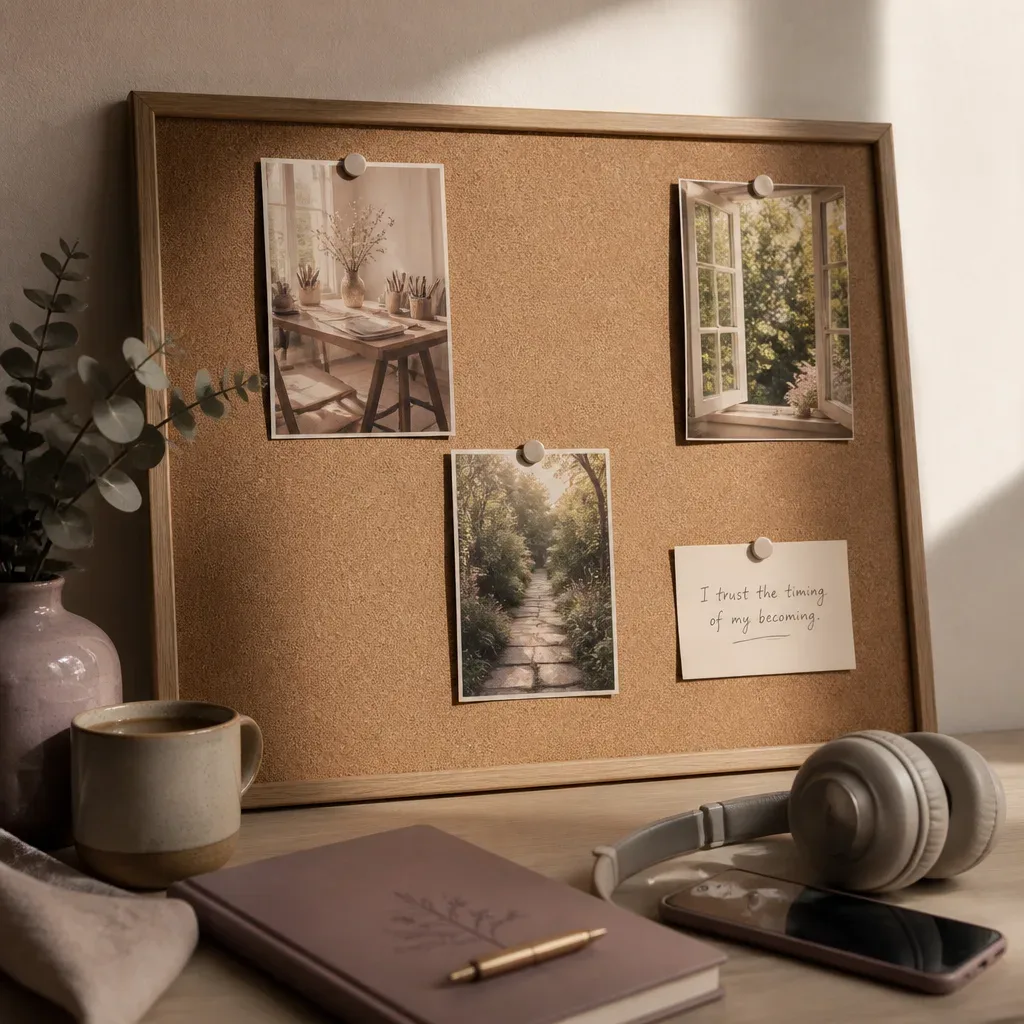
Can astrology help you time or theme a vision board?
Astrology can help you choose rhythm and reflection, as long as it does not replace your own listening.
Some people make boards at the new moon. Some prefer birthdays, January, a move, or the first clean morning after grief. Timing can make a ritual easier to remember. A 2022 Pew Research Center survey found that about 30 percent of U.S. adults said they believe in astrology. Belief is not the point here. Pattern is.
If you use astrology and manifestation, keep it practical. A new moon can be a time to choose. A full moon can be a time to review. A Saturn season can ask for structure. A Venus season can ask what beauty you can actually live with. None of this needs to be dramatic.
The risk is outsourcing your yes. If the chart says start, but your body says wait, wait. If the date is auspicious but the goal is borrowed, do not add it. The board is not more sacred because the sky was involved. It is more honest because you were.
For a quiet timing check, ask:
- Does this date help me remember?
- Does this timing create pressure or care?
- Am I using astrology to listen more closely or to avoid choosing?
- What would I still want without a sign?
A ritual should return you to yourself. Not pull you away.
What should you do after you add a goal to the board?
After you add a goal, pair it with repetition, review, and one small behavior you can keep.
This is where many boards stop too early. The image goes up. The room looks different. Then nothing changes. A board needs a daily thread. For Aya, that thread is the audio: listen to your Dream-Self Moment, then let the board remind your eyes of what your ears have already received.
Keep the practice small. James Clear popularized the idea that habits compound through repeated small actions, but the deeper research agrees on the shape: cues, repetition, and feedback matter. Lally’s 66-day average is not a rule. It is a mercy. It tells you that becoming familiar with a new behavior takes time.
Use a weekly review with four questions:
- Did I listen this week?
- Did I take the attached action?
- Did the image still feel true?
- What needs to be removed, softened, or made more specific?
You can also connect the board back to a wider practice. Read the Manifestation pillar when you need the larger frame. Return to the AYA Method when you need the audio itself. Let the Manifestation Board stay in its rightful place: visible, helpful, secondary.
I like clay for the same reason. A vessel becomes real through touch, water, pressure, waiting, fire. Not all at once. Never all at once. The board is similar. It asks for contact, not conquest.
The future becomes believable when you meet it in small repeatable ways.
Leave one corner empty, so the true thing has room to arrive.