evening rituals
Sunday Reset Routine With Future-Self Audio
A quiet Sunday reset routine using a 3-minute future-self audio, one clear surface, and a small plan for Monday without adding pressure.

The kettle clicks off. Your shoes are by the door. A Sunday reset routine can be small: clear one surface, listen to a 3-minute future-self audio, write three true lines, and choose one Monday cue. Twenty minutes is enough when the practice is specific and repeated.
What is a Sunday reset routine when it stays small?
A Sunday reset routine is a short closing ritual that helps you meet Monday with fewer loose ends.
It doesn’t need a scrubbed home, a color-coded calendar, or a long list with twelve categories. It needs a cue, a sequence, and an ending. Behavioral researchers often describe habits as cue-based loops. In a 2009 study from University College London, the average time for a new behavior to feel automatic was 66 days, with wide variation from person to person. That number matters because Sunday doesn’t have to carry the whole week. It only has to repeat.
Keep the reset small enough that your nervous system doesn’t argue with it. One cleared surface. One audio. One page. One next step. The quietest routines often last because they don’t ask you to become a new person by Monday morning.
The difference between a reset and a life audit is mercy. A reset asks, what would make tomorrow easier by 5 percent? A life audit asks, why haven’t I fixed everything yet? Pew Research Center reported in 2023 that many adults feel strained by money, work, and health concerns at once. When the mind is already carrying several tabs, a compact ritual is kinder than a full review.
A small Sunday reset might include:
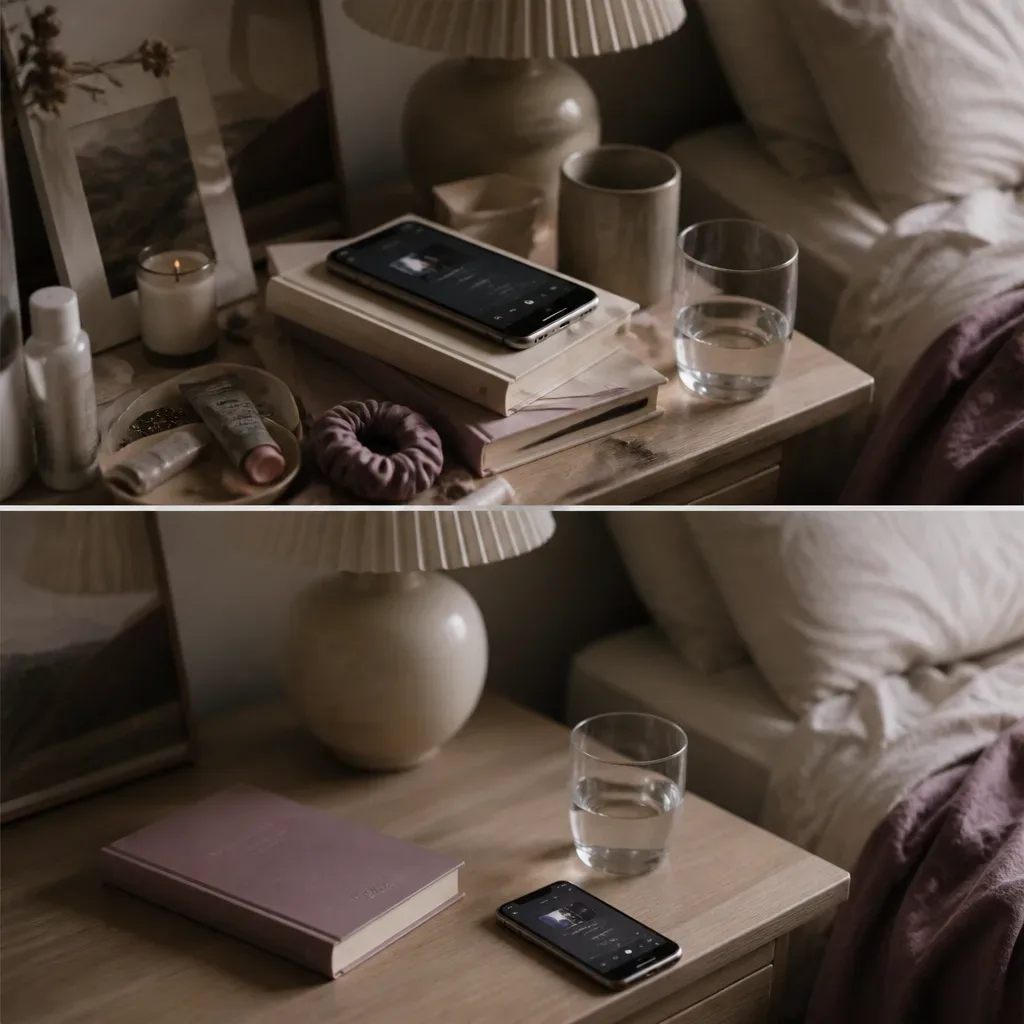
- a glass of water beside you
- one lamp instead of overhead light
- your 3-minute future-self audio
- three lines in a notebook
- one visible cue for Monday morning
A reset isn’t a performance. It’s a return.
If you want the wider frame, the Manifestation pillar explains how desire, attention, and repetition can become a practice rather than a mood. For Sunday, make it ordinary. The ordinary thing is the one you’ll do again.
Why begin with a 3-minute future-self audio?
Begin with audio because it gives the mind a felt direction before it starts solving problems.
Planning from stress tends to create more stress. You open the calendar, see five demands, and begin negotiating with a version of yourself who is already tired. A 3-minute future-self audio interrupts that pattern. It lets you hear your next self before you write your next task. In self-affirmation research, Claude Steele’s theory and later reviews by Sherman and Cohen have suggested that reflecting on valued identity can reduce defensiveness under threat. The point isn’t fantasy. It’s steadiness.
This is where the AYA Method comes in, without ceremony. The AYA Method is a daily audio manifestation practice. Each day you listen to a short personalized recording — your Dream-Self Moment — narrated from the version of you who has already manifested the life you intend. Listening is the practice. Repetition is the work. The audio is the method.
Three minutes is not too short. It is short enough to survive real Sundays. The CDC has reported that about 1 in 3 U.S. adults doesn’t get the recommended 7 hours of sleep, and tired people need rituals with low entry costs. A long routine may sound beautiful at 10 a.m. and feel impossible at 8:40 p.m. The 3-minute audio stays within reach.
The audio should come before the list. A list records what needs doing. Audio reminds you who is doing it. That order changes the tone of the whole reset.
Use headphones if the house is loud. Sit if you can. Lie down if you need to. Don’t clean while listening. Don’t answer a message. Don’t turn the practice into background noise. The future-self audio works because, for three minutes, you give it the whole room.
How do you prepare the room without making it another task?
Prepare the room by choosing one small boundary, not by redesigning the night.
Start with the smallest visible friction. Move the plate. Fold the blanket. Put the laptop on a chair across the room. A 2011 Princeton Neuroscience Institute study found that visual clutter can compete for neural attention, making it harder to focus on the task at hand. You don’t need a perfect room. You need one place where your eyes can rest.
The room is not the practice. The room is only the invitation. If you spend 40 minutes preparing to feel ready, you may never begin. Set a timer for 2 minutes and stop when it ends. This is especially important on Sunday, when preparation can disguise avoidance.
Try this simple setup:
| Reset element | Time | Why it helps |
|---|---|---|
| Clear one surface | 2 minutes | Reduces visual noise |
| Dim one light | 30 seconds | Signals a slower pace |
| Open audio | 30 seconds | Lowers start-up friction |
| Place notebook nearby | 30 seconds | Keeps reflection close |
| Set a stop time | 15 seconds | Prevents the ritual from expanding |
There is comfort in limits. A Sunday reset routine should have walls around it. Research on implementation intentions by Peter Gollwitzer and Paschal Sheeran, including a 2006 meta-analysis of 94 studies, found that if-then plans can meaningfully improve follow-through. The room version is simple: if it’s Sunday evening, then I clear one surface and press play.
You can add a complement if it helps. A daily affirmation may give the practice a sentence to hold. If you’re curious, the Affirmations pillar explains how repeated statements can shape attention when they’re believable and specific. Still, keep the order clear. The audio is the method. The sentence is a support.
What are the exact steps for a 20-minute Sunday reset routine?
Use a 20-minute sequence that starts with listening and ends before you begin overthinking.
Here is the whole routine. You can write it on an index card. You can keep it in your notes app. The American Psychological Association’s 2023 Stress in America reporting showed that stress often gathers around money, health, family, and the future at the same time. A written sequence protects you from deciding what to do while already tense.
- Minute 0 to 2: clear one surface. Choose a desk, bedside table, or kitchen corner. Put away only what belongs somewhere obvious.
- Minute 2 to 5: listen to your Dream-Self Moment. Press play. Let the 3-minute future-self audio be the center.
- Minute 5 to 10: write three true lines. What is complete? What needs care? What would your future self choose first?
- Minute 10 to 17: choose three practical next steps. One for your body, one for your calendar, one for your home.
- Minute 17 to 20: place one Monday cue. Leave the notebook, shoes, water glass, or calendar page where you’ll see it.
Notice what is missing. No full closet clean-out. No weekly reinvention. No scrolling for a better system. According to the Bureau of Labor Statistics, people in the U.S. spent an average of about 2.8 hours per day on household activities in 2023, but most Sunday resets fail because they try to borrow from cleaning, planning, therapy, and productivity all at once. Keep this one narrow.
Your three practical next steps should be almost plain. Body: fill the water bottle. Calendar: confirm the first appointment. Home: take out the bag by the door. The more ordinary the action, the more trustworthy it becomes.
If you practice manifestation with timing, seasons, or lunar language, you may like reading Astrology and manifestation. Use it as meaning, not pressure. Sunday doesn’t need to become a cosmic deadline. It can stay close to the floor, where your shoes are.
What do you write down after the audio?
Write down what became clear, not everything you’re afraid you’ll forget.
The page after the audio is not a diary unless you want it to be. It is a bridge between the future-self voice and Monday morning. Expressive writing studies by James Pennebaker and later researchers have found that brief structured writing can support emotional processing, though results vary by person and context. For Sunday, structure is the kindness.
Use three prompts:
- What is complete? Name one thing from the week that can be closed.
- What is asking for care? Name one thing that needs attention but not panic.
- What would the next version of me choose first? Name one action that fits your future-self audio.
You can answer each in one sentence. You don’t need beautiful language. You need true language. If the line sounds like someone else’s planner, cross it out.
A useful line might be: I answered the message, and that is complete. Another might be: My body is asking for an earlier dinner. Another: The next version of me opens the document before checking the news. Each line is small enough to do, which makes it more honest.
In a 2015 study in Social Cognitive and Affective Neuroscience, self-affirmation was associated with activity in brain regions linked to self-processing and valuation when people considered future-oriented messages. That doesn’t mean every affirmation works. It suggests that personally meaningful language matters. Your Sunday lines should sound like you.
The future self is not louder than you. She is clearer.
If you want a broader practice, return to the Manifestation pillar after the reset, not during it. Sunday night is not the time to gather every theory. It is the time to listen, write, and choose.
How do you keep the reset from becoming a Monday pressure list?
Keep the reset gentle by limiting Monday to one cue, one first action, and one permission.
The pressure list has a recognizable feeling. It starts as care and becomes a courtroom. You write ten tasks, then twelve, then remember the thing from Thursday, then punish yourself for forgetting. Cognitive load theory, first described by John Sweller in 1988, is often used in learning research, but the principle applies here: working memory has limits. Too many open demands make clear action harder.
So give Monday a smaller door. Choose one cue you will see before the day takes over. A water glass beside the sink. Shoes facing the door. A sticky note on the laptop that says open the file first. Environmental cues work because they reduce the need to remember. In habit research, context stability is one reason repeated behaviors become easier over time.
Then choose one first action. Not the most impressive action. The first true one. Open the document. Send the confirmation. Take the medicine. Walk for 8 minutes. If it takes more than 15 minutes, make it smaller.
Finally, write one permission. This may sound too soft, but it matters. Permission might be: I don’t have to solve the whole week before breakfast. Or: I can begin with the part I understand. People are more likely to avoid tasks when the task feels vague or emotionally loaded; procrastination research by Piers Steel has linked delay to task aversion and impulsiveness across many studies.
A Sunday reset routine isn’t a promise that Monday will be easy. It is a promise that you won’t abandon yourself before it begins.
You can revisit the AYA Method on Monday morning if you need the voice again. The app also includes complements like an affirmation and Manifestation Board, but the listening remains the center. Audio first. Then the visible cue. Then the small action.

What if Sunday night feels heavy?
If Sunday night feels heavy, shorten the routine until your body can say yes.
Some Sundays arrive with a weight in the chest. The week isn’t here yet, but it already feels close. Researchers have studied what many people call the Sunday scaries, and surveys from workplace platforms often report that a large share of workers feel anticipatory stress before Monday. Treat those numbers carefully because many are self-reported, but the pattern is familiar enough: the mind starts rehearsing before the day begins.
On a heavy night, do the 7-minute version:
- Clear one small object from your line of sight.
- Listen to the 3-minute future-self audio.
- Write one sentence: tomorrow begins with this.
- Put one cue where you’ll see it.
That is enough. More is not always more honest. Sometimes the most faithful practice is the one that respects the state you’re actually in.
If you feel tempted to skip because you can’t do it well, make the ritual smaller again. Listen from bed. Write in the notes app. Use one word if one sentence is too much. In small clinical and mindfulness studies, even brief breathing or attention practices have shown modest effects on stress markers for some participants, though results depend on design and consistency. The lesson is not that three minutes cures everything. The lesson is that small inputs can still count.
There is also a time to ask for more care. If Sunday anxiety is intense, recurring, or tied to dread you can’t soothe, a ritual is not a replacement for support from a qualified professional. The reset can sit beside therapy, medical care, medication, rest, and hard conversations. It doesn’t need to pretend to be everything.
End before you feel done. That is the secret. Stop while the practice still feels kind. Let the week meet a version of you who has already been listened to.
Leave the glass where morning can find it.