audio manifestation
Guided Manifestation Audio: What to Listen to Daily
Guided manifestation audio works best as a short daily recording of your future self, heard with repetition, belief, and a quiet cue.

The headphones are on the table. Your tea is still too hot. Guided manifestation audio is a short daily recording you listen to so your mind can rehearse a future-self identity with repetition, emotion, and clarity. Listen to one believable Dream-Self Moment, at the same cue, for 3 to 7 minutes.
What makes guided manifestation audio different from ordinary meditation?
Guided manifestation audio is different because it rehearses a specific future-self identity, not only calm attention.
A meditation may ask you to notice the breath, scan the body, or watch thoughts pass. That can be very good. The CDC reported that meditation use among U.S. adults rose from 4.1% in 2012 to 14.2% in 2017, which tells you something simple: many people are looking for a daily way to return to themselves. Guided manifestation audio has a narrower task. It gives your attention a chosen place to go.
The best recording is not a lecture. It doesn’t try to talk you into wanting your life. It speaks from the version of you who already lives differently. A new morning. A calmer email. A paid invoice. A conversation that no longer makes you shrink. One scene is enough.
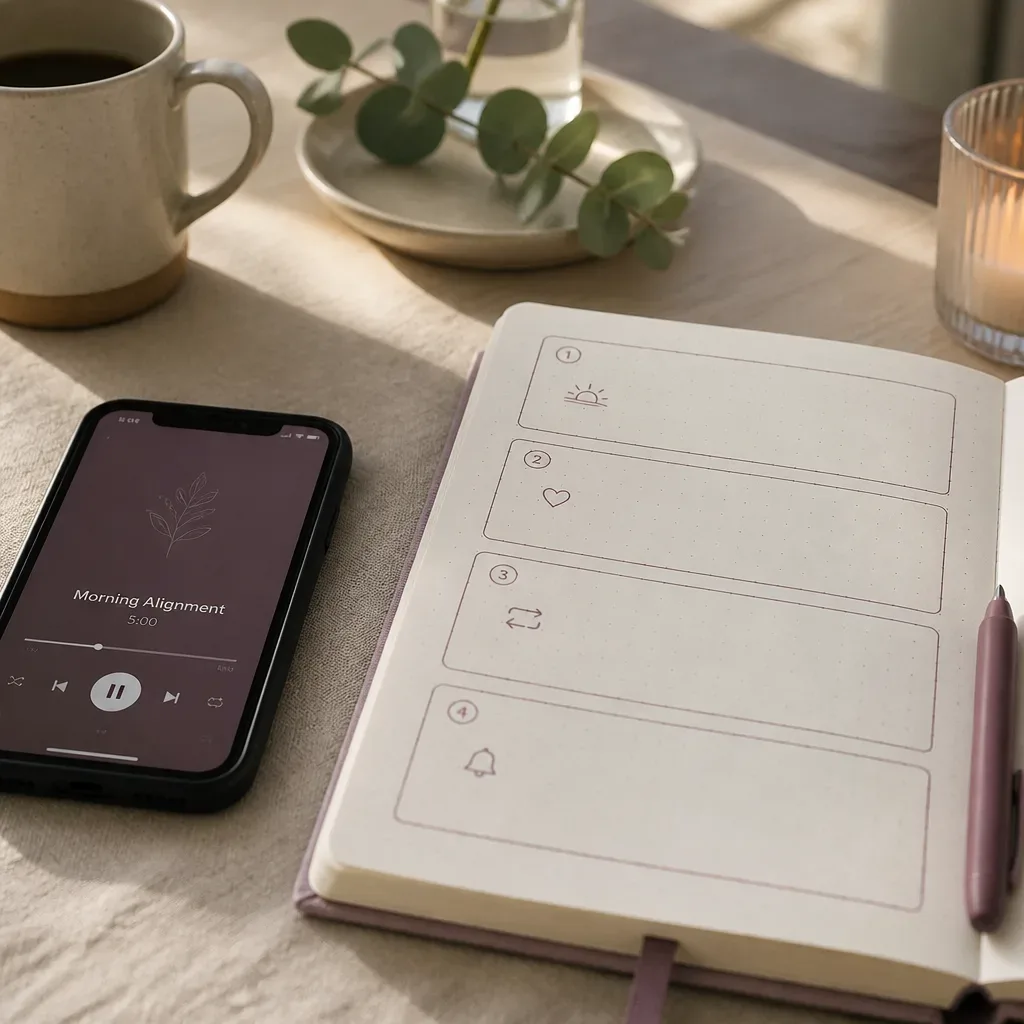
The AYA Method is a daily audio manifestation practice. Each day you listen to a short personalized recording — your Dream-Self Moment — narrated from the version of you who has already manifested the life you intend. Listening is the practice. Repetition is the work. The audio is the method.
That last line matters. The audio is not background. It is the place where the practice happens. The app also includes a daily affirmation and a Manifestation Board, but those are complements. They help you see or name the intention. The listening is the daily return.
A good manifestation recording doesn’t shout at doubt. It gives the nervous system a quieter sentence to practice.
If you want a broader map of the idea, the manifestation pillar gives the wider frame. Here, stay smaller. Ask: what do I need to hear today, and what would I actually repeat tomorrow?
What should you listen to every day?
Listen to one short, personal recording that names the life you intend through a normal scene you can believe.
Daily audio works best when it has a center. Not ten goals. Not a whole new personality by Friday. One future-self scene. Psychologist Shelley Taylor and colleagues found in a 1998 study that students who mentally simulated the process of studying tended to study more and do better than students who only imagined the grade. Process matters. The mind needs something it can rehearse.
So your recording might begin in a kitchen, a tram, a bathroom mirror, or the small room where you work. It might say: you open the laptop and don’t panic. You answer one message before checking the whole pile. You let money be a thing you can look at. You go to bed without needing to fix yourself first.
Use these pieces:
- Present-tense language: you are doing it now.
- One ordinary scene: the scene should be easy to picture.
- A bodily cue: breath, shoulders, hands, feet, jaw.
- One emotional truth: safe, ready, steady, chosen, enough.
- A next action: one small behavior that matches the new self.
Neville Goddard called this kind of inner rehearsal living from the fulfilled wish. You don’t have to take every metaphysical claim as fact to use the practice well. You only need to know that attention, imagery, and repetition shape what feels available. Dr. Andrew Huberman often describes neuroplasticity as being shaped by attention and repeated behavior. That is plain enough.
The sentence that works is usually not the biggest one. It is the one your body doesn’t reject.
How long should guided manifestation audio be?
Keep it short enough to repeat, usually between 3 and 7 minutes.
Length has a quiet psychology. If a recording is 22 minutes long, you may respect it and still avoid it. If it is 4 minutes and 40 seconds, you can put it between brushing your teeth and opening the curtains. A typical calm narration runs around 120 to 150 words per minute, so a 5-minute audio can hold roughly 600 to 750 words. That is enough.
The point is not to flood the mind. It is to return to the same place until it becomes familiar. In the 2009 European Journal of Social Psychology study by Phillippa Lally and colleagues, habit automaticity took a median of 66 days, with a wide range from 18 to 254 days. The number is useful because it removes the drama. If you missed Tuesday, you’re not ruined. You’re practicing a pattern.
Here is a simple daily structure:
| Part of audio | Time | What it does |
|---|---|---|
| Arrival | 30 to 45 seconds | settles breath and attention |
| Dream-Self Moment | 2 to 4 minutes | lets you hear the future self as real |
| Repetition phrase | 30 to 60 seconds | gives one line to carry after listening |
| Closing cue | 15 to 30 seconds | names the next small action |
A 6-minute recording done for 30 days gives you 180 minutes of identity rehearsal. That is only 3 hours. Small enough to be honest. Large enough to leave a trace.
If you also use affirmations, let one line from the audio become the daily affirmation. Not a separate performance. Just a sentence from the recording, placed where you’ll see it.
When is the best time to listen?
The best time is the one you can attach to an existing cue without bargaining.
Morning has a clear appeal. You listen before the day starts making claims on you. You can carry the Dream-Self Moment into choices that happen at 9:12, 11:03, and 4:48. But night has its own softness. The room is quieter. The body is less interested in pretending. A 2015 National Sleep Foundation recommendation puts healthy adult sleep at 7 to 9 hours, so if night listening steals sleep, it is not helping.
Choose the cue before you choose the hour. A cue is stronger than a plan because it already exists. After coffee. Before the first message. When the dog gets the lead. When the lamp turns off. BJ Fogg’s behavior model, widely used in habit design, places tiny actions after existing prompts because prompts reduce decision-making. You don’t need a heroic mood. You need a place to put the practice.
Try this order for 7 days:
- Pick one cue you already do daily.
- Put the audio where friction is low.
- Listen with both feet on the floor or while walking slowly.
- After listening, do one action that matches the recording.
- Mark the day with a simple check, not a speech.
If you use timing from astrology and manifestation, keep it supportive. A new moon may help you name an intention. A transit may help you reflect. But don’t let timing become another way to wait. The daily audio still belongs to the ordinary day.
A practice that requires perfect timing is often a practice trying to avoid being practiced.
What should the voice and words sound like?
The voice should sound close, steady, and believable enough that you don’t brace against it.
Many people think manifestation audio should sound grand. It shouldn’t. Your nervous system is not a stadium. A quiet voice can be more useful because it doesn’t demand that you perform certainty. In clinical uses of guided imagery, including pain and stress studies reviewed across medical settings, the useful element is often repeated sensory detail: where you are, what you see, how the body softens, what action comes next. Details make the scene easier to enter.
Your words should feel like someone kind who knows you well. Not a poster. Not a command. If the sentence is too far from belief, soften it. Instead of saying, I never feel afraid, try: I feel the fear and still open the door. Instead of saying, everything is mine, try: I can receive one real opportunity and answer it well.
Use this small test:
- If your jaw tightens, make the line more specific.
- If you roll your eyes, make the line less dramatic.
- If you feel sad, add tenderness instead of force.
- If you feel nothing, add a concrete scene.
- If you want to keep listening, the tone is probably near enough.
There is also the matter of voice. Some people prefer their own voice because it builds self-recognition. Others prefer a narrator because it lets them receive the words without managing them. In small self-affirmation studies, such as work connected to Claude Steele’s self-affirmation theory, values-based statements can reduce defensiveness under stress. The same principle applies here: the words must return you to what is true, not decorate what is false.

Let the recording be almost plain. Plain is where the mind can rest.
How do you know if the daily audio is working?
You know it is working when your choices become slightly more like the person in the recording.
Do not look only for a sudden outer sign. Look for earlier evidence. You answer the message instead of circling it. You pause before agreeing. You put your invoice in one folder. You walk away from the conversation 6 minutes sooner. These are not small because they are invisible. They are the hinges.
Researchers at Princeton’s Global Consciousness Project have reported statistical deviations in random number generators around major world events, though the interpretation is debated and not proof of personal manifestation. I mention it carefully because it shows why evidence matters. You don’t have to make every mystery into proof. In daily practice, your better evidence is behavioral: what changed in what you did?
Track three things for 28 days:
- Listened: yes or no.
- Felt sense: one word, such as steady, resistant, soft, numb, clear.
- Matched action: one behavior from the recording that you did that day.
Twenty-eight days is four weeks. It is long enough to see a pattern and short enough not to become a life sentence. If you skip, return the next day. No punishment. Punishment is not repetition. It is noise.
If the audio starts to feel false after two weeks, revise one part, not the whole thing. Change the scene. Change the voice. Make the next action smaller. The intention may still be true. The doorway may simply be too narrow.
For more on the wider practice, return to manifestation. For the sentence-level layer, keep affirmations nearby. And when you want the audio to hold the practice for you, return to the AYA Method.
The recording is waiting where you left it.