affirmations
Confidence Affirmations Before a Big Day
Confidence affirmations work best before a big day when you listen slowly, let your body settle, and choose words your nervous system can believe.
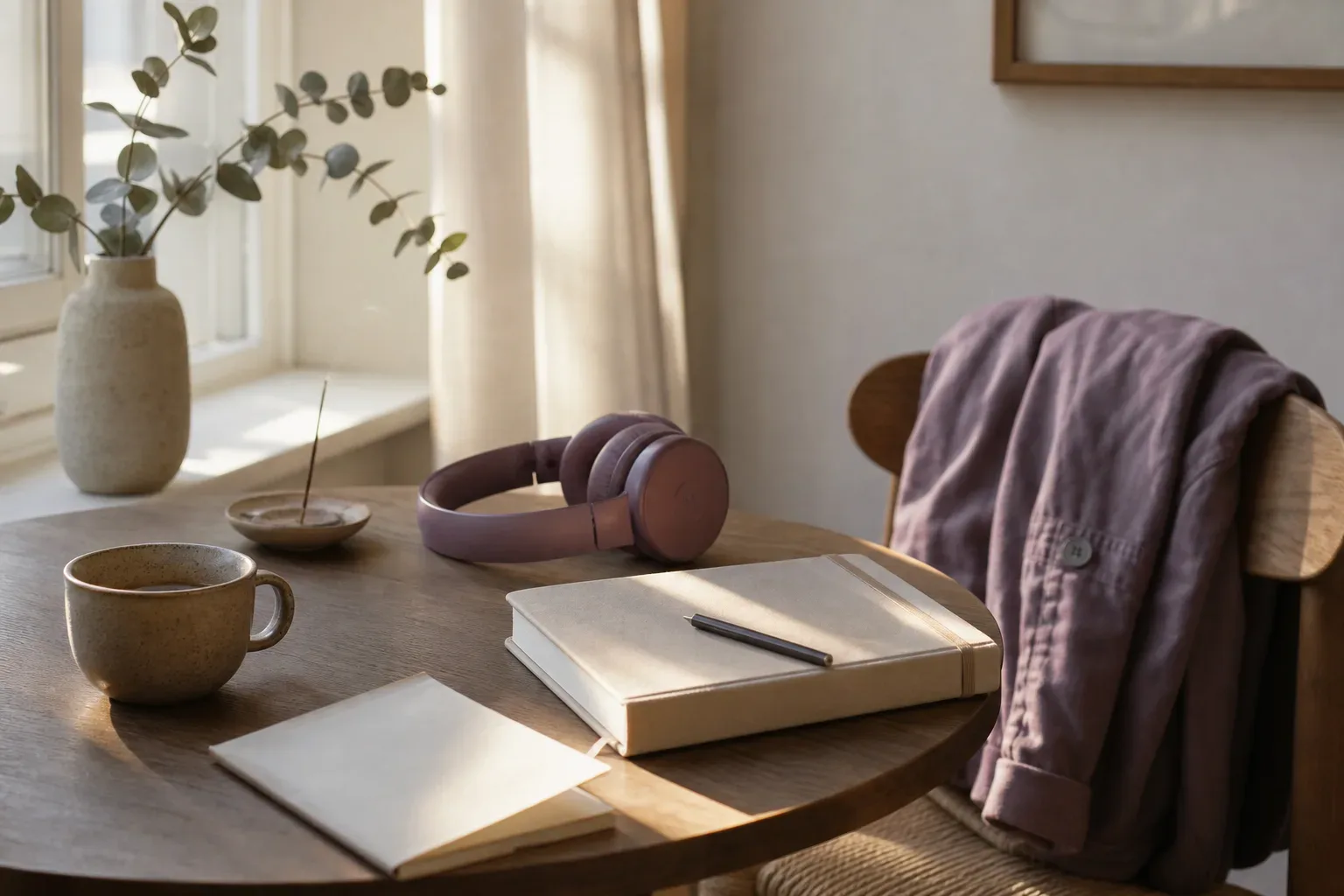
Your jacket is on the chair. The message is drafted. The door is almost opening. Confidence affirmations work best before a big day when you listen to them, not when you force yourself to recite them. Audio lets the body receive steadiness first, then the mind can follow.
Why listen to confidence affirmations instead of reciting them?
Listening helps because it lowers the demand to perform confidence while you are already under pressure.
When a big day is close, your body may not care that you have a good sentence. It cares about pace, breath, tone, and safety. A 2023 Cell Reports Medicine study by Balban and colleagues found that 5 minutes of cyclic sighing improved mood and reduced respiratory rate more than several other brief breathing practices in 108 adults. This matters because a sentence lands differently in a slower body.
Reciting can become another test. You say, I am confident, then immediately check whether it is true. If your chest tightens, the phrase starts to feel like evidence against you. Joanne Wood, W. Q. Elaine Perunovic, and John Lee reported in Psychological Science in 2009 that very positive self-statements could make people with low self-esteem feel worse. The words were not wrong. They were too far away.
Listening gives you a small distance. You do not have to generate the voice. You can let it meet you. This is why audio can feel kinder before an interview, court date, performance, medical appointment, exam, or hard conversation. The body hears rhythm before it believes content.
The right affirmation is not the loudest sentence. It is the sentence your body does not reject.
If you already use confidence affirmations, keep them. Just change the delivery. Put the words in a short recording. Slow them down. Leave space after each line. A 2014 Annual Review of Psychology paper by Cohen and Sherman described self-affirmation as most useful when it reconnects you with values, not when it asks you to pretend fear is gone.
What makes an affirmation believable before a big day?
A believable affirmation tells the truth in a steadier tense.
The body does not need a perfect claim. It needs a possible one. I never get nervous is brittle. I can feel nerves and still speak clearly is stronger because it includes what is already here. In somatic work, this matters. You are not arguing with the body. You are giving it a sentence it can stand beside.
A 2016 Social Cognitive and Affective Neuroscience study by Cascio and colleagues found that self-affirmation activated brain regions linked with self-related processing and future orientation, including the ventromedial prefrontal cortex. The study included 67 adults. That does not mean every phrase will help. It suggests that words tied to self and future action can change what the brain attends to.
Use this small test. Say the line once in your head. Notice your jaw, belly, and shoulders. If the body tightens sharply, soften the wording by 10 percent. If I am ready feels false, try I have prepared enough to begin. If Everyone will see my worth feels too wide, try I can let one person hear me clearly.
Here are useful shifts:
| If the phrase feels too far | Try this instead |
|---|---|
| I am fearless | I can feel fear and stay present |
| I will be perfect | I can be clear enough |
| Everyone will love me | I can meet the room one breath at a time |
| I cannot fail | I can respond to what happens |
| I am completely confident | Some part of me already knows how to do this |
The phrase should not flatter you. It should return you to yourself. In manifestation practice, the same rule holds: the future self has to feel close enough to listen to, not so distant that the body goes numb.

How do you prepare the body before listening?
Prepare the body by giving it 60 to 90 seconds of simple sensory cues before the audio begins.
Confidence is often treated as a thought, but the first signal may be muscular. A 2013 PLOS ONE study by Nair and colleagues with 74 participants found that upright seated posture helped people maintain self-esteem and reduce fear compared with a slumped posture during a stressful task. You do not need a dramatic pose. You need enough support to breathe.
Start with the room. Name 3 things you can see. Feel 2 points of contact, such as feet on the floor and back on the chair. Take 1 longer exhale. This is not decoration. It tells the body that the present moment is survivable. Dr. Andrew Huberman has often taught the physiological sigh as a fast way to reduce arousal: two inhales through the nose, followed by a long exhale. In the 2023 breathing study above, daily 5-minute breathwork showed measurable change after one month.
Then listen. Not while scrolling. Not while checking the agenda. The audio needs a quiet field. If you only have a hallway or a parked car, that is enough. Small is allowed.
Try this order:
- Put both feet down.
- Let your eyes rest on one fixed point.
- Unclench your tongue from the roof of your mouth.
- Exhale slowly once.
- Press play.
- Let the first sentence arrive before you answer it.
This is the part many people skip. They want the affirmation to do all the work. But a tense body can make even a good sentence sound like pressure. The body is not an obstacle to confidence. The body is where confidence has to become real.
What should the audio actually say?
The audio should speak from the version of you who has already crossed the threshold and stayed with yourself.
Keep it short. George Miller’s 1956 paper on working memory gave the famous estimate of 7 plus or minus 2 items, and later research often argues for even fewer when stress is high. Before a big day, do not carry 20 lines. Carry one clear thread.
A good confidence audio has 4 parts. First, it names the moment. Second, it gives the body permission to feel what it feels. Third, it remembers your preparation. Fourth, it points to the next small action. This is why listening can feel more natural than reciting. You can be guided through the sequence without holding the whole map in your head.
Here is a simple script you can record in your own voice:
You are here. Your feet are under you. You do not need to become someone else for this day. You have prepared enough to begin. You can feel nerves and still be clear. You can pause. You can answer one question at a time. The room does not decide who you are. You return to the next breath, then the next word.
Read it slowly. Leave 3 to 5 seconds between lines. A 2020 review in Frontiers in Psychology noted that slower breathing practices around 6 breaths per minute are often associated with better heart-rate variability, a marker linked with regulation. You do not need to count perfectly. You only need to stop rushing the words.
If you use the AYA Method, this is where the practice becomes very clear. The AYA Method is a daily audio manifestation practice. Each day you listen to a short personalized recording — your Dream-Self Moment — narrated from the version of you who has already manifested the life you intend. Listening is the practice. Repetition is the work. The audio is the method.
The app also includes a daily affirmation and a Manifestation Board, but those are complements. The audio leads. Before a big day, that matters. You are not trying to chant yourself into a new person. You are listening to the self you are practicing becoming.
When should you listen on the day itself?
Listen close enough to the event that the body remembers the cue, but not so close that the audio becomes another rush.
For most people, that means once the night before and once 10 to 30 minutes before the big moment. Sleep research from the National Sleep Foundation has long suggested that adults usually need 7 to 9 hours of sleep, and pre-sleep rumination can disturb rest. A short listen the night before gives the mind a softer final input than rehearsing every possible mistake.
On the day itself, choose a threshold. Before you leave the house. Before you enter the building. Before you open the video call. The threshold matters because the body learns by pairing. In behavioral psychology, implementation intentions, studied by Peter Gollwitzer since the 1990s, use if-then cues to improve follow-through. If I reach the lobby, then I listen for 2 minutes. Simple cues survive stress better than vague plans.
Do not over-listen. If you play the same affirmation 17 times because you are checking whether it has worked, the practice can become reassurance-seeking. One or two listens is usually enough. Then choose one line to carry.
Good anchor lines sound like this:
- I can be nervous and still be clear.
- I have prepared enough to begin.
- I can pause before I answer.
- I do not have to leave myself to be received.
- One breath, one sentence, one next step.
If timing is tied to a larger ritual, you might pair it with a simple morning manifestation routine. Keep the audio first. Then, if it helps, glance at a written affirmation or image after. The visible tools support the listening. They do not replace it.

How do you use confidence affirmations without bypassing fear?
You use them well by allowing fear to be present while choosing the next true action.
Fear before a big day is not proof that you are unready. It is often proof that the day matters. The American Psychological Association has noted for years that stress can be helpful in moderate amounts when it is interpreted as a signal for mobilization rather than danger. The wording matters. I should not feel this way creates a fight. This is my body preparing gives you somewhere to stand.
Confidence affirmations become thin when they deny reality. They become useful when they widen it. You can be scared and prepared. You can shake and still speak. You can want approval and still remain yours. A 2013 Journal of Experimental Psychology study by Alison Wood Brooks found that reframing anxiety as excitement improved performance in stressful tasks such as karaoke and public speaking. You do not have to use the word excitement if it feels too bright. You can simply say, My body is mobilizing.
This is also where astrology can be used gently, if it is part of your language. A transit, moon phase, or natal placement can offer a symbol for timing and self-inquiry. It should not become a verdict. If you read about astrology and manifestation, keep the same quiet standard: does this help me listen, or does it make me outsource myself?
A grounded confidence practice includes:
- a phrase that admits the body is active
- a breath that lengthens the exhale
- a next action smaller than the whole event
- a boundary around over-rehearsing
- a way to return if something goes wrong
One sentence can hold all of that: I can feel this and still stay with myself. It is not flashy. It is usable. Usable is better than impressive on a big day.
What should you do after the big day is over?
After the big day, listen once more and record what your body learned.
Most people end the practice too early. They use confidence affirmations before the event, then let the nervous system absorb the outcome alone. Take 3 minutes afterward. Not to grade yourself. To complete the loop. In learning research, retrieval and reflection improve memory more than passive review; a 2011 Science paper by Karpicke and Blunt found retrieval practice produced stronger long-term learning than concept mapping in student participants.
Ask 3 questions in writing:
- What did I do that I want to remember?
- Where did I stay with myself, even a little?
- What sentence would have helped me most?
Then adjust your audio. If the line I am ready felt too big, change it. If I can pause before I answer helped, keep it. The practice becomes more accurate through contact with real days. That is how affirmations stop being pretty phrases and start becoming a living record of trust.
You can also make a small note on your Manifestation Board if you use one. Add the sentence that proved true. Add the image that now feels honest. But remember the order. The board is what you can see. The affirmation is what you can read. The audio is what you return to when your body needs to hear the future self speak first.
Confidence is not the absence of trembling. It is the decision not to abandon yourself when trembling comes.
The next big day will ask for something slightly different. Good. Your words can change. Your listening can stay.
Stay close enough to hear yourself return.