audio manifestation
Manifest While Cleaning With Future-Self Audio
Learn how to manifest while cleaning by pairing ordinary chores with future-self audio, so your practice stays quiet, repeatable, and real.

The kettle clicks off, and the floor needs sweeping. You can manifest while cleaning by listening to future-self audio during a simple, repetitive chore. The cleaning keeps your body steady. The audio gives your mind a place to return. Nothing has to look spiritual to be real.
Can you really manifest while cleaning?
Yes, if the manifestation practice is the audio and the cleaning is only the container.
A lot of people think manifestation has to happen sitting still. A cushion. A candle. A clean table. Good posture. No one knocking on the door. That can be lovely. It can also be rare. The laundry does not wait for your perfect morning.
The quieter truth is this: attention can be trained inside ordinary motion. Walking, washing dishes, folding towels, sweeping crumbs from under the table. Repetitive tasks give your body something familiar to do. In cognitive psychology, familiar motor routines often require less conscious effort than novel tasks; Daniel Kahneman wrote about attention as a limited resource in 1973, and that still helps explain why folding socks can leave room for inner listening.
The AYA Method is a daily audio manifestation practice. Each day you listen to a short personalized recording — your Dream-Self Moment — narrated from the version of you who has already manifested the life you intend. Listening is the practice. Repetition is the work. The audio is the method.
That last line matters. The mop is not the method. The tidy room is not proof. The daily affirmation and Manifestation Board can support you, but they are complements. The audio is where the practice begins.
Research on habit formation is useful here because it is wonderfully unromantic. In a 2009 study in the European Journal of Social Psychology, Phillippa Lally and colleagues found that new habits took an average of 66 days to become automatic, with a range from 18 to 254 days. The practice that gets repeated is usually the practice that fits through the door of your actual life.
A ritual does not become real because it is impressive. It becomes real because you return to it.
If you already clean most days, you already have a small doorway. You do not need to add an hour. You can add one listen.
Why does future-self audio work when your hands are busy?
Future-self audio works during cleaning because repeated sound can guide attention while the body performs a safe, familiar task.
Audio is intimate. It does not ask you to stare at a page. It does not ask you to hold a visual image for ten minutes. You can hear it while your hands are in warm water. You can hear it while you shake out a blanket. This is one reason audio practices travel well through ordinary life.
Neuroscience does not prove every manifestation claim, and it should not be bent until it says more than it says. Still, attention and repetition are well studied. Dr. Andrew Huberman has often described neuroplasticity as depending on focused attention followed by rest; in research settings, attention is one of the signals that tells the brain what matters. You are not forcing the future. You are rehearsing a self-concept often enough that it becomes easier to remember.
Neville Goddard called this living from the end. Joe Dispenza often speaks about mental rehearsal and the emotional familiarity of a chosen future. You do not need to accept every sentence from either teacher to use the practical center: the mind changes through repeated contact with an image of self. In sports psychology, mental rehearsal has been studied for decades; a 2012 review in Frontiers in Human Neuroscience noted that motor imagery can activate neural systems also used in physical action.
Cleaning adds a useful limit. You are not lying on the bed trying to feel something grand. You are wiping a sink. You are hearing a future-self sentence while removing toothpaste from porcelain. It keeps the practice from becoming theatrical.
A small table helps:
| If you tend to… | Cleaning gives you… | Audio gives you… |
|---|---|---|
| Overthink | a physical task | a single thread to follow |
| Fall asleep during practice | gentle movement | spoken structure |
| Avoid long rituals | a chore you already do | a short daily return |
| Need visible proof | one finished surface | one remembered sentence |
The future self becomes believable in the places where you usually forget her.
If you want the wider foundation, the manifestation guide explains the practice as attention, identity, and repetition rather than wishful thinking.
How do you set up a cleaning-listening ritual in 10 minutes?
Set it up by choosing one safe chore, one short audio, and one clear finish line.
Do not begin with the whole house. The whole house is how a small ritual becomes a moral exam. Begin with the kind of chore that would take less than 10 minutes even on a tired day. The U.S. Bureau of Labor Statistics reported that in 2023, people in the U.S. spent an average of about 1.8 hours a day on household activities. You only need a little piece of that existing time.
Try this once, then make it smaller if needed:
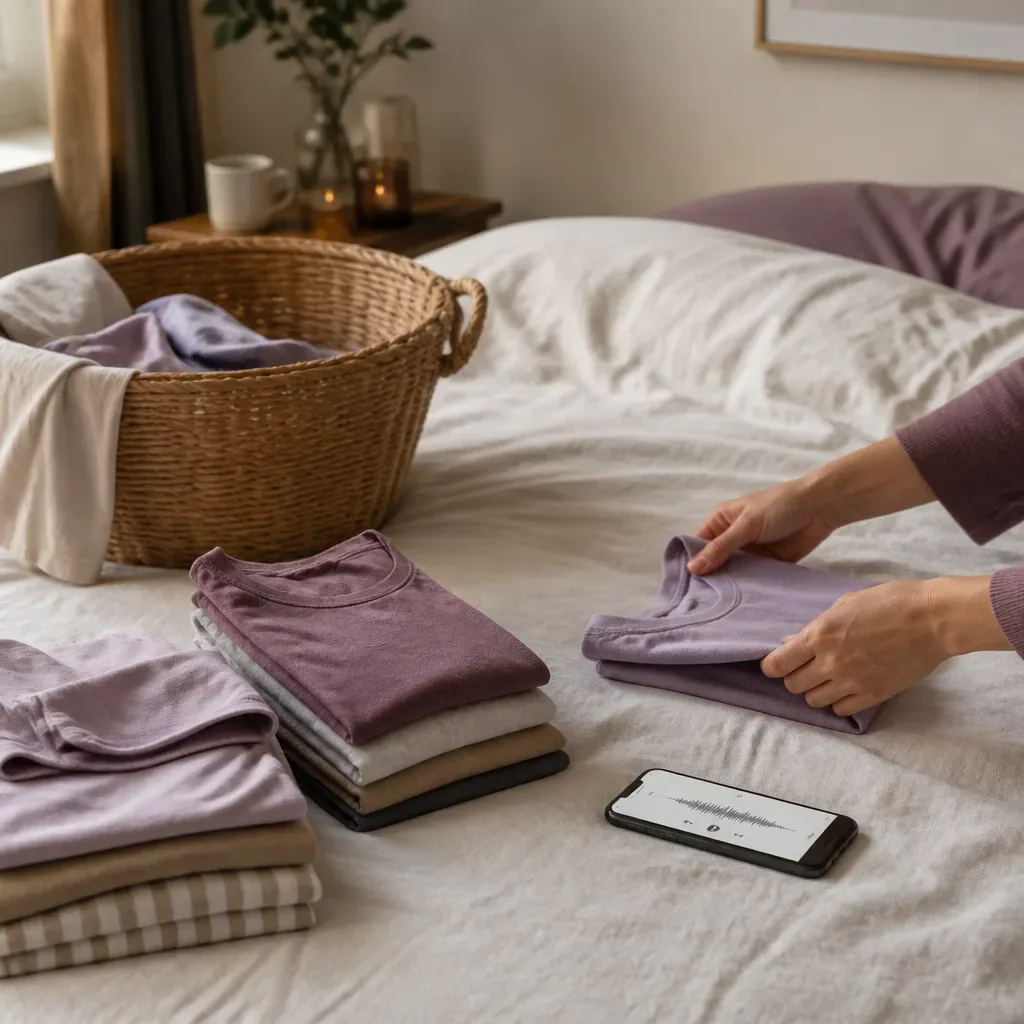
- Choose one chore. Folding one basket. Wiping one counter. Sweeping one room. Not cleaning the apartment.
- Put on headphones if safe. Keep the volume low enough to hear your surroundings.
- Start your Dream-Self Moment. Do not restart when your mind wanders.
- Move at normal speed. No ceremonial slowness required.
- Catch one sentence. Let one line from the audio stay with you.
- Finish one visible edge. Put the towels away. Hang the cloth. Empty the dustpan.
Ten minutes is not a spiritual downgrade. It is often the reason something survives. BJ Fogg, the Stanford behavior researcher behind Tiny Habits, has spent years teaching that small behaviors attach more easily to existing routines. His model is simple: behavior happens when motivation, ability, and a prompt meet at the same time. Cleaning is already the prompt.
The practice may look like this: after breakfast, you put your mug in the sink, start the audio, and wipe the counter. Or after work, before you take off your shoes, you listen while putting away the mail and folding the blanket on the sofa. The cue should be ordinary. The less dramatic it is, the more likely you are to repeat it.
If you also use a daily affirmation, let it come after. One sentence. Maybe the one that stayed from the audio. The affirmations guide can help you keep the wording plain and believable.
What should you listen for while you clean?
Listen for the sentence that feels calm, specific, and almost already known.
You are not trying to catch every word. That would make cleaning tense and listening brittle. Future-self audio works more like a thread through the room. Sometimes you hear the whole thing. Sometimes one phrase finds you while you are rinsing a cup. That is enough.
In mindfulness research, brief practices can still matter. A 2019 review in Behaviour Research and Therapy found that short mindfulness interventions can reduce distress in some settings, though effects vary by study quality and population. The point is not that manifestation and mindfulness are identical. They are not. The useful overlap is attention returning to a chosen object.
With future-self audio, the chosen object is identity. Not identity as performance. Identity as the quiet answer to the question: who am I practicing being today?
Here are the lines worth noticing:
- A sentence that describes how you respond now.
- A sentence that names what you no longer chase.
- A sentence that feels kind to your nervous system.
- A sentence that is specific enough to recognize later.
- A sentence you can remember while doing something else.
A sentence that says you never doubt yourself may be too far away today. A sentence that says you pause before answering may be close enough. Close enough is not weak. Close enough is how the nervous system consents.
Princeton Engineering Anomalies Research, often called PEAR, studied mind and intention for nearly 28 years. Its conclusions remain debated, and you should hold them lightly. More grounded behavioral research is enough for this practice: what you repeat gets easier to access. Cognitive behavioral therapy has long used repeated thoughts and rehearsed responses as part of change; the Journal of Behavioral Medicine has published many studies linking mental practice, coping statements, and health behavior over time.
The line that stays is the line your day can carry.
You can write it down later if you like. But do not stop mid-sweep to make it perfect. The broom is moving. Let that be enough.
Which chores pair best with future-self audio?
The best chores are repetitive, low-risk, and short enough that you can finish them before resentment arrives.
Not all cleaning is right for listening. Please do not use future-self audio while handling knives, climbing a ladder, using strong chemicals, driving, or managing anything hot enough to burn you. Your future self would like you with all your fingers.
A 2022 report from the American Cleaning Institute found that many people clean more when they feel stressed, and survey reports often link cleaning with a desire for control. That can be useful, but it can also become pressure. The aim here is not spotless living. The aim is a repeatable contact with the self you are practicing.
Good pairings are boring in the best way:
- Folding laundry.
- Making the bed.
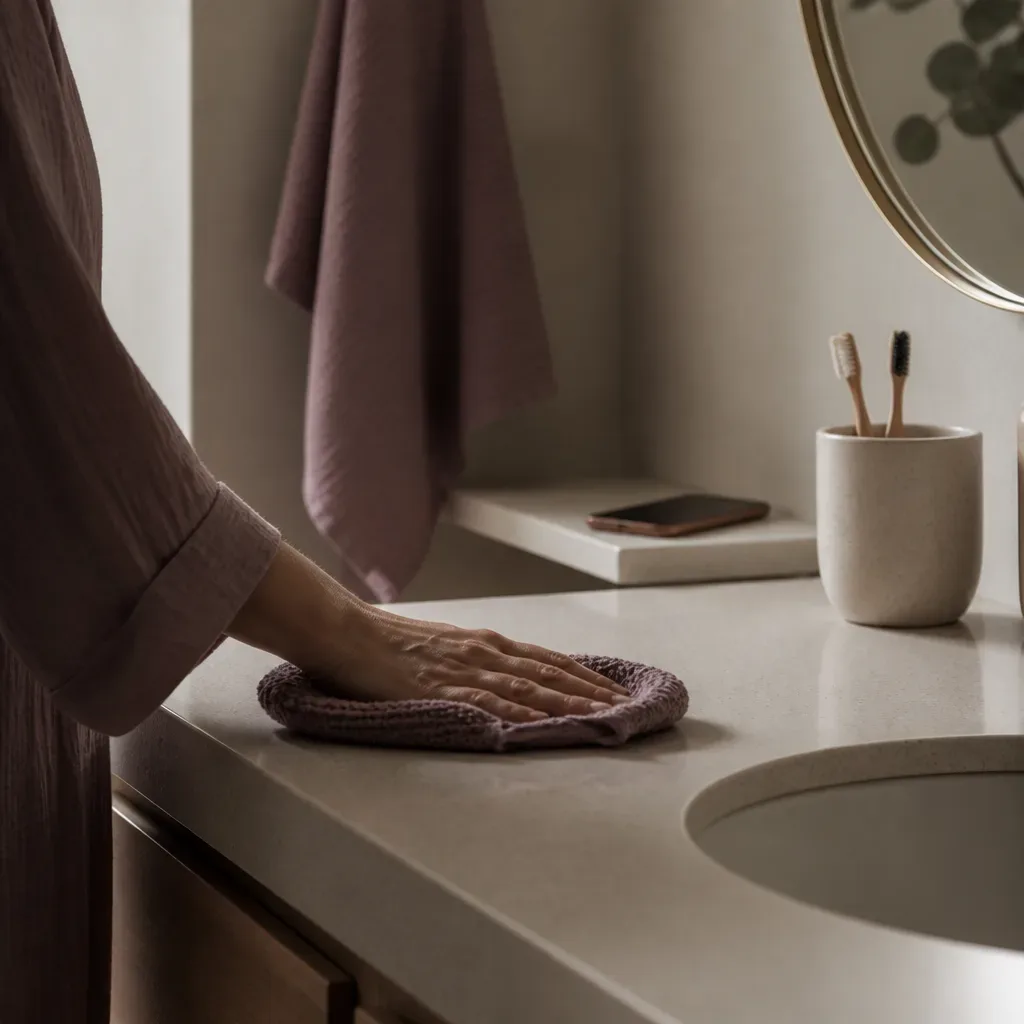
- Wiping bathroom surfaces with a mild cloth.
- Sweeping one room.
- Unloading the dishwasher.
- Watering plants.
- Putting books back on a shelf.
- Clearing one small table.
As a librarian, I have strong feelings about shelves. People think the ambitious books change them. Often, it is the small book that comes back soft at the corners. Practices are the same. The one you actually finish leaves a mark.
If you like visible anchors, you can place one image from your Manifestation Board near the chore zone. Not as a command. Just as a reminder. The board supports the audio the way a bookmark supports reading. It is not the reading itself.
You might also notice timing. Morning chores often carry a different tone than evening chores. A Pew Research Center report from 2023 found that about 4 in 10 U.S. adults say they feel rushed at least sometimes in daily life. If mornings are already tight, do not place the ritual there because someone told you mornings are pure. Put it where your life has a little give.
The right chore is the one you can repeat without bargaining.
How do you keep the practice gentle enough to repeat?
Keep it gentle by making the minimum version so small that you can do it on an ordinary Tuesday.
There will be days when the room is a mess and you are not poetic about it. Good. This practice should still fit. One listen while folding three shirts counts. One listen while wiping half the counter counts. The nervous system learns safety from kept promises, especially small ones.
The American Psychological Association has noted for years that stress affects attention, sleep, and decision-making. When a practice becomes too large, it can become one more stressor. You are not trying to build a monument. You are trying to build a return.
Use this scale:
| Day type | Cleaning action | Listening action |
|---|---|---|
| Low capacity | put 5 items away | listen once, seated or moving |
| Normal day | fold one basket | listen once while folding |
| Clear day | clean one small area | listen once, then note one sentence |
| Rest day | no chore | listen lying down if needed |
Notice the rest day. It belongs there. A method that cannot survive rest is secretly a demand.
You can also use a two-minute rule. James Clear popularized the idea that new habits should begin in under two minutes, and the principle has older roots in behavior design. Start tiny, then let the practice grow only if it wants to. If you clean longer, fine. If the audio ends before the chore does, finish in silence.
Some people like pairing the practice with lunar timing or birth charts. If that speaks to you, keep it soft. The astrology and manifestation guide can give you symbolic timing without making you wait for a perfect sky. Tuesday with a full sink is still available.
What if your mind wanders or you feel silly?
If your mind wanders or you feel silly, keep cleaning and return to one audible sentence without scolding yourself.
Mind wandering is not failure. In a well-known 2010 Science paper, Matthew Killingsworth and Daniel Gilbert reported that people’s minds wandered about 47 percent of the time in their sample. That number is not a personal insult. It is a relief. The human mind leaves the room often. Practice is the act of coming back.
Feeling silly is also common, especially if you were raised to trust only effort you can measure. Cleaning helps because it gives the practical mind a receipt. The counter is wiped. The socks are folded. The room is slightly kinder to live in. Meanwhile, the audio has done its quieter work.
Try this when you drift:
- Notice the drift without naming it bad.
- Touch the object in your hand.
- Listen for the next complete sentence.
- Repeat that sentence once in your mind.
- Finish the small chore you chose.
Do not restart the audio unless you truly want to. Restarting can become a perfection loop. One imperfect listen repeated 60 times will teach you more than one perfect listen you keep postponing.
This is also where audio manifestation has a practical advantage. Sound can meet you while you are already moving through the day. If you want to read more broadly about the visible side of practice, the Manifestation Board guide can help, but keep the order clear. Listening is the practice. The board is a support.
You do not need a cleaner house to begin. You need one small chore and a voice you can return to.
If there is a day when even that feels like too much, sit on the edge of the bed and listen once. No sweeping. No lesson. The method is still intact because the audio is still there.
The towel folds. The sentence stays.