audio manifestation
Manifestation Music vs Future-Self Audio
Manifestation music can calm your body, but future-self audio gives your mind a daily script. Here’s what to play, when, and why.
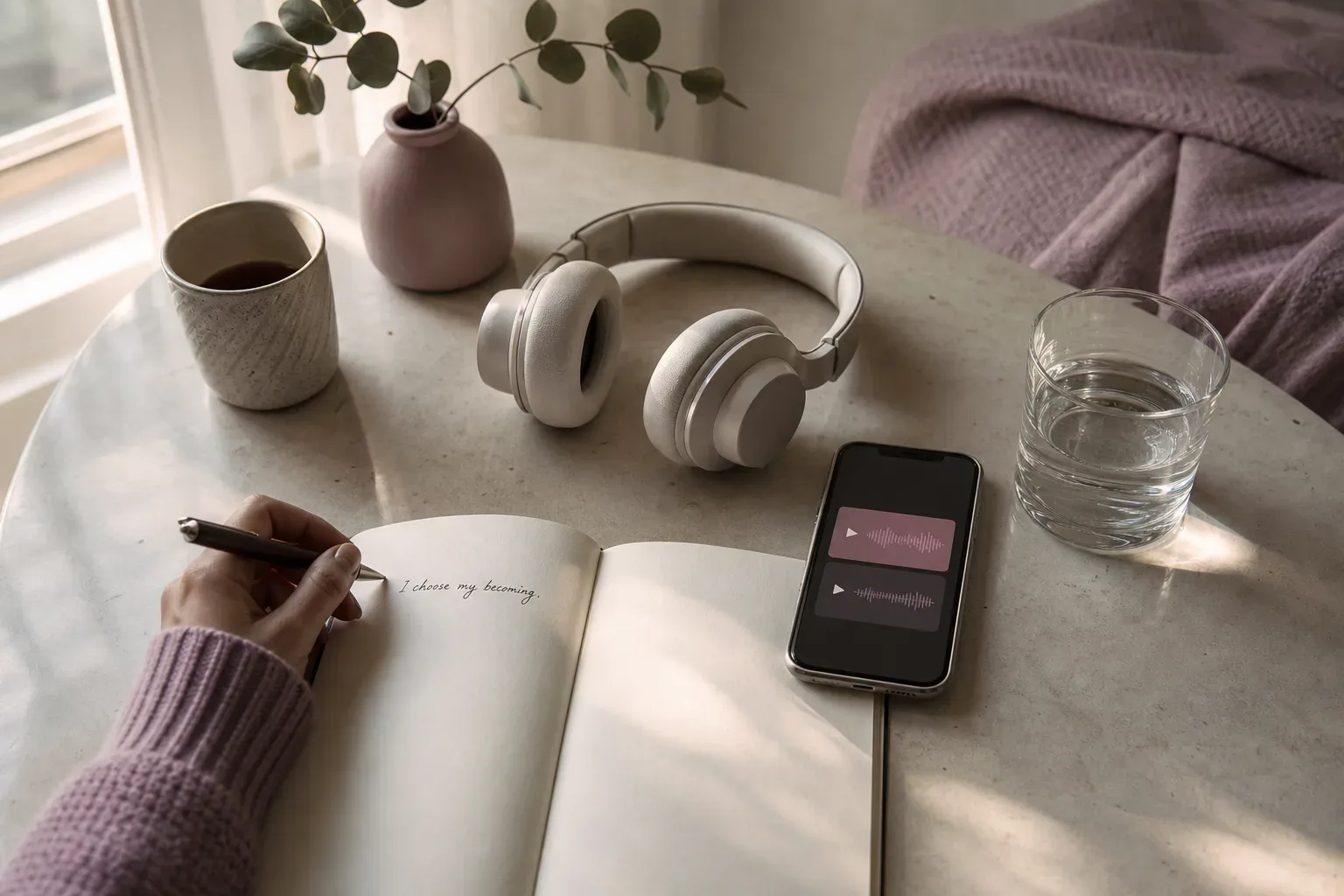
Your phone is faceup on the table. One playlist says manifestation music. One recording has your own future written into it. Play music when your body needs to settle. Play future-self audio when your mind needs direction. For daily practice, the spoken future-self recording should lead.
What does manifestation music actually do?
Manifestation music helps shape your state, not your specific vision.
That matters. A restless body is a loud room. If the shoulders are tight, the breath is shallow, and the mind is still arguing with yesterday, soft sound can make a little space. A 2013 Cochrane review on music interventions before surgery looked at 26 trials with more than 2,000 participants and found music reduced anxiety compared with standard care. That doesn’t prove music manifests a new life. It does show something simple. Sound can change the body’s readiness to receive.
Most manifestation music falls into a few types:
- ambient sound with slow tempo
- frequency-labeled tracks, such as 432 Hz or 528 Hz
- binaural beats
- nature sound with pads or drones
- instrumental tracks made for meditation
Some claims around frequency music are stronger than the evidence. Small studies on binaural beats have reported changes in mood or attention, but reviews often find mixed results and many methods are hard to compare. If a track helps you breathe more slowly for 5 minutes, that’s already useful. You don’t have to make it more mystical than it is.
Music is the light in the room. It tells the body whether to brace or soften. But light is not the floor plan. The floor plan is the set of decisions you keep returning to.
If your daily practice is only music, you may feel calmer without becoming clearer. Calm is kind. But calm without direction can become a beautiful waiting room. A song can soften the room; a sentence can redraw it.
This is why I place manifestation music near the beginning of practice, not at the center. It’s a threshold. It helps you enter. It doesn’t tell you what you came to remember. For that, you need language that’s yours. If you want the wider frame, the manifestation pillar gives the old word a more grounded place to stand.
What does future-self audio do that music can’t?
Future-self audio gives your attention a specific identity to rehearse.
The difference is not volume. It’s instruction. Manifestation music says, be still. Future-self audio says, this is who you are practicing being. That distinction matters because the brain learns through repetition, prediction, and meaning. In 1999, psychologist Peter Gollwitzer described implementation intentions as if-then plans that make action more likely because they link a cue to a behavior. Future-self audio works close to that doorway. It doesn’t only calm you. It gives the day a cue.
Here is the exact definition I return to: the AYA Method is a daily audio manifestation practice. Each day you listen to a short personalized recording — your Dream-Self Moment — narrated from the version of you who has already manifested the life you intend. Listening is the practice. Repetition is the work. The audio is the method.
That last sentence matters. The app also includes a daily affirmation and a Manifestation Board, but they are complements. The audio is the method. The Dream-Self Moment is not background sound. It is a small spoken site visit to the self you’re building.
Research on self-affirmation gives part of the scaffolding here. In a 2014 Annual Review of Psychology paper, Geoffrey Cohen and David Sherman reviewed decades of work showing that self-affirmation can reduce defensiveness and help people stay open under threat. Future-self audio is not the same as a lab affirmation task. Still, it shares one quiet mechanism. It gives the self a stable sentence to stand inside.
The audio you repeat becomes a room you know how to enter. When the words are personal, they carry more weight than a generic track titled wealth frequency or miracle sleep. Not because they’re louder. Because they name the life you’re actually practicing.
Which one should you play daily?
Play future-self audio daily, and use manifestation music as support when it helps you arrive.
If you’re choosing one, choose the recording that speaks. A daily practice needs enough sameness to teach the nervous system and enough specificity to guide attention. In a 2010 study by Phillippa Lally and colleagues, 96 people building new habits took an average of 66 days to reach automaticity, with wide variation from 18 to 254 days. Repetition is not decorative. It’s how a practice gets into the walls.
Here is the clean comparison.
| Daily audio choice | Best use | Main limit | Where it belongs |
|---|---|---|---|
| Manifestation music | Settling the body, reducing noise, creating quiet | Often generic and unspecific | Before practice, during journaling, or while walking |
| Future-self audio | Rehearsing identity, intention, and daily direction | Requires attention to spoken words | The center of the daily practice |
| Affirmation audio | Repeating one chosen sentence | Can feel thin if disconnected from lived scenes | After future-self audio or as a midday return |
| Silence | Integration and sensing what’s true | Can become rumination if the mind is crowded | After listening, for 1 to 3 minutes |
I don’t mean music is lesser. I mean it has a different job. In architecture, a courtyard and a staircase can both be beautiful, but you don’t ask the courtyard to carry you between floors. The same is true here. Music holds atmosphere. Future-self audio carries direction.
A simple daily order can be enough:
- Play 2 minutes of quiet manifestation music, if your body feels noisy.
- Listen to your future-self audio once, without multitasking.
- Sit for 60 seconds after it ends.
- Write one line you can live today.
- Leave the practice before you start improving it.
If you want to add a sentence after the audio, use the affirmations pillar as a reference point. One clear line is better than 30 lines you don’t believe by breakfast.
When does manifestation music help most?
Manifestation music helps most when your body needs a doorway into attention.
There are mornings when words feel too sharp at first. The city is already awake. Someone has started drilling upstairs. You open the app and even your own future sounds far away. This is where music can be generous. Two to five minutes of low, steady sound can bring the body down one notch before the spoken practice begins.
Dr. Andrew Huberman has often discussed non-sleep deep rest protocols in the range of 10 to 30 minutes for recovery and nervous system settling. That is longer than most people need before a daily manifestation practice, but the principle is useful. First reduce physiological noise. Then ask attention to choose.
Use manifestation music when:
- you’re anxious before listening
- you’re moving from work into practice
- you’re walking and need a soft anchor
- you’re journaling after the Dream-Self Moment
- you’re trying not to check your phone at night
Music also helps when language feels overused. If you’ve been reading, replying, explaining, and deciding all day, the first medicine may be nonverbal. A 2022 review in JAMA Network Open on music interventions and health-related quality of life found associations between music and meaningful improvements in mental well-being measures, though the studies varied. Again, the claim is modest. Music can help you feel better enough to listen.
But don’t let the preparation replace the practice. I’ve seen this in rooms and in minds. People spend months arranging the entryway and never enter the house. The playlist grows. The candles multiply. The future-self audio waits.
Your future self needs a daily appointment, not a bigger speaker. If music helps you keep that appointment, keep it. If it becomes a way to stay dreamy and unspecific, lower the volume and return to the voice.
When can manifestation music get in the way?
Manifestation music gets in the way when it becomes a substitute for choosing.
A track can make longing feel productive. That’s the risk. You lie still for 40 minutes, the sound is beautiful, the body floats, and for a while you feel close to the life you want. Then the track ends. Nothing has been named. No decision has become easier. No sentence has been practiced enough to meet you in the ordinary hour.
Neville Goddard wrote often about assuming the feeling of the wish fulfilled. His language was devotional and theatrical. But even in that tradition, the feeling was tied to an imaginal act, not only to mood. Joe Dispenza, in a different register, has also spoken for years about rehearsing a future self through meditation and repeated inner practice. You don’t have to accept every claim from either teacher to see the common thread. Specific rehearsal matters.
This is the design problem. Music can become wallpaper. Future-self audio is more like a measured drawing. It tells you where the doorway is, where the window goes, and what the room is for.
There is another issue. Some manifestation music online is wrapped in promises no track can honestly make. One hour for instant money. One frequency for a person to text. One night for a completely different life. Be careful. The more exact the promise, the less trustworthy the source may be. Good practice returns agency to you. It doesn’t hide it inside a file name.
If you use astrology and manifestation as timing support, keep the same rule. Timing can be a frame. It should not become an excuse to avoid the daily act of listening.
A soft state is not the same as a lived choice. That sentence is worth keeping near the phone.
How do you combine both without making the practice too big?
Keep the practice under 10 minutes and give each audio one clear job.
A daily practice survives because it fits inside a real day. It has to survive the late train, the child at the door, the message from your manager, the night you slept badly. In behavior research, consistency usually beats intensity. Lally’s 2010 habit study is useful here again because it showed that missing one opportunity did not erase progress, but repetition across time mattered. The practice has to be repeatable enough to return to.
Try this 8-minute structure:
| Minute | What to play | Why it’s there |
|---|---|---|
| 0:00 to 2:00 | Manifestation music | Settles breath and room |
| 2:00 to 5:00 | Future-self audio | Gives the mind its daily script |
| 5:00 to 6:00 | Silence | Lets the words land |
| 6:00 to 8:00 | One written line | Brings the practice into action |
This is enough. More can be lovely, but more is not always truer. If you keep adding pieces, ask what each piece is doing. Is it helping you listen, or helping you avoid listening?
The daily affirmation can sit after the Dream-Self Moment. The Manifestation Board can sit nearby as a visual reminder. They do not need to compete with the audio. If you want a broader orientation to affirmation practice, the affirmations pillar is there. But keep the center clear.
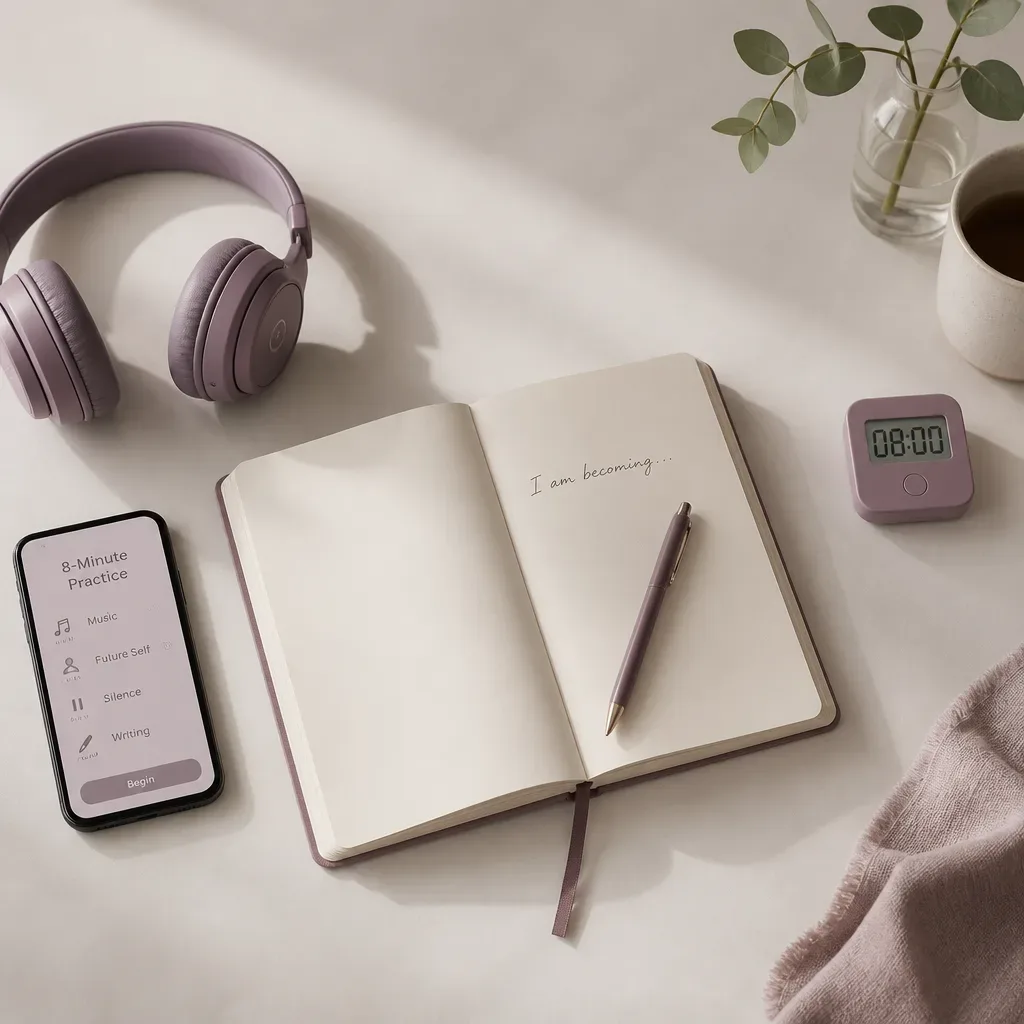
There is a quiet discipline in not decorating the practice too much. A chair. A pair of headphones. A short recording. Maybe a soft track before it. Then one sentence written in a notebook with the date. If you’re in Mumbai, like I am, this may happen before the first horn outside. If you’re somewhere colder and darker, it may happen under a blanket. The architecture is the same.
The audio you can repeat is better than the ritual you keep postponing.
What should you listen for in a good future-self audio?
Listen for specificity, believability, and a voice that feels close enough to enter.
A good future-self recording doesn’t shout at you. It doesn’t force certainty. It speaks from the life you’re practicing as if that life is already known, already ordinary, already yours. In Laura King’s 2001 research on writing about the best possible self, participants wrote for 20 minutes across 4 days, and the exercise was linked with increased positive mood compared with controls. The point wasn’t fantasy for its own sake. It was structured contact with a possible self.
Your future-self audio should have some of that structure. It should tell the truth about the life you intend, but in language your body doesn’t reject. If the recording says, I never feel fear, and you feel fear every morning, the sentence may split you in two. Better: I know how to move with fear and still choose the next true thing.
Look for these qualities:
- concrete scenes, not vague wishes
- present-tense language that feels lived-in
- emotional steadiness rather than hype
- a length you’ll actually repeat, often 3 to 7 minutes
- one or two phrases that stay with you during the day
If the recording is personal, it can meet you where a generic playlist can’t. It can name the work you do, the room you wake in, the way you speak to yourself, the kind of love you’re learning not to abandon. That level of detail matters. The mind holds images more readily when they’re specific.
You can still keep manifestation music in the practice. Let it be the lamp. Let the future-self audio be the letter on the table. If you’re building a daily manifestation practice, the manifestation pillar can hold the larger map, but the daily play button should remain simple.
Play the voice that brings you home.