astrology manifestation
Winter Solstice Manifestation: Listen Before You Plan
A quiet winter solstice manifestation ritual for listening first, writing second, and planning from the self you are already becoming.

A candle on the table. A kettle cooling. Winter solstice manifestation works best when you listen before you plan: mark the longest night, hear your future self through audio, write only what stays, then choose one small action for the next 48 hours. The ritual is quiet because the season is quiet.
Why should winter solstice manifestation begin with listening?
Winter solstice manifestation should begin with listening because the longest night asks for receptivity before intention.
The winter solstice is an astronomical event, not a mood. In the Northern Hemisphere, it usually falls on December 21 or 22; in 2026, the December solstice occurs on December 21 at about 15:50 UTC, according to timeanddate.com and standard astronomical calendars. It marks the moment the North Pole is tilted farthest from the sun. That is why the day is short and the night is long.
You can use that fact without making it loud. The point is not to perform spirituality. The point is to respect timing. New York gets about 9 hours and 15 minutes of daylight near the solstice. London gets about 7 hours and 49 minutes. Athens, where my grandmother used to dry mountain tea in paper sacks, gets about 9 hours and 31 minutes. The body notices these numbers even when the mind pretends it does not.
Planning is useful. Planning too soon can be a disguise for fear. The solstice is not asking you to fill the dark. It is asking you to sit in it long enough to hear what is still true. Listening is not a delay. Listening is the part of intention that stops you from lying to yourself.
This is where the AYA Method belongs, simply and clearly. The AYA Method is a daily audio manifestation practice. Each day you listen to a short personalized recording — your Dream-Self Moment — narrated from the version of you who has already manifested the life you intend. Listening is the practice. Repetition is the work. The audio is the method.
If you only do one thing on the solstice, listen. The app also includes a daily affirmation and Manifestation Board as complements, not pillars, but the ritual begins with sound. For a wider grounding in the practice, you can keep this manifestation guide beside you and return to it when the night feels too abstract.
The longest night is not empty. It is full of what you have not rushed past yet.
What do you need before the ritual begins?
You need very little: low light, a warm drink, your audio, paper, and enough privacy to stop performing.
I like a table cleared of everything except one candle, a cup, and a notebook. That is not because objects are magic by themselves. It is because the nervous system reads context quickly. A 2010 review in Health Psychology Review found that behavior is strongly shaped by cues and repeated settings. When you use the same corner, cup, or candle, the body starts to understand: this is where I listen.
Keep the materials plain. One flame. One pen. One audio practice. One page. A ritual becomes easier to repeat when it has fewer decisions inside it. Decision research often cites the rough finding that adults make thousands of small choices each day; even if the exact number varies by study, the felt load is real. On the solstice, reduce the load.
Here is the small kit I use in the greenhouse when the glass goes black before supper:
- A candle or shaded lamp
- A notebook that is not precious
- A pen that writes without scratching
- A warm drink, often sage, chamomile, or mountain tea
- Your Dream-Self Moment audio
- A timer set for 25 minutes
- A folded blanket or shawl
Do not cleanse the room until it becomes another way to delay. Do not buy new tools because a post told you to. If you work with plants, choose one herb and keep it humble. Chamomile has been studied for sleep and anxiety in small clinical trials, including work published in Phytomedicine in 2016. It does not need to promise anything grand. It can simply help the body soften.
The room does not need to look sacred. It needs to stop asking for your attention. A quiet table is a better altar than a beautiful one that makes you self-conscious.

How do you do the ritual step by step?
Do the ritual in five movements: prepare, listen, write, name, and act.
Set aside 25 minutes near sunset or before bed. If you cannot do the exact solstice night, use the night before or after. Astronomically, the solstice is a precise moment; ritually, the threshold can hold a little space on either side. Many seasonal traditions work this way. The old calendars were practical. People had fires to tend, animals to feed, bread to watch.
Follow this order:
- Lower the light for 5 minutes. Put your phone away unless it is playing the audio. Light one candle. Pour tea. Take 6 slow breaths. Dr. Andrew Huberman often teaches that deliberate breathing can affect autonomic arousal; even one to three minutes of slow exhale-focused breathing can help the body settle.
- Listen for 10 minutes. Play your Dream-Self Moment. Do not write while listening. Let the recording speak from the life you intend. If your mind argues, let it argue quietly. Return to the voice.
- Write for 7 minutes. Write the phrases that stayed. Not the clever ones. The true ones. If one sentence made your chest loosen, copy it exactly.
- Choose one winter intention. Keep it plain: “I practice receiving help,” “I protect my mornings,” “I finish the proposal,” or “I stop rehearsing old rejection.”
- Choose one action within 48 hours. Send the message. Block the hour. Wash the cup before bed. Small is not weak. Small is where the future can enter the room.
This order matters. In implementation-intention research, psychologist Peter Gollwitzer showed across many studies that pairing an intention with a specific cue, often phrased as “if X, then Y,” improves follow-through. The solstice ritual gives you the cue. The 48-hour action gives the intention a door.
If you practice affirmations, place one after the audio, not before it. Let the affirmation come from what you heard. That keeps it from becoming a slogan. One affirmation is enough. The sentence should feel like a hand on the shoulder, not a command.
What should you write after listening?
Write what you heard, what you resisted, and what you can practice before the year turns.
The page after listening is not a wish list. It is a witness. James Pennebaker’s expressive writing research, beginning in the 1980s and expanded across many studies, suggests that writing about emotionally meaningful material for even 15 to 20 minutes can support processing and health-related outcomes for some people. Your 7 minutes are smaller, but the principle is close: name what is inside so it does not have to speak through tension.
Use three prompts. Keep them in this order:
| Prompt | What it reveals | Example |
|---|---|---|
| What did I hear? | The clear signal | “I am allowed to move slowly and still arrive.” |
| What did I resist? | The old protection | “I wanted to dismiss the part about asking for help.” |
| What can I practice this week? | The first honest action | “I will send the invoice before Friday noon.” |
The second prompt matters. Resistance is not failure. It is information with its coat still on. When you resist a sentence from your Dream-Self Moment, ask whether it feels false or simply unfamiliar. Neville Goddard wrote often about assuming the feeling of the wish fulfilled. You do not have to take every metaphysical claim literally to use the practical question: what would I practice if this were already becoming normal?
Joe Dispenza’s work is often discussed in manifestation circles because he links rehearsal, emotion, and identity. Some of his claims are debated, and they should be read with care. Still, one grounded point is useful: repetition changes what feels familiar. Neuroscience broadly supports that repeated mental rehearsal can shape attention and behavior, especially when paired with action.
Do not write ten intentions. The winter body does not need ten fires. Choose one. If the intention is real, it will have branches later.
A true intention gets quieter when you write it down. It does not need to impress the page.
How can astrology support the ritual without taking over?
Astrology can support the ritual by giving language to timing, but it should not replace your own listening.
The solstice is tied to the Sun’s apparent movement into the sign of Capricorn in tropical astrology. Capricorn language often centers on structure, patience, responsibility, and time. That can be useful for manifestation because the solstice is not only a dream night. It is also a planning threshold. The light begins to return by seconds, then minutes. Growth is not dramatic at first.
If you want more context, read astrology and manifestation as a companion, not a rulebook. Astrology is most helpful when it asks better questions. Where do I need structure? What responsibility is actually mine? What have I outgrown but kept maintaining? A 2018 Pew Research Center report found that about 29% of American adults said they believed in astrology. Belief varies. Use what helps you listen. Leave the rest.
You can also check your birth chart if that is already part of your practice. Look at the house where Capricorn falls, or the house where the solstice Sun lands by transit. Keep it simple. If it falls near your 4th house, you may write about home and family patterns. Near the 10th, work and public role may speak louder. Near the 12th, rest, privacy, or release may be the honest topic.
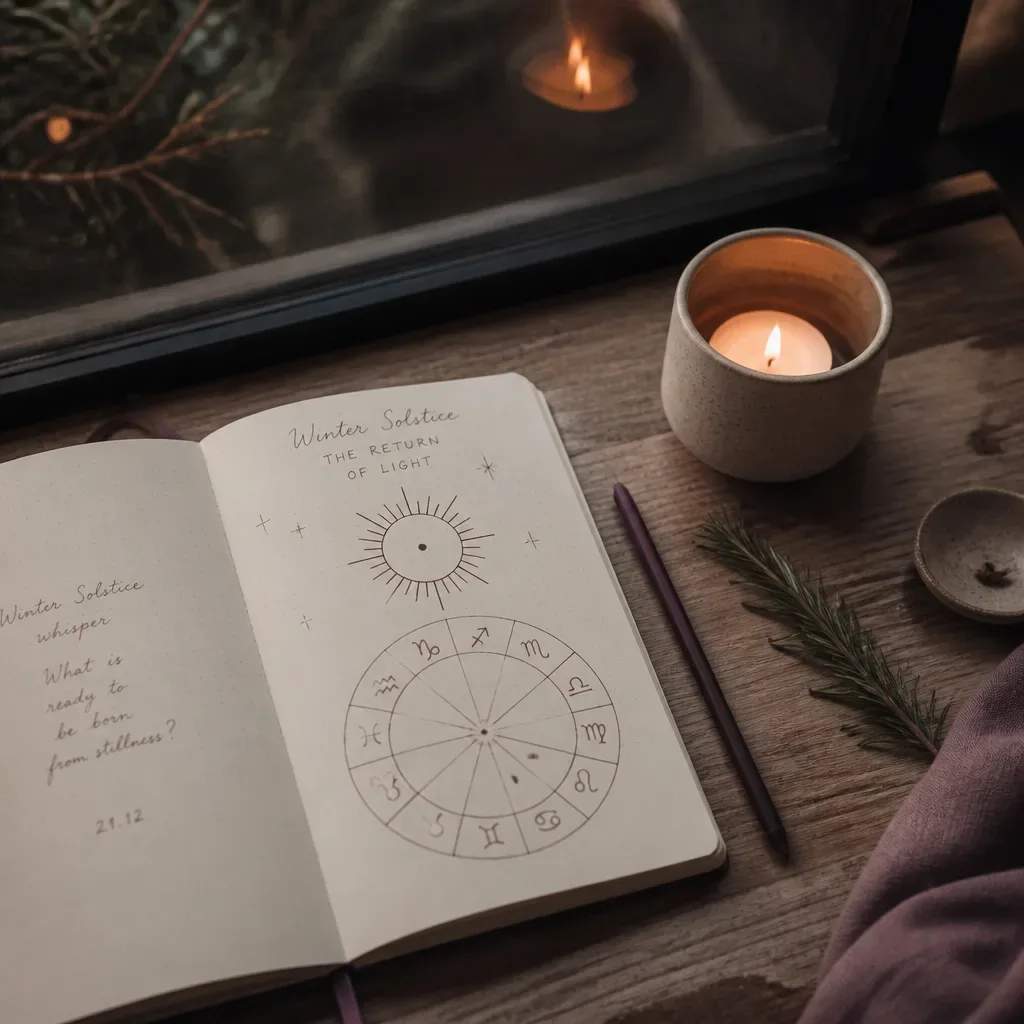
The danger is outsourcing your knowing. A chart can be a mirror. It should not become a master. The same is true of any manifestation tool, including a board, a card spread, or a list of signs. The core remains listening. If astrology makes you frantic, close the tab and return to the candle.
The solstice does not need you to decode everything. It needs one clean promise you can keep.
What mistakes make a solstice ritual feel heavy?
A solstice ritual feels heavy when you try to force certainty, beauty, or too many outcomes.
The first mistake is making the ritual photogenic. The camera changes the room. If you want a picture, take it after. During the ritual, let the cup be chipped. Let the notebook be plain. A 2023 Pew report on internet use noted that large majorities of adults are online daily; many people are already trained to make meaning visible for others. This ritual is private medicine. Do not turn it into content before it has spoken to you.
The second mistake is asking the longest night for a full-year plan. That is too much weight for one candle. Research on goals often points toward specificity and manageable steps. Gabriele Oettingen’s mental contrasting work, often taught through WOOP, pairs a wish with outcome, obstacle, and plan. The obstacle matters. It keeps desire attached to the ground.
Avoid these common traps:
- Writing a list of 20 desires and calling it clarity
- Choosing an intention because it sounds impressive
- Repeating an affirmation that makes your body tense
- Treating astrology as a verdict
- Skipping the audio and going straight to planning
- Waiting for the perfect mood before beginning
The third mistake is confusing discomfort with a no. Sometimes the truest sentence is uncomfortable because it asks you to stop betraying yourself in a familiar way. Sometimes it is uncomfortable because it is not yours. The difference is subtle. Give it 24 hours before deciding.
If you use a Manifestation Board, add only one image or phrase after the ritual. The board can hold a visual thread, but it is not the center. The same is true of manifestation practices that involve scripting or visualization. They can help. They should not drown the voice you just heard.
If the ritual makes you tense, make it smaller. The soul often enters through the smallest door.
How do you carry the intention into the weeks after solstice?
Carry the intention by repeating the audio daily and attaching one small behavior to a clear cue.
The solstice is not a finish line. It is a beginning so quiet you might miss it. In the days after December 21, daylight increases slowly in the Northern Hemisphere. In many places, the change is only seconds at first, then a few minutes. That is good teaching. You do not need a dramatic life change to prove the ritual worked. You need repetition that your body can trust.
Use a 7-day follow-through plan:
- Listen to your Dream-Self Moment at the same time each day.
- Read the one intention after listening.
- Take one action that matches it, even if it takes 5 minutes.
- Note one piece of evidence that you kept faith with yourself.
- Rest before adding more.
- Review the intention on day 7.
- Keep it, soften it, or make it more specific.
Repetition is not glamorous. It is how a new self becomes ordinary. Studies on habit formation vary widely, but a well-known 2009 study by Phillippa Lally and colleagues in the European Journal of Social Psychology found an average of 66 days for a new behavior to become automatic, with a wide range from 18 to 254 days. Seven days will not finish the work. It will start a track.
For more seasonal context, place this ritual beside astrology and manifestation and return to the AYA Method when you need the center again. The method does not ask you to chase signs. It asks you to listen daily to the self you are practicing becoming.
If you miss a day, do not dramatize it. Begin again the next morning. The winter sun does not apologize for rising slowly.
Leave one candle unlit for what is still becoming.