sleep hypnosis affirmations
Sleep Hypnosis Manifestation vs Dream-Self Audio
Sleep hypnosis manifestation and Dream-Self Audio both work with night listening, but they train different states, habits, and kinds of belief.
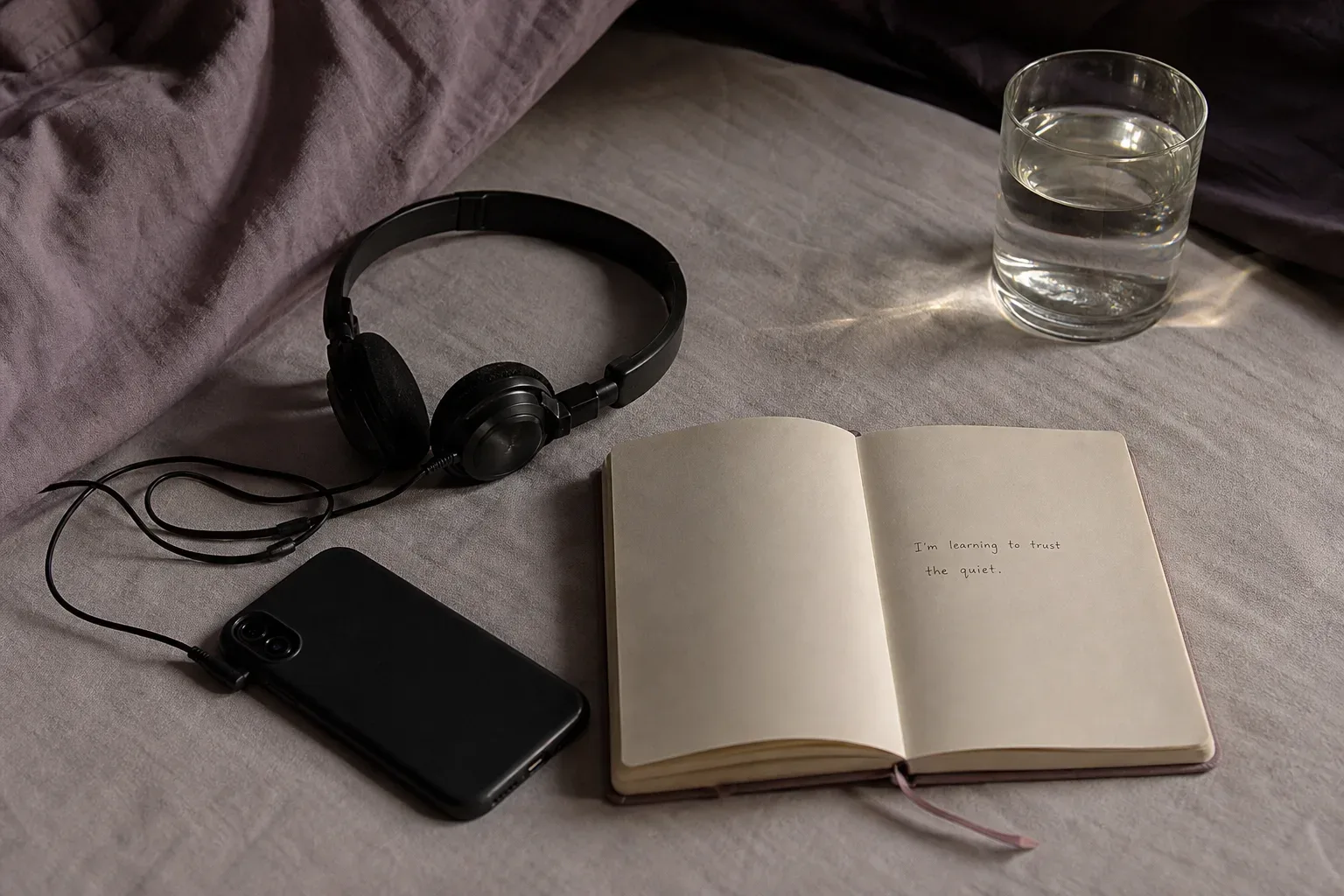
Your phone is face down on the sheet. The room has gone blue. Sleep hypnosis manifestation and Dream-Self Audio both use a relaxed mind, but they ask different things of you: hypnosis guides you toward sleep with suggestion, while Dream-Self Audio trains recognition through daily listening. One softens the doorway. The other gives you a voice to return to.
What is sleep hypnosis manifestation actually doing?
Sleep hypnosis manifestation uses relaxation and suggestion to speak to the mind when it’s less busy defending its old story.
Most recordings follow a familiar arc: slower breathing, body heaviness, counting down, then statements about the life you want to receive as true. The aim is not ordinary sleep advice. It’s a state of narrowed attention. In clinical hypnosis research, hypnotic response varies; Stanford researchers have long estimated that roughly 10% to 15% of adults are highly hypnotizable, while many sit in the middle range. That matters. Some people feel suggestion very vividly. Some simply get sleepy.
The useful part is not magic. It’s timing. Dr. Andrew Huberman often describes the transition into sleep as a period when the brain changes its relationship to external input and internal imagery. You know this threshold. The room is here, then less here. Your thoughts loosen their grip. Sleep hypnosis tries to place a new sentence inside that loosening.
A 2018 review in Sleep Medicine Reviews looked at hypnosis for sleep and found that 58.3% of included studies reported benefit, though study quality and methods varied. That’s a modest, careful finding. It says hypnosis may help sleep for some people. It does not prove that every manifestation script will create every desired outcome. The quieter claim is enough: a relaxed mind can rehearse a different self with less argument.
Sleep hypnosis is best understood as a doorway practice. It lowers the noise. It doesn’t always build a clear relationship with the future self you’re trying to know.
A soft mind can receive a sentence. A practiced mind can live from it.
What is Dream-Self Audio doing instead?
Dream-Self Audio asks you to listen daily to the future self until that voice becomes familiar enough to guide your ordinary choices.
The AYA Method is a daily audio manifestation practice. Each day you listen to a short personalized recording — your Dream-Self Moment — narrated from the version of you who has already manifested the life you intend. Listening is the practice. Repetition is the work. The audio is the method.
That definition is plain on purpose. It matters because the practice is not built around chasing a rare state. It is built around returning. The daily affirmation and Manifestation Board can support it, the way a candle or a notebook can support a room. They are not the center. The center is the audio. The center is hearing the already-real version of you speak from inside the life you intend.
This is close to Neville Goddard’s idea of living from the end, but the shape is different. Goddard wrote and taught for decades about assuming the feeling of the wish fulfilled. Dream-Self Audio gives that assumption a daily sound. Not a vague wish. A voice. A scene. A felt place you can revisit in 3 or 5 minutes.
Repetition matters here. In habit research, context and repetition are not small things. A widely cited 2009 study in the European Journal of Social Psychology found that automaticity took a median of 66 days to form, with wide variation from 18 to 254 days. That number gets repeated because it tells the truth gently: your mind learns through return, not performance.
Dream-Self Audio is not trying to catch you half-asleep. It can be heard before bed, yes. But it also works while you’re awake enough to notice what the recording asks you to remember.
Where do the two practices differ most?
The main difference is that sleep hypnosis manifestation leans on state, while Dream-Self Audio leans on relationship.
A sleep hypnosis recording often asks you to relax so deeply that suggestion can pass beneath your usual filters. Dream-Self Audio asks you to build familiarity with the person you’re becoming, one listen at a time. Both can be gentle. Both can help. But they train different muscles.
| Question | Sleep hypnosis manifestation | Dream-Self Audio |
|---|---|---|
| Main doorway | Drowsiness and relaxation | Daily recognition |
| Best time | Bedtime or naps | Any repeatable time |
| Script style | General suggestion or guided induction | Personalized future-self narration |
| Main risk | Falling asleep before receiving the message | Listening without letting it touch choices |
| Best use | Softening resistance before sleep | Training identity through repetition |
The distinction shows up in memory. Sleep supports consolidation; the National Institutes of Health notes that sleep helps stabilize memories and clear metabolic waste from the brain. But if you’re asleep before the core message arrives, your relationship to the words may be thin. With Dream-Self Audio, you’re often awake enough to hear the sentence and carry it.
This is why manifestation becomes more grounded when it’s specific. A broad phrase like “I receive success” may feel pleasant, then float away. A Dream-Self Moment can say, in your own terms, what your morning looks like, how your body feels, what kind of work you choose, and what you no longer negotiate.
The comparison is not a contest. It’s a question of fit. If your mind is loud at night, hypnosis may help you soften. If your intention feels distant during the day, Dream-Self Audio may help it become more real.
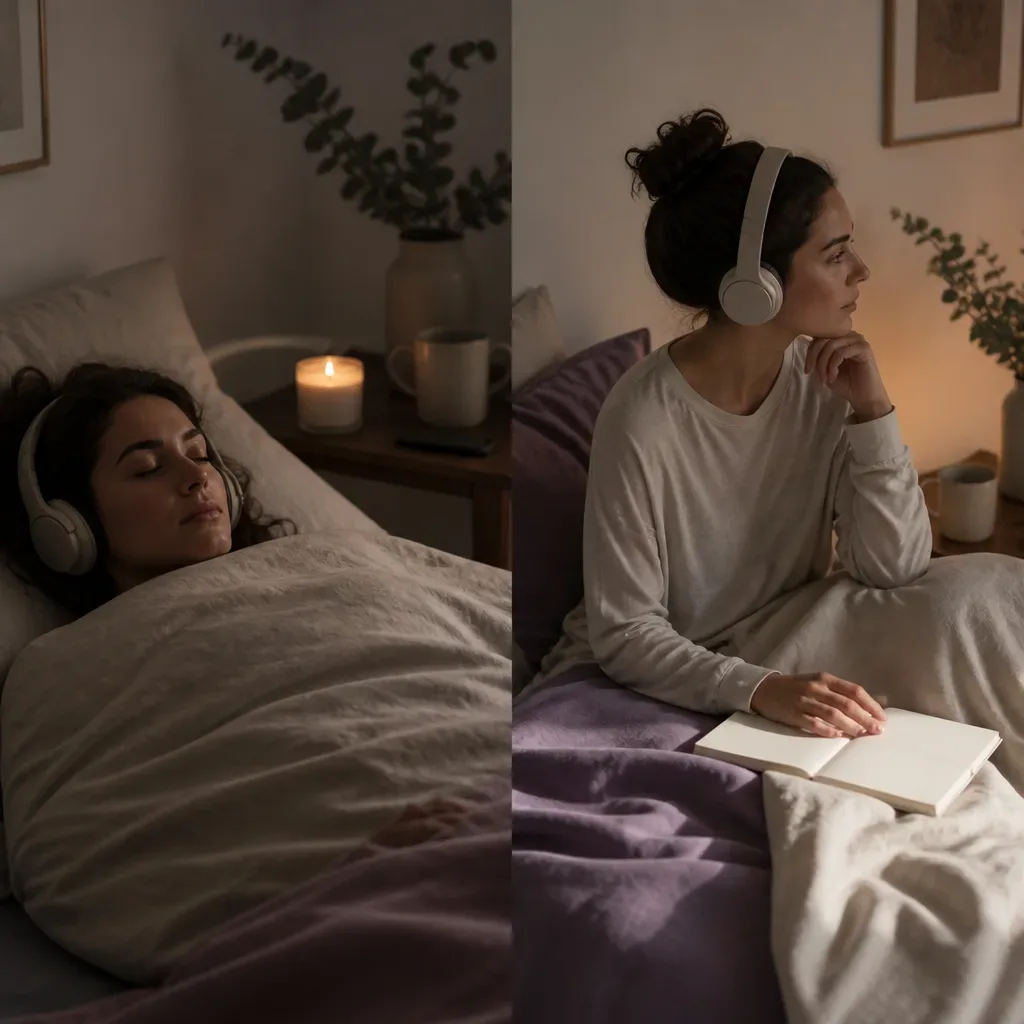
Which one works better if you fall asleep quickly?
If you fall asleep quickly, Dream-Self Audio usually gives you more usable contact because you can listen earlier, before sleep takes the words away.
This is practical. The American Academy of Sleep Medicine recommends at least 7 hours of sleep for most adults. If you’re protecting sleep, you may not want a 45-minute recording running through the night. You may want 4 minutes before the lamp goes off. You hear it. You place the phone down. You let sleep come without asking sleep to do all the work.
Sleep hypnosis can still be useful if it helps your body settle. But if your intention only reaches you after minute 22 and you’re gone by minute 6, the method becomes uncertain. Some people like that. They trust the sleeping mind. Others need to hear the words awake, once, with the inner yes still present.
Joe Dispenza’s meditations often use long-form repetition, breath, imagery, and emotional rehearsal. Many people find that structure helpful. But time matters. A practice that requires 40 minutes may become a weekend practice. A practice that takes 5 minutes can become daily. The quietest method is often the one you actually repeat.
If you want a clear test, try this for 14 nights:
- Choose one sleep hypnosis manifestation recording and use it for 7 nights.
- Choose one Dream-Self Audio recording and listen before sleep for 7 nights.
- Each morning, write one line: “What do I remember feeling as true?”
- At the end, compare not mood, but follow-through.
This is not laboratory science. It’s honest self-observation. In behavior change studies, self-monitoring is consistently linked with better adherence, especially when the record is simple. One line is enough.
The practice that stays with you after waking is the practice that has entered your life.
How do affirmations fit without taking over?
Affirmations fit best as a small carry-sentence after the audio, not as a replacement for the audio.
This matters because affirmations can be misunderstood. A sentence repeated without contact can become decoration. A sentence repeated after hearing your Dream-Self Moment can become a handle. You listen first. Then you take one line with you. The daily affirmation is a complement, not a second main pillar.
There is research worth holding gently here. A 2016 study in Social Cognitive and Affective Neuroscience found that self-affirmation activated brain systems related to self-processing and valuation, especially when people reflected on future-oriented values. That does not mean every phrase works. It suggests that personally meaningful language can change attention.
Use affirmations when they are simple enough to remember under ordinary pressure. Not ten lines. Not a paragraph. One sentence you can find while boiling water, opening email, or standing at the tram stop. A good affirmation does not shout. It returns.
Try these as filters rather than formulas:
- Does this sentence sound like me?
- Can I remember it without looking?
- Does it point back to the Dream-Self Moment?
- Does it ask for one real behavior today?
- Does it feel steady, not inflated?
The Manifestation Board can do similar supporting work. It gives the eye a place to land. But the board is still a complement. If the image is beautiful and the audio is absent, the practice can become visual longing. If the audio is present, the image has a voice behind it.
A good affirmation is not a spell. It’s a sentence your future self can stand inside.
What does science say about night listening and belief?
Science supports parts of night listening, especially relaxation, repetition, and memory, but it does not prove that any single manifestation recording controls outcomes.
That boundary is kind. Sleep learning research is mixed. Studies suggest the sleeping brain can process some sound cues, especially when tied to prior learning, but complex new learning during sleep is limited. A 2015 review in Trends in Cognitive Sciences described targeted memory reactivation as promising when cues reactivate material already learned while awake. In plain words: sleep may strengthen what you’ve already touched. It may not build the whole house for you.
This is where Dream-Self Audio has an advantage. You are not relying only on sleep. You are learning the voice while awake, then allowing sleep to carry what has already been heard. The nervous system likes repetition. The mind likes proof. Your day gives both.
Princeton’s Global Consciousness Project is sometimes mentioned in manifestation circles, especially in conversations about intention and collective attention. Its findings remain debated, and mainstream science has not treated them as settled proof. It’s better to be honest. The more dependable evidence sits closer to home: sleep affects memory, repetition affects habit, and self-relevant language affects attention.
You can also bring timing into this with care. Astrology and manifestation can help some people choose symbolic dates for beginning again, like a new moon or personal transit. But timing is not the practice. Listening is. A date can open the page. It cannot write the sentence for you.
The strongest claim is also the simplest: what you hear often begins to feel possible, and what feels possible becomes easier to choose.
What should you choose tonight?
Choose sleep hypnosis manifestation when you need help softening into rest; choose Dream-Self Audio when you want a daily relationship with the self you’re becoming.
You don’t have to reject one to honor the other. Use sleep hypnosis like a dimmer switch. Use Dream-Self Audio like a name being called from the next room. One helps the body loosen. The other helps identity become known.
A clear comparison can keep you from collecting practices instead of practicing:
| If you need | Choose | Why |
|---|---|---|
| A calmer bedtime | Sleep hypnosis manifestation | It supports relaxation and sleep onset |
| A specific future-self identity | Dream-Self Audio | It uses personalized narration |
| A very short daily ritual | Dream-Self Audio | It can be 3 to 5 minutes |
| Help releasing the day | Sleep hypnosis manifestation | It pairs suggestion with body rest |
| Continuity across weeks | Dream-Self Audio | Repetition is built into the method |
If you already use the AYA Method, keep the order simple. Listen to your Dream-Self Moment first. If you want, follow with a sleep hypnosis track for rest. The identity work has been heard. The body can then go down into sleep.
If you’re new to manifestation practice, start smaller than your ambition. Seven nights. One recording. One morning note. The aim is not to feel certain every time. The aim is to return often enough that the future stops feeling theatrical and starts feeling known.
There are nights when hypnosis will be the mercy. There are mornings when Dream-Self Audio will be the thread. Both can belong to a quiet life. Just don’t confuse being soothed with being shaped. Rest is holy. Repetition is craft.
The room is still, and your future voice is near.