astrology manifestation
Lunar Eclipse Manifestation: Listen Before Release
A quiet lunar eclipse manifestation guide for listening first, releasing with care, and returning to your future self through daily audio practice.
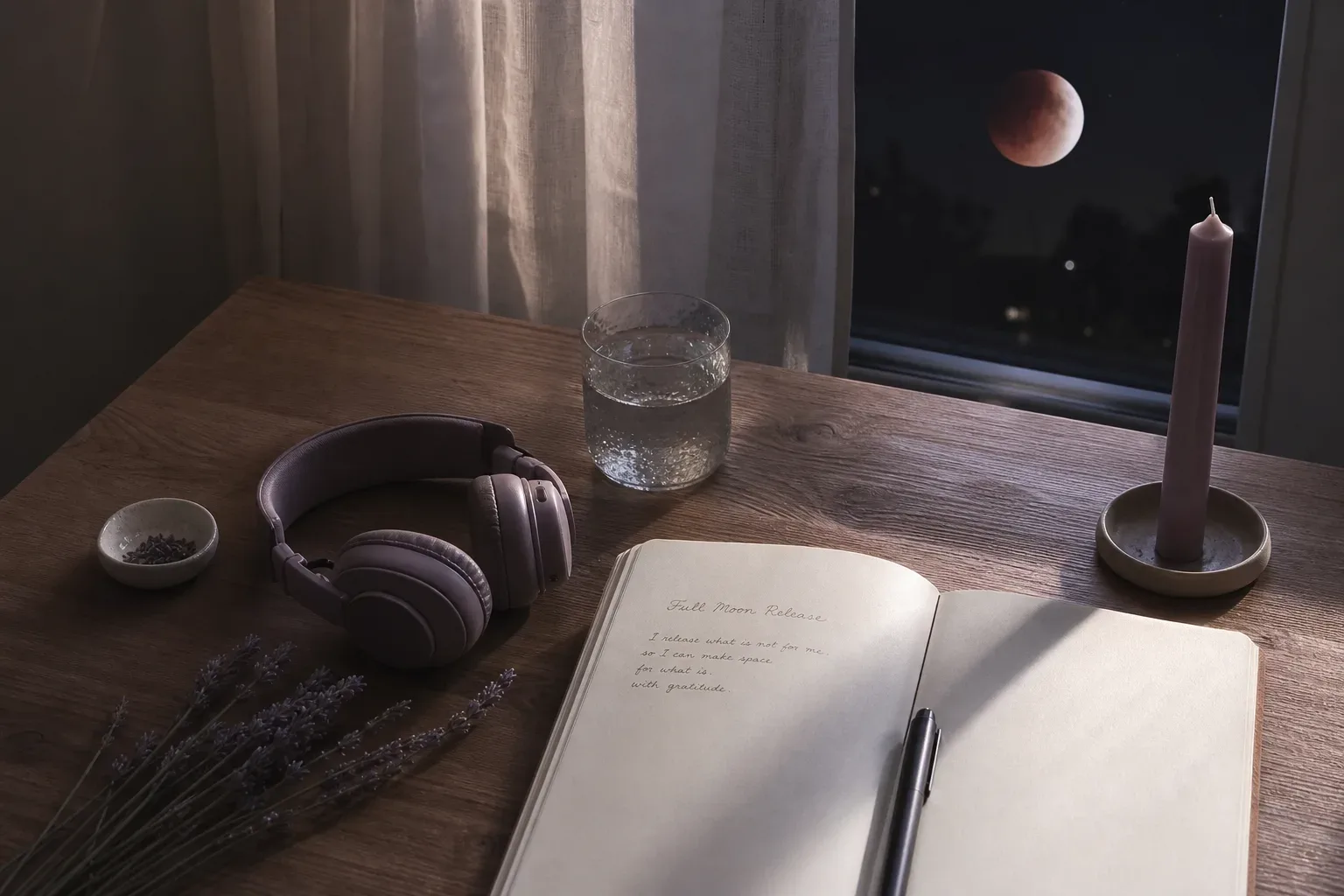
The moon darkens. The room stays ordinary. Lunar eclipse manifestation is best done by listening first, then releasing one thing with care. Use the eclipse as a mirror, not a deadline: hear your Dream-Self Moment, write what’s complete, choose one small release, and return to the audio tomorrow.
What changes during lunar eclipse manifestation?
A lunar eclipse gives your manifestation practice a clear threshold: something is seen, something is softened, and something is no longer fed.
Astronomically, a lunar eclipse happens only at a full moon, when Earth moves between the sun and the moon and casts its shadow across the lunar surface. NASA notes that total lunar eclipses can last for more than an hour, while the full penumbral and partial phases can stretch across several hours. The sky does not ask you to hurry. It shows you timing.
Astrologically, people often treat a lunar eclipse as a full moon with stronger contrast. Not louder. Clearer. The feeling is less about asking for more and more about seeing what has been taking up space. If manifestation is the practice of becoming familiar with a chosen reality, eclipse work asks a quieter question: what makes that reality harder to live?
This is why lunar eclipse manifestation can feel different from a new moon intention. New moon work often begins with planting. Full moon work often begins with seeing. Eclipse work begins with interruption. In 2022, Pew Research Center reported that about 29% of U.S. adults said they believed in astrology; that number does not prove astrology, but it does show how many people use celestial timing as a language for self-reflection.
A ritual does not need to prove the sky controls you. It only needs to help you listen to yourself without lying.
Why should you listen before you release?
You listen before you release because the future self gives the release a direction.
Many release rituals begin with a list: the old pattern, the fear, the name, the habit, the sentence you keep repeating. That can help. But without a felt sense of what you’re returning to, the release can become an empty gesture. You put something down, then pick it up again because your nervous system still recognizes it as home.
The AYA practice begins somewhere else. The AYA Method is a daily audio manifestation practice. Each day you listen to a short personalized recording — your Dream-Self Moment — narrated from the version of you who has already manifested the life you intend. Listening is the practice. Repetition is the work. The audio is the method.
That order matters during eclipse work. Audio enters before argument. A 2019 review in Neuroscience & Biobehavioral Reviews noted that repeated mental rehearsal can influence attention, emotion, and behavior, especially when paired with vivid internal cues. You’re not trying to force a feeling. You’re giving the mind a known place to return.
Neville Goddard taught that feeling the wish fulfilled was central to imaginal practice. Joe Dispenza writes often about rehearsing a future self until the body begins to recognize the choice. You do not have to take either teacher as doctrine. The practical point is simple: if you can hear where you’re going, you can release what does not belong there.
Release without listening can become self-punishment. Listening first makes release an act of recognition.
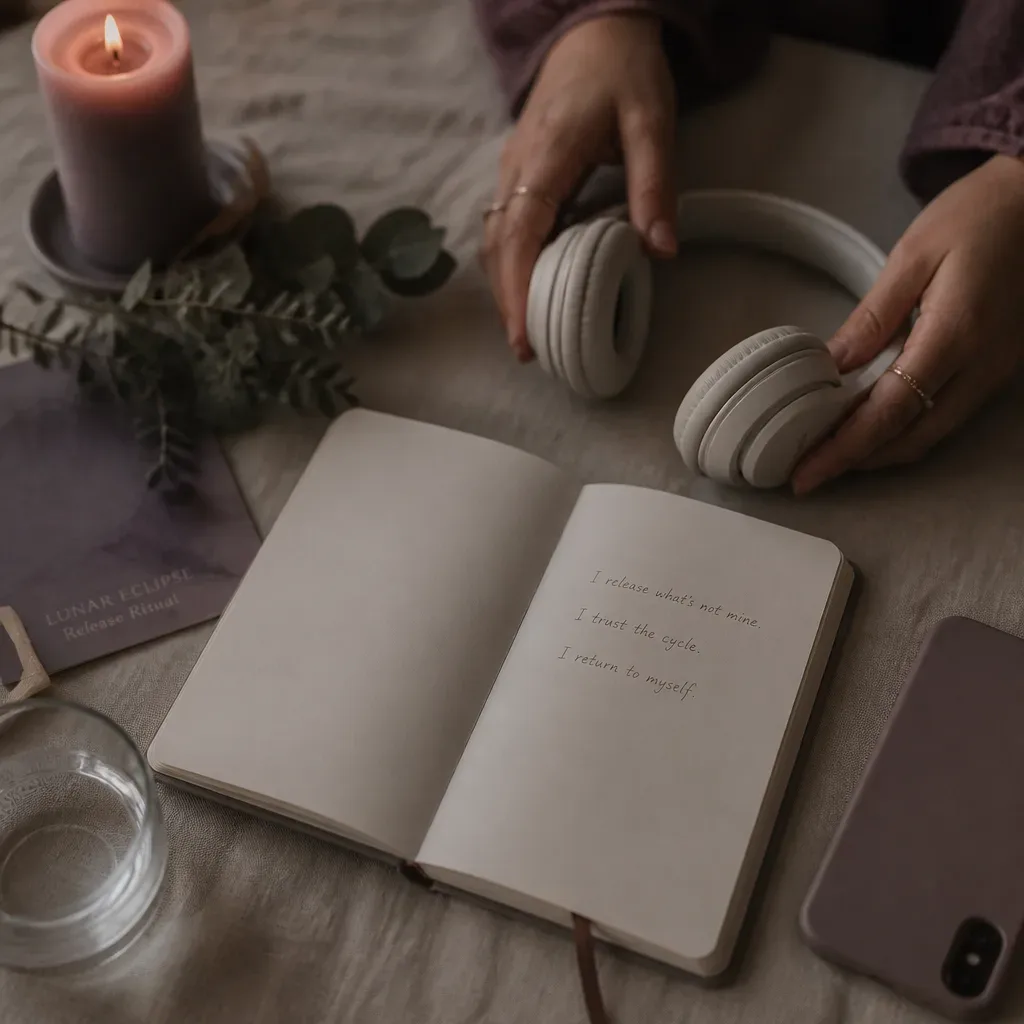
How do you prepare a 20-minute lunar eclipse ritual?
Prepare by making the ritual small enough that your body can trust it.
Twenty minutes is enough. Longer is not always truer. A 2020 study in Frontiers in Psychology found that brief mindfulness practices, even around 10 minutes, can reduce stress markers and improve attention in some participants. You’re not building a ceremony to impress anyone. You’re making a quiet room where you can tell the truth.
Before you begin, check the eclipse timing if that helps you feel held by the sky. NASA and Timeanddate.com publish local visibility windows for eclipses. If the eclipse is not visible where you live, the ritual still works as symbolic timing. The moon does not have to be visible to be useful.
Set out only what you need:
- headphones
- a glass of water
- a notebook
- one pen
- a candle, if flame is safe
- a timer set for 20 minutes
Then remove what turns the practice into performance. No phone scrolling. No long playlist hunt. No five-page script. If you use the app, let the audio be the center. The daily affirmation can support the moment, and the Manifestation Board can remind you visually, but they are complements. The listening is the practice.
Here is a simple structure:
| Minute | Practice | Why it helps |
|---|---|---|
| 0–2 | Sit, breathe, lower the light | Marks the threshold |
| 2–7 | Listen to your Dream-Self Moment | Gives the release direction |
| 7–12 | Write three true lines | Names what is complete |
| 12–17 | Choose one release | Keeps the work honest |
| 17–20 | Drink water and close | Returns you to the body |
A small ritual done honestly is stronger than a large ritual done for display.
What do you actually do during the eclipse window?
During the eclipse window, you listen once, write plainly, release one thing, and close without bargaining.
Start seated. Let your feet touch the floor or tuck them under you. Put on headphones. Play your Dream-Self Moment once. Not twice to get it right. Once, with attention. Dr. Andrew Huberman has often spoken about the role of attention in nervous system change; in basic terms, the brain learns what it repeatedly attends to. Give your attention one clean object.
Then write three sentences. Not a page. Not a confession. Three sentences that begin like this:
- “I see that I have been carrying…”
- “I no longer need to prove…”
- “The version of me I heard in the audio does not keep feeding…”
Keep the language plain. If you write, “I release fear,” ask for the smaller truth. Fear of what? Being seen? Losing approval? Resting before everything is finished? In clinical writing research, James Pennebaker’s work on expressive writing has often used short sessions of 15 to 20 minutes across several days. The benefit comes less from pretty language and more from coherent naming.
Now choose one release. One. A lunar eclipse can tempt you into dramatic cleaning: delete the number, change the plan, announce the ending. Sometimes life needs action. Still, the ritual itself should be narrow. Write one sentence: “I release the belief that…” Then finish it with something specific enough to recognize tomorrow.
Examples:
- “I release the belief that rest has to be earned.”
- “I release the habit of checking for approval before I begin.”
- “I release the old loyalty to being unseen.”
- “I release the story that slow means late.”
If you want a broader foundation for timing your practice with the sky, keep Astrology and manifestation nearby. The sky can be a calendar. It should not become a cage.
What should you release, and what should you keep?
Release what keeps contradicting your chosen self, and keep what makes that self easier to live.
This is where eclipse work becomes tender. Not every old thing is bad. Some patterns protected you for years. Some guarded you when you had fewer choices. A lunar eclipse manifestation ritual is not a trial. It is a listening room. You’re allowed to thank what helped you survive before you stop letting it lead.
Use this test: after hearing your Dream-Self Moment, ask, “Would she still need this?” If the answer is no, ask one more question: “What was this trying to protect?” That second question matters. A 2005 review by Baikie and Wilhelm in Advances in Psychiatric Treatment found that expressive writing can support emotional processing, but the tone of writing matters. Cruel clarity is still cruelty.
Release these, if they’re true:
- the belief that urgency makes you worthy
- the need to rehearse rejection before it arrives
- the habit of shrinking good news
- the fear that being calm means you do not care
- the story that your timing has already passed
Keep these:
- the boundary that helps you sleep
- the friend who tells the truth softly
- the practice you can repeat on a normal Tuesday
- the desire that still feels clean after fear quiets
- the part of you that knows before it can explain
If affirmations help you steady the release, use one. Keep it short. The affirmations that work best here are not declarations shouted over doubt. They are sentences the body can almost believe. “I can stop carrying what is not mine” is enough.
What is yours will not require you to abandon yourself to keep it.

How do you close the ritual without making it too big?
You close the ritual by returning to the body and refusing to turn the eclipse into a test.
Drink water. Put the pen down. Blow out the candle if you used one. If you wrote a release sentence, you can fold the paper and place it under a book overnight. You do not need to burn it. Fire is not more true than paper. Safety is part of the practice.
The closing matters because the nervous system learns from endings. In habit research, Wendy Wood has written that stable cues make behaviors easier to repeat over time; a cue can be as simple as headphones on the bedside table. If your ritual ends in frantic checking, the body remembers frantic checking. If it ends in stillness, the body remembers that too.
You might close with one of these lines:
- “I have heard what I needed to hear.”
- “I release only what is ready to leave.”
- “I do not have to prove this tonight.”
- “I will return tomorrow.”
Then sleep, or at least lower the day. No search spiral. No asking three more people what the eclipse means. If you need language for the wider practice, the manifestation guide can hold the bigger frame. But tonight, do less.
The release is not real because it was dramatic. It becomes real when you stop feeding the old sentence tomorrow morning.
What do you do the morning after a lunar eclipse?
The morning after, you repeat the audio and choose one ordinary action that agrees with what you released.
This is the part people skip. The eclipse night feels charged. The next morning feels like laundry, coffee, unread messages, a face in the mirror. Good. That is where manifestation becomes honest. A practice that only works under a red moon is too fragile for a human life.
Listen again. The audio is not a souvenir from last night. It is the method. If the AYA app also gives you a daily affirmation or a visual board, use them as support, but do not confuse support with the center. The center is hearing the future self until her voice becomes familiar in small decisions.
Choose one action that proves nothing and changes the shape of the day by 2%. Gollwitzer’s 1999 work on implementation intentions found that “if-then” planning can increase follow-through across many goal settings. Make it plain:
- If I reach for approval, then I will pause for one breath first.
- If I start rushing, then I will put both feet on the floor.
- If I doubt the release, then I will listen again before deciding.
- If I want to hide, then I will send the honest message.
You can also mark the lunar rhythm for the next 14 days, from full moon toward dark moon. Not with pressure. With noticing. Write one line each morning: “Today I did not feed…” Then name the old pattern. Fourteen lines will show you more than one dramatic night ever could.
For a wider way to work with moon timing, return to astrology and manifestation. Let the sky give you structure. Let your listening give you truth.
The moon goes quiet, and you listen.