audio manifestation
Sleep Manifestation Audio Before Bed: A Quiet Guide
Learn how to use sleep manifestation audio before bed with a simple 12-minute ritual that supports attention, rest, and repetition.
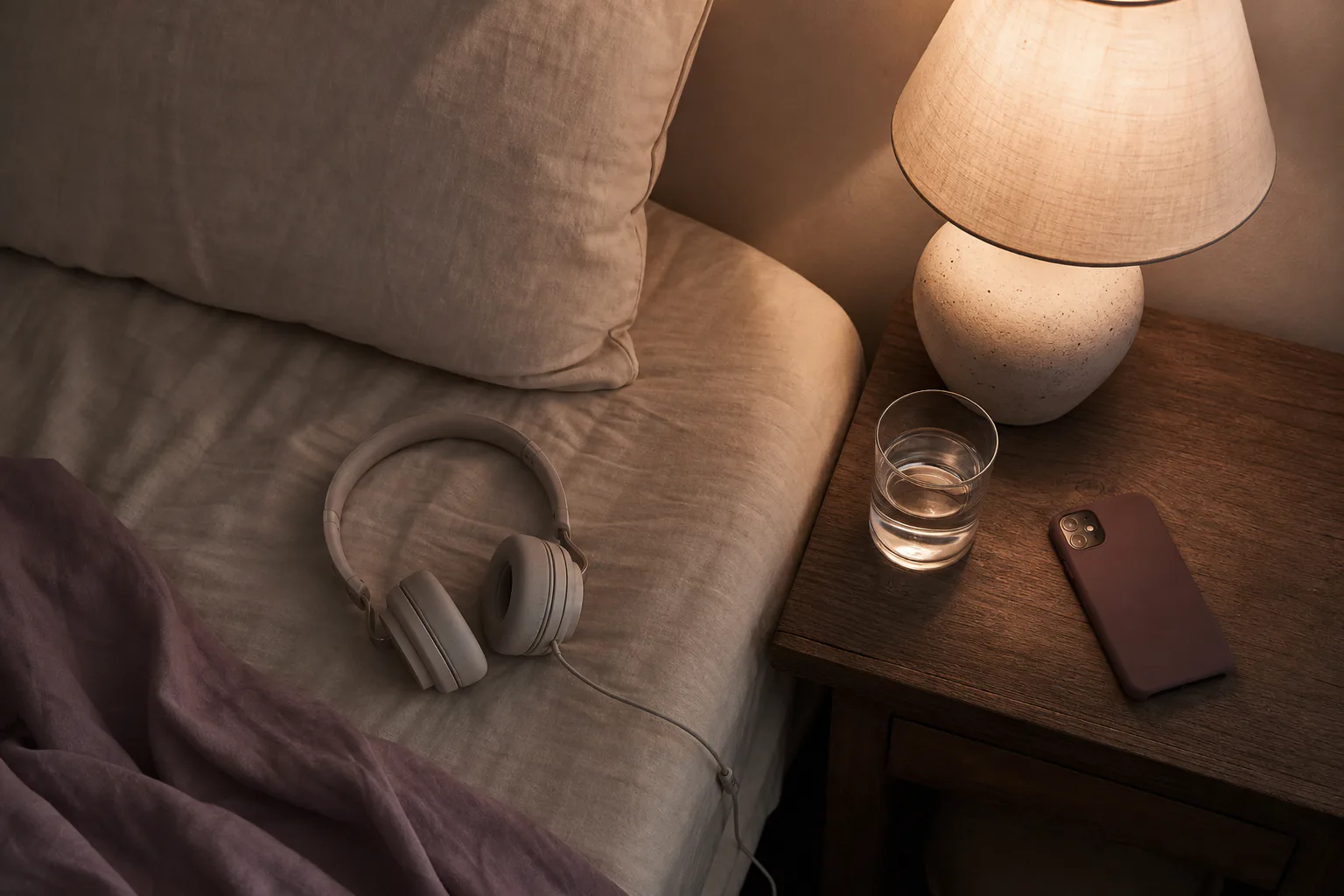
The lamp is low. Your teeth are brushed. A sleep manifestation audio works best when you treat it as the last clear signal of the day: a short recording, heard softly, that lets your attention rehearse who you’re becoming before sleep takes over.
What is a sleep manifestation audio, really?
A sleep manifestation audio is a short bedtime recording that helps you rehearse a chosen future self while your mind is quiet enough to receive repetition.
It is not a spell. It is not a demand placed on the night. It is a listening practice. You place words, images, and emotional cues near the threshold of sleep, then return to them again tomorrow. The American Academy of Sleep Medicine says most adults need at least 7 hours of sleep each night; a good bedtime practice should respect that number, not steal from it.
In the AYA Method, the definition is precise: The AYA Method is a daily audio manifestation practice. Each day you listen to a short personalized recording — your Dream-Self Moment — narrated from the version of you who has already manifested the life you intend. Listening is the practice. Repetition is the work. The audio is the method.
That matters because sleep is already full of inputs. Light, scrolling, arguments, unfinished plans, the last thing you read. A 2023 Sleep Foundation survey reported that many adults use screens within an hour of bed, and blue-enriched light has been shown in laboratory studies to delay melatonin timing. Your audio is not trying to control sleep. It is trying to become the final thing you hand your attention.
A good sleep manifestation audio has 3 qualities: it is short, believable enough to stay with, and voiced in the present tense. It doesn’t shout at your mind. It makes a room inside you.
The last voice you hear before sleep should not be the voice of panic.
If you’re new to manifestation, begin gently. Manifestation here means repeated inner rehearsal paired with chosen attention and daily action. The recording is not a substitute for your life. It is a small way of returning to the life you say is yours.
How do you prepare your room before listening?
Prepare the room by removing stimulation, lowering light, and making the audio easy to start without extra decisions.
The preparation should take 2 minutes. More than that, and it becomes another task. Dr. Andrew Huberman has often recommended reducing bright light exposure late in the evening because light is one of the strongest signals for circadian timing. You don’t need a perfect sleep cave. You need less negotiation.
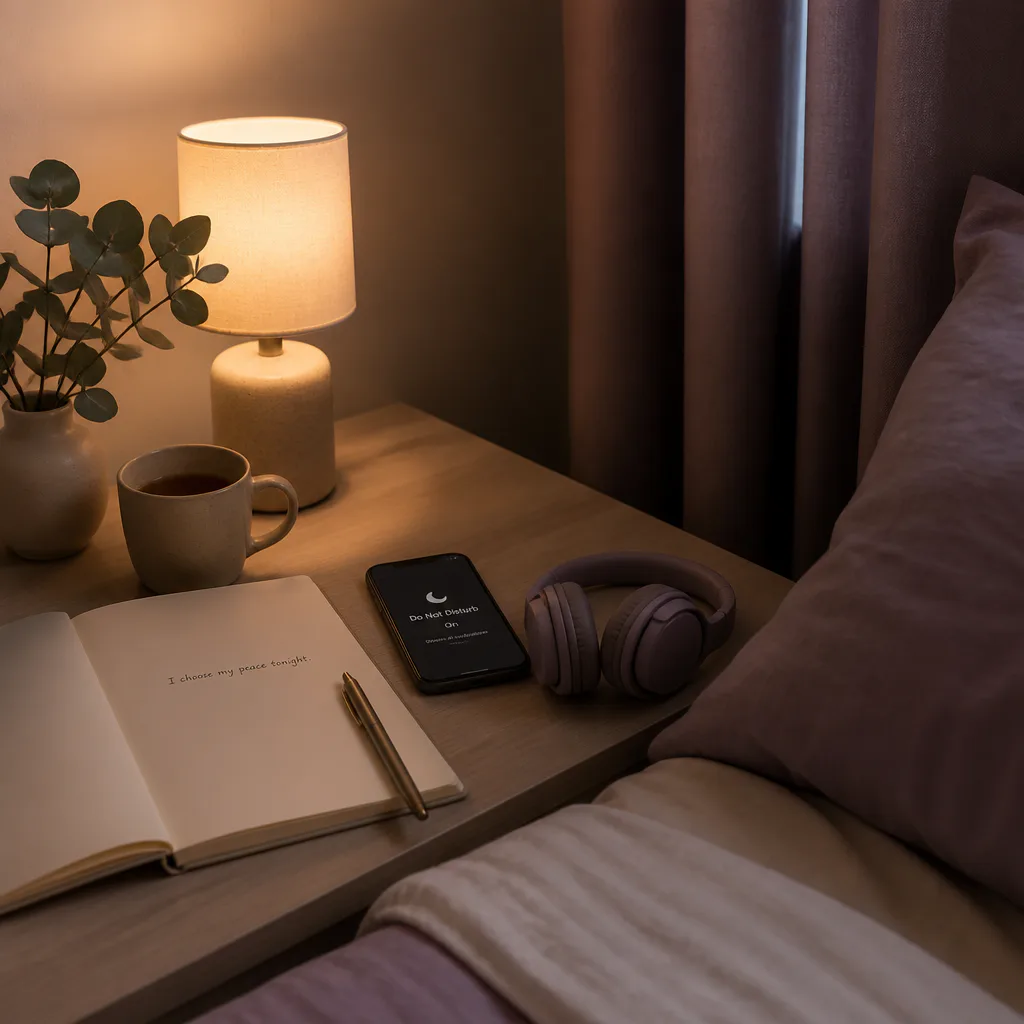
Here is the quiet order I use when clay dust is still under my nails and my mind wants one more hour:
- Put the phone on Do Not Disturb.
- Dim the room or switch to one warm lamp.
- Place the audio where you can press play once.
- Set water nearby, so you don’t get up again.
- Choose one sentence from the audio to remember if you wake.
If you share a bed, tell the person beside you what you’re doing. One sentence is enough: “I’m going to listen for 10 minutes before sleep.” A 2019 Pew Research Center report found that 28% of partnered adults said their partner was often or sometimes distracted by a phone. Bedtime practices do better when they don’t become secret phone use.
A room also holds unfinished things. The laundry chair. The message you didn’t answer. The bill. Do not solve them from bed. Write one line on paper if you must: “Tomorrow at 10, I will look.” Implementation intention research by Peter Gollwitzer has shown across dozens of studies that specific if-then plans increase follow-through. The mind calms when it knows where a task will land.
Use this small table as a check, not a rulebook:
| Bedtime cue | Why it helps | Quiet version |
|---|---|---|
| Lower light | Supports melatonin timing | One lamp, screen down |
| Same audio | Builds familiarity | Repeat for 7 nights |
| Low volume | Reduces alerting | Whisper level |
| No notes after | Protects sleep pressure | Let it end |
A ritual works because it removes the need to keep deciding.
What should you do while the audio is playing?
While the audio plays, listen with the body first and let the words arrive without forcing belief.
Lie down. Let your jaw soften. Put one hand on the ribs or belly if that feels steady. You don’t need a special breathing pattern, though slow nasal breathing can help some people downshift. In small clinical studies, paced breathing around 6 breaths per minute has been associated with increased heart rate variability, a marker linked to parasympathetic activity.
The main instruction is simple: don’t argue with the recording. If your audio says, “I move through tomorrow with steadiness,” and your mind says, “No, you don’t,” let both be there. You are not trying to win a courtroom case. You are letting a new sentence become familiar.
This is where a sleep manifestation audio differs from ordinary positive thinking. It is sensory. You listen to tone, tempo, breath, and image. You hear yourself already inside the changed pattern. Neville Goddard often taught imaginal acts before sleep; you don’t have to adopt every metaphysical claim to understand the psychological usefulness of rehearsing from the state fulfilled.
If the AYA app also gives you a daily affirmation, use it as a small companion earlier in the day. The audio remains the method. The affirmations can help you name one sentence. The bedtime listening helps you hear it as a place you can return to.
Try this during the recording:
- Let one image become clear, not ten.
- Notice the body sensation of already being safe enough.
- Let the narrator carry the structure.
- If you drift, drift.
- If you wake at the end, don’t grade yourself.
Sleep onset is not always linear. The National Institutes of Health notes that adults cycle through sleep stages roughly every 90 minutes. Your practice doesn’t need to control those cycles. It only needs to stop adding noise.
You don’t need to force belief; you need to stop rehearsing the opposite every night.
How long should the bedtime audio be?
The best bedtime audio is usually 5 to 12 minutes, short enough to repeat and long enough to create a felt shift.
Long recordings can feel comforting at first, but tired attention has limits. If an audio asks too much of you at 11:40 p.m., you will stop using it by night 4. A 2022 review in sleep medicine literature noted that consistency of bedtime routines matters more than complexity for sleep hygiene. Simple repeats.
I like 7 to 10 minutes for most people. It gives enough time for the body to understand, “This is the turn toward sleep,” without becoming a second evening. If you are highly anxious at night, begin with 5 minutes and add only if your body asks for more. If you fall asleep before it ends, that is not failure. The last conscious doorway still mattered.
For the AYA Method, daily repetition is the work. Many habit studies are misquoted as “21 days,” but a 2009 study in the European Journal of Social Psychology by Phillippa Lally and colleagues found habit formation varied widely, with an average of 66 days for automaticity in the studied behaviors. Let that humble you in a kind way. A week is a beginning. A month is a relationship.
Here is a simple timing guide:
| Your state at bedtime | Suggested length | What to watch |
|---|---|---|
| Calm but unfocused | 8–12 minutes | Wandering thoughts |
| Anxious or wired | 5–7 minutes | Feeling pressured |
| Very sleepy | 3–5 minutes | Falling asleep fast |
| Grieving or tender | 5–10 minutes | Language feeling too sharp |
The right length is the one you can meet again tomorrow. This is also why I prefer one recording for a season, not a new one every night. Novelty wakes the mind. Familiarity lets it lower its shoulders.
If you’re curious how audio fits within a larger practice, read more about an audio manifestation practice. Keep the order clear. Listen first. Add visual or written complements only if they help you stay close to what is true.
What words should your sleep manifestation audio include?
Your audio should use present-tense, embodied, specific language that feels close enough for your nervous system to stay open.
The words matter. A sentence that is too grand can create inner recoil. A sentence that is too vague gives the mind nothing to hold. In clinical psychology, cognitive rehearsal and imagery have been used for decades in performance, anxiety treatment, and behavior change; the details vary, but specificity is a recurring factor.
Use language that points to lived evidence. Not “I am perfect.” Try “I answer the message before noon.” Not “Everything is fixed.” Try “I wake and choose the next honest step.” The brain likes scenes. In neuroscience, mental imagery activates some overlapping neural systems with perception, though not identically; studies using fMRI have shown partial overlap between imagined and seen objects.
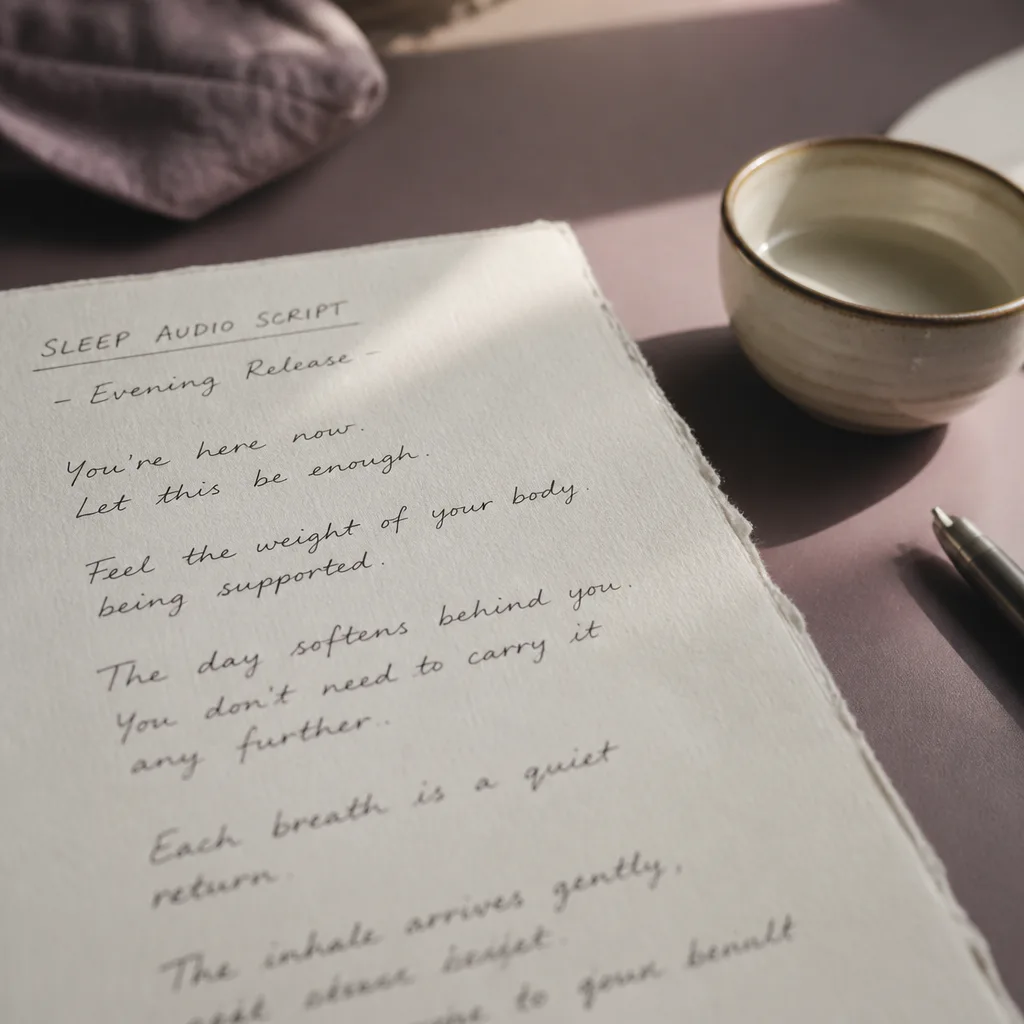
A good bedtime script often includes 4 kinds of lines:
- Identity: “I am someone who returns to what matters.”
- Body: “My shoulders soften because the day is complete.”
- Behavior: “I choose the first small action in the morning.”
- Evidence: “I notice the proof I used to rush past.”
If you use astrology as a reflective timing tool, keep it gentle. A moon phase or transit can be a prompt, not a command. The quiet way is to ask, “What am I practicing this week?” You can read Aya’s note on astrology and manifestation if timing helps you listen more closely.
Avoid words that make your body tighten. Avoid promises that remove your agency. Avoid scripts that make rest feel like a test. A 2018 study in the Journal of Experimental Psychology found that writing a specific to-do list before bed helped some participants fall asleep faster than writing completed tasks. The mind often rests when future action is named clearly.
The future self should sound like home, not like a stranger giving orders.
What if you fall asleep, cry, or feel nothing?
If you fall asleep, cry, or feel nothing, the practice is still working as a repetition of attention, not as a performance.
Falling asleep is allowed. Crying is allowed. Feeling bored is allowed. The nervous system has many ways of meeting new language. Some nights the words land. Some nights they pass over you like rain on a roof. You don’t need to make each session meaningful.
Crying can happen when the audio names something you stopped letting yourself want. Keep it simple. Place a hand on the chest. Let the recording continue or stop it if you need to. If night brings panic, trauma memories, or a sense of being unsafe, pause the practice and seek support. The World Health Organization estimates that anxiety disorders affect hundreds of millions of people worldwide; care is not a failure of manifestation.
Feeling nothing may be the most common response. That is fine. Clay doesn’t look changed after the first pass of water either. Repetition is quiet before it is visible. Joe Dispenza often speaks about mental rehearsal and emotional state; you don’t have to accept every claim to see the practical point: what you repeat becomes easier to access.
If the audio begins to irritate you, check 3 things:
- Is the volume too loud?
- Is the wording too far from what you can believe?
- Are you listening too late, when you’re already resentful?
Adjust one thing at a time. In behavioral research, changing too many variables makes it harder to know what helped. Try 3 nights at a lower volume before changing the whole script. Try listening 20 minutes earlier before deciding the practice is wrong for you.
Do not use the morning to interrogate the night. If you remember one line, write it down. If you remember nothing, continue. The body learns through return.
How do you make it a 7-night practice?
Make it a 7-night practice by choosing one audio, one start time, and one tiny sign of completion.
Seven nights is not magic. It is just long enough to notice friction. By night 3, you will know what interrupts you. By night 5, you will know whether the language feels true enough. By night 7, you have evidence. The CDC has reported that about 1 in 3 U.S. adults don’t get enough sleep, so your practice must protect rest first.
Use this plan:
- Night 1: Listen without changing anything. Notice your first resistance.
- Night 2: Lower the volume until the body stops reaching for the sound.
- Night 3: Remove one bedtime distraction.
- Night 4: Choose one line to carry into morning.
- Night 5: Pair the line with one action under 10 minutes.
- Night 6: Let the audio end without notes.
- Night 7: Ask, “What became easier to remember?”
This is where a Manifestation Board can help, but only as a complement. If one image from the audio keeps returning, place it where you can see it during the day. Do not turn the board into another project. The listening is still the center.
You may also want to read the broader manifestation guide if you need a clearer definition of attention, repetition, and action. If one sentence from the sleep audio becomes a daytime anchor, the affirmations guide can help you keep it clean and usable.
Track lightly. A checkmark is enough. Research on self-monitoring in behavior change, including reviews in health psychology, often finds that tracking can improve follow-through. But tracking can also become pressure. Keep it small enough that your future self would thank you.
The most useful question after 7 nights is not, “Did my life change?” It is, “Did I become more available to the life I keep saying I want?” That question is honest. It doesn’t rush the kiln.
Leave the audio by the bed, and let the night stay soft.