mindset
Inner Critic Meditation: 5-Minute Future-Self Audio
A quiet inner critic meditation using a 5-minute future-self audio, with simple steps to soften harsh self-talk and return to what is true.

Your phone is face down. The room is not special. An inner critic meditation can take 5 minutes: name the harsh thought, listen to a future-self audio, breathe, and answer from a steadier voice. The point is not to silence yourself. The point is to know which voice is yours.
What is an inner critic meditation, really?
An inner critic meditation is a brief practice for noticing harsh self-talk and responding without becoming harsh back.
The inner critic is not always loud. Sometimes it sounds practical. You should be further. You missed your chance. Everyone else knows how. Cognitive therapists have studied automatic thoughts since Aaron Beck named them in the 1960s, and the pattern is familiar: a sentence repeats until it feels like fact. Meditation gives you 1 small space before belief.
This matters because inner speech is common, not strange. In a 2011 review in Frontiers in Psychology, researchers Russell Hurlburt and Charles Fernyhough described inner speech as varied and frequent, though not constant. Some people hear full sentences. Some get images. Some feel a pressure in the chest before words arrive. Your practice can meet any of these forms.
A future-self audio changes the posture of the meditation. You are not sitting alone with a scolding mind. You are listening to a version of you who has more room inside. The AYA Method is a daily audio manifestation practice. Each day you listen to a short personalized recording — your Dream-Self Moment — narrated from the version of you who has already manifested the life you intend. Listening is the practice. Repetition is the work. The audio is the method.
That distinction is small, and important. The audio leads. A daily affirmation can support it. A Manifestation Board can give your eyes something to return to. But the method is the listening.
The critic gets quieter when it is no longer the only voice in the room.
Why does future-self audio help the critic soften?
Future-self audio helps because it gives your mind a rehearsed alternative to the harsh sentence it already knows.
Your brain learns by repetition. That is not mystical. It is ordinary. In 1949, psychologist Donald Hebb described the principle often shortened to cells that fire together wire together. Modern neuroscience is more complex than that phrase, but the practical point remains: repeated attention strengthens familiar paths. If your critic has had 10 years of rehearsal, it makes sense that one kind thought feels thin at first.
Future-self work also borrows from a tested idea: psychological distance. In a 2014 study in the Journal of Personality and Social Psychology, Ethan Kross and colleagues found that using your own name or second-person language during self-talk helped people handle stressful tasks with less rumination. The wording created a little distance. Not cold distance. Useful distance.
This is why audio can be gentler than silent effort. When you hear a narrated Dream-Self Moment, you do not have to invent a new voice while the critic is speaking. You receive it. The body can rest into the pace. Dr. Andrew Huberman has often pointed to breathing rhythm as a lever for state change, and even a 30-second physiological sigh can reduce arousal in the moment. Pair that with 5 minutes of listening, and the mind has more than one cue.
Future-self audio is not pretending. Pretending says, this hurts, but I must act like it does not. Future-self audio says, this hurts, and there is another true sentence available.
If you want the wider frame, the manifestation guide explains why rehearsal, attention, and chosen identity matter. This post stays smaller. One chair. One audio. One critic you do not have to crown.

How do you do the 5-minute practice?
You do the practice by giving each minute a simple job, so the critic does not take over the whole room.
Set a timer for 5 minutes if that helps. If timers make you tense, use the length of the audio. A 2019 Pew Research Center report found that 81% of Americans owned a smartphone, and by 2024 that number had risen further in many surveys. This practice uses the device you already touch. No cushion required. No perfect morning.
Here is the 5-minute structure:
- Minute 1: Arrive. Sit down. Feel both feet or both hips. Name the room you are in.
- Minute 2: Name the critic. Write or whisper the sentence as it is. Not the whole story. Just the line.
- Minutes 3 and 4: Listen. Play your future-self audio. Let the voice carry the practice.
- Minute 5: Answer. Choose 1 sentence that feels true enough to repeat.
This is not a performance of calm. If your shoulders stay high, that is still practice. If your mind argues, that is still practice. In mindfulness research, even brief interventions can affect perceived stress. A 2014 review in JAMA Internal Medicine found moderate evidence that mindfulness meditation programs improve anxiety, depression, and pain, though effect sizes vary.
Use a table if your mind likes design. I do. Years of drawing plans taught me that a room becomes less frightening when its walls are named.
| Minute | What you do | What it teaches |
|---|---|---|
| 1 | Sit and feel contact | I am here now |
| 2 | Name the critic | A thought is not a law |
| 3-4 | Listen to audio | Another voice is available |
| 5 | Repeat one true line | I can return to this |
The whole practice is small by design. Five minutes is not a consolation prize. Five minutes is a doorway you can actually use.
What should your future-self audio say?
Your future-self audio should sound specific, believable, and kind enough that your body does not reject it.
The critic often speaks in extremes. Always. Never. Too late. Not enough. A useful audio does the opposite. It names ordinary evidence. You answered the email. You drank water. You paused before saying yes. Specificity lowers the mind’s need to argue. In self-affirmation research, including work by Claude Steele and later health psychology studies, values-based reflection has been linked with lower defensiveness and better follow-through in some contexts.
A future-self script does not need grand language. It might say:
- You are allowed to move slowly and still move.
- You have made hard choices before.
- You do not need to become cruel to become clear.
- You can repair what needs repair, 1 step at a time.
- You are not behind your own life.
Notice the scale. These are not declarations that ask you to deny your day. They are sentences that can live inside an ordinary Tuesday. If you work with affirmations, keep them close to the body. The best line is often the one you can say without flinching.
A strong Dream-Self Moment has 3 parts. First, it names where you are. Second, it speaks from the future self with calm certainty. Third, it returns you to one action. Not 14 actions. One. Behavioral science keeps finding that smaller cues are easier to repeat. BJ Fogg’s Tiny Habits model, published widely after 2019, is built on this simple observation: make the behavior small enough to do.
A sentence does not have to be grand to be medicine.
What if your inner critic is trying to protect you?
Often, the critic is a protector using old methods, and the practice works better when you treat it that way.
This does not mean the critic is right. It means the critic may have learned fear as a form of planning. Many people first meet inner criticism in school, family systems, or work cultures where mistakes were costly. Self-compassion researcher Kristin Neff began publishing on self-compassion in 2003, and her work separates self-kindness from self-indulgence. Kindness is not letting yourself off the hook. It is refusing to use shame as the hook.
When the critic says, you will fail, try hearing the hidden question: how will you stay safe if this goes badly? That question can be answered. You can make a smaller plan. You can ask for help. You can pause. The critic repeats catastrophe because it does not trust you to prepare. Show it preparation without surrendering your whole life to fear.
Use this 3-line response after the audio:
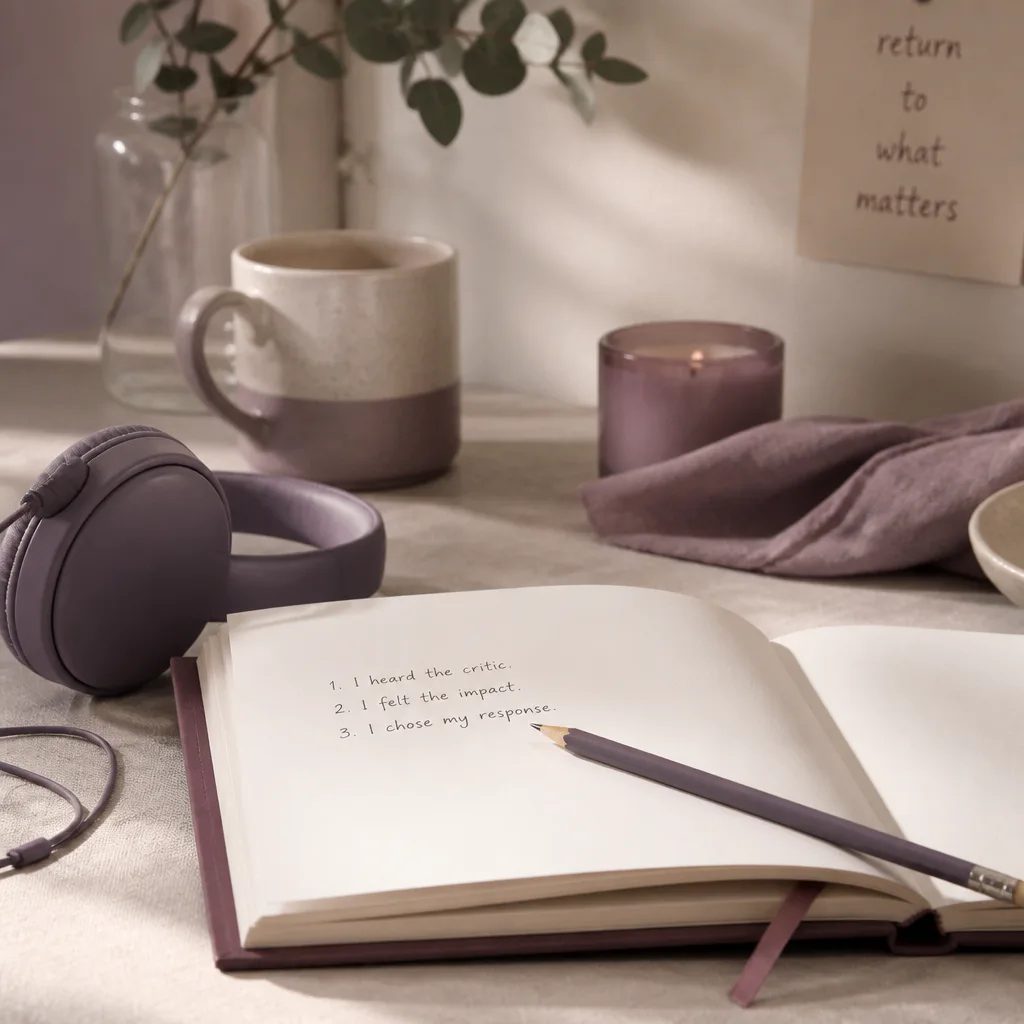
- I hear the warning. This lowers the fight.
- I choose the next true step. This keeps you in motion.
- I will check again after 24 hours. This stops the mind from demanding a life verdict right now.
Clinical approaches like Internal Family Systems, developed by Richard Schwartz in the 1980s, often treat inner parts as protective rather than defective. You do not need to adopt the whole model to borrow the mercy. A part of you learned to scan for danger. Another part of you can learn to lead.
If you follow timing, moon cycles, or symbolic reflection, keep it grounded. Astrology and manifestation can be a mirror for attention, but it does not replace the listening. The audio remains the daily practice. The symbol is only useful if it returns you to what is true.
How do you know the practice is working?
You know it is working when the critic still appears, but you recover sooner and obey it less.
Do not measure success by silence. A silent mind is rare, and chasing it can become another critic. Measure the interval. Last month, a harsh sentence took the whole afternoon. This week, it took 20 minutes. Tomorrow, maybe 6. That is not small. That is a new pattern showing itself.
Track 3 signs for 7 days:
- Recovery time: How long before you remember yourself?
- Tone: Is the second voice less cruel than the first?
- Action: Did you take 1 clean step anyway?
A 7-day measure matters because mood changes daily. Sleep, food, hormones, grief, weather, and workload all change the volume of self-talk. The American Psychological Association has reported for years that stress affects attention, irritability, and decision-making. If you judge the practice from one tired evening, you may miss the pattern.
The AYA app also includes a daily affirmation and Manifestation Board as complements. Use them lightly. After the audio, you might write the one sentence you heard most clearly. Or you might place one image where your eyes land in the morning. But do not turn the complements into more tasks for the critic to grade.
Healing often begins as a shorter distance between the wound and the return.
There is a design principle I trust: a room should tell the body where to rest. Your inner practice can do the same. Same chair. Same 5 minutes. Same voice from the self you are learning to know.
How do you keep this from becoming another task to fail at?
You keep it gentle by making the practice repeatable on your worst ordinary day, not your best one.
Do not build a ritual that requires a clean desk, quiet neighbors, perfect sleep, and a better version of your personality. That ritual will become a museum. Build one for the bus stop. The bathroom floor. The 5 minutes before a meeting. In behavior research, consistency is helped by stable cues. A 2009 study in the European Journal of Social Psychology found habit formation varied widely, with an average of 66 days for a behavior to become automatic. Wide variation is the point. You are allowed to take time.
Try these rules:
- If you miss a day, return the next day without a speech.
- If 5 minutes is too much, listen for 60 seconds.
- If the audio feels too tender, keep your eyes open.
- If the critic argues, write down only the next action.
- If you want more, stop while the practice still feels kind.
This is where the AYA Method is helpful for people who do not want another elaborate routine. It gives the day a short listening practice. The Dream-Self Moment does not ask you to become someone else before breakfast. It asks you to hear from the self that already knows how to speak with care.
For a broader foundation, you can return to manifestation as the larger practice of attention and chosen becoming. You can return to affirmations when you need one line. But for the inner critic, start with the audio. Let listening be enough.
You do not quiet the critic by becoming louder than it. You quiet it by becoming more true.
Come back to the small voice that does not rush you.