love manifestation
Manifest Love Without Chasing: Future-Self Audio
Learn how to manifest love without chasing through a quiet future-self audio practice that steadies the body, softens urgency, and supports real action.

The phone is face down. Your hand still knows where it is. To manifest love without chasing, practice becoming the person who can receive mutual love without proving, pleading, or performing. A future-self audio helps your body rehearse that steadiness daily, then choose actions that match it.
What does it mean to manifest love without chasing?
It means you stop treating urgency as proof of love and begin practicing the inner state of being chosen, respected, and met.
Chasing is not the same as wanting. Wanting is clean. It says, I would like love here. Chasing bends the body forward. It refreshes the screen. It translates silence into a job. Pew Research Center reported in 2020 that about 3 in 10 U.S. adults were single, and many single adults said dating had become harder over the previous decade. So if your body feels tired in the search, you’re not strange. You’re human inside a very noisy mating system.
Manifesting love, in this sense, is not trying to make one person text you back. It is not a spell against someone’s will. It is the daily practice of becoming honest enough to recognize real reciprocity. The Manifestation pillar says desire becomes usable when it’s made specific and repeated with attention. For love, specificity matters. Not “someone.” Not “any sign.” A warm life. A steady tone. A person whose care does not require you to disappear.
Attachment research gives this language a body. In the 1980s, Cindy Hazan and Phillip Shaver applied attachment theory to adult romantic love, showing that patterns of security, anxiety, and avoidance often shape how people reach or withdraw. Later research has found that securely attached people tend to report higher relationship satisfaction. The point is not to diagnose yourself in a mirror at midnight. The point is kinder. Your reaching may have a history.
Chasing is often an old survival skill wearing the costume of romance.
When you manifest love without chasing, you do 2 things at once. You honor the longing. You refuse the panic. That refusal is not cold. It is devotion to the part of you that is done auditioning.
Why does future-self audio help the body stop reaching?
Future-self audio helps because the nervous system learns through repeated felt rehearsal, not only through ideas.
You can understand self-worth and still send the fifth message. You can know someone is unavailable and still wait for the small light of their name. Knowledge lives in the head first. Pattern lives lower. This is why a short audio can matter. It gives your body a place to practice before the moment of choice arrives.
The AYA Method is a daily audio manifestation practice. Each day you listen to a short personalized recording — your Dream-Self Moment — narrated from the version of you who has already manifested the life you intend. Listening is the practice. Repetition is the work. The audio is the method.
Neuroscience is careful here, and it should be. Mental rehearsal is not magic. But there is evidence that imagined practice can change performance and neural patterns. A well-known 1995 study by Alvaro Pascual-Leone and colleagues found that people who mentally practiced a piano exercise showed measurable changes in motor cortex maps, though physical practice produced stronger results. Love is not a piano scale. Still, the principle is useful: the brain and body respond to repeated inner rehearsal.
For love, the rehearsal is not “they choose me.” That is too dependent on another person’s nervous system. The rehearsal is “I am steady when I desire. I can wait without shrinking. I can receive without suspicion. I can leave what harms me.” Those sentences change the next small action.
The future self is not a fantasy person. She is you, with fewer negotiations against your own knowing.
A 3 to 7 minute recording is enough for most people because repetition matters more than length. Dr. Andrew Huberman has often pointed to the role of repeated cues and state shifts in habit formation, and broader habit research suggests consistency beats intensity. You are not trying to flood the body. You are giving it one quiet pattern, again and again.
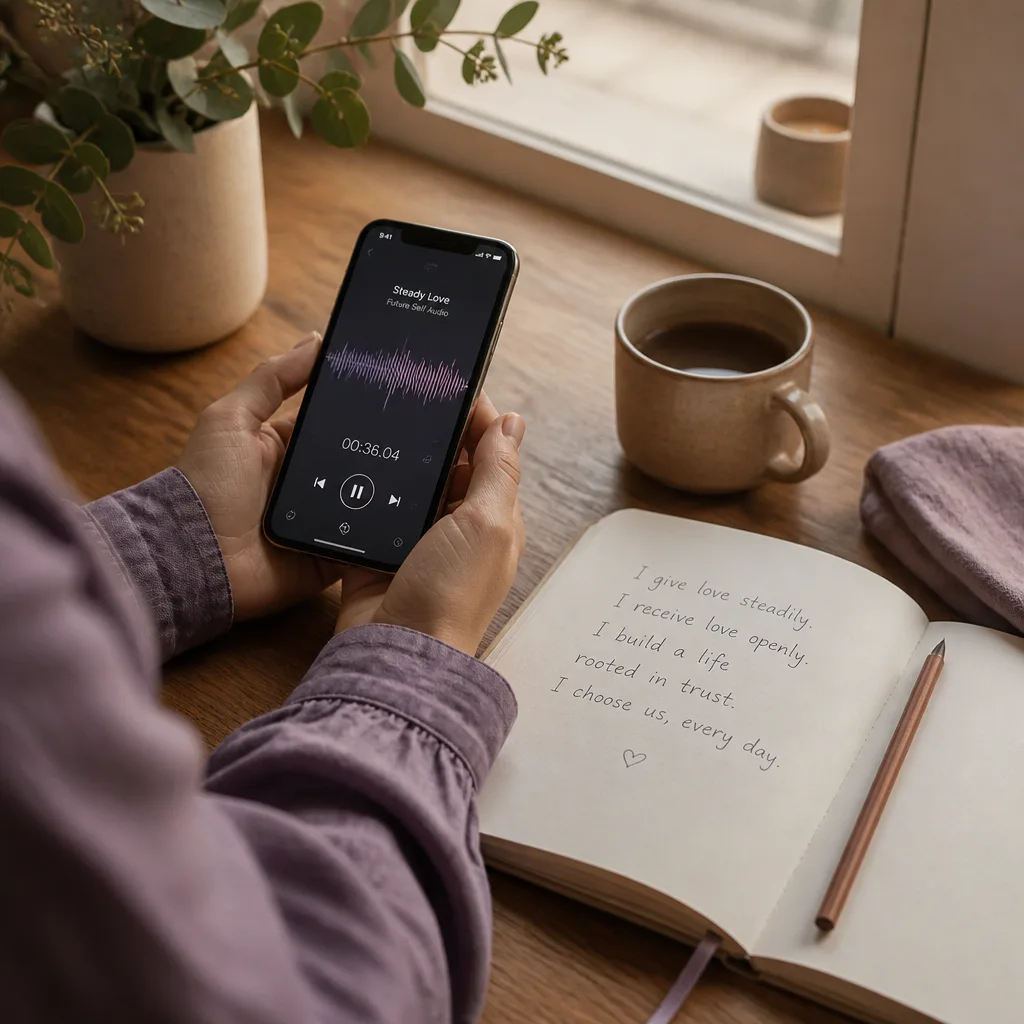
How do you create a love audio that feels believable?
You make it small, sensory, present tense, and emotionally honest enough that your body doesn’t reject it.
Start with one scene. Not the wedding. Not the perfect holiday photograph. Choose something your body can enter. A cup on the bedside table. Two toothbrushes. A message that does not make your stomach drop. The future self speaks from the life where steady love is normal, but she speaks in ordinary images. The nervous system trusts ordinary things.
Use present tense. In the AYA app, this becomes your Dream-Self Moment, but you can draft the bones of it on paper first. Research on implementation intentions by psychologist Peter Gollwitzer has shown that specific “if-then” plans can improve follow-through across many behaviors. For love, the plan might be: “If I want to chase, then I listen before I act.” The audio holds the emotional part. The plan holds the doorway.
Here is a simple structure:
- Arrive in the scene. Name where you are and what you can see.
- Name the felt truth. Say how love feels in your body now.
- Name your new behavior. Describe how you respond when desire rises.
- Name your standard. Say what you no longer negotiate.
- Return softly. End with one sentence you can carry into the day.
A draft might sound like this: “I wake without checking. The room is pale. My chest is open, not tight. Love is here in the way I speak to myself before anyone else speaks to me. I answer slowly. I tell the truth. I don’t lean toward what keeps stepping back.”
Notice the restraint. No grand claim. No demand that a certain person appear. A 2021 review in Clinical Psychology Review noted that self-compassion is linked with lower anxiety and depression symptoms across many studies. Your audio should sound self-compassionate, not inflated. If a sentence makes you tense, soften it until it becomes usable.
| Chasing script | Future-self audio script |
|---|---|
| “I need them to choose me today.” | “I let mutual care reveal itself over time.” |
| “If I stop reaching, I’ll lose them.” | “What is mine doesn’t require self-erasure.” |
| “I have to be more interesting.” | “I am already a full person in the room.” |
| “Any attention is a sign.” | “Consistency is the sign I trust.” |
The sentence that saves you is usually plain.
What should you do before you text, scroll, or check?
Listen first, then let the body choose from steadiness instead of alarm.
This is the practical hinge. The practice is not meant to live in a soft notebook while your hands keep doing the old thing. Put the audio before the reaching behavior. If checking happens at night, listen at night. If you send anxious texts after dates, listen before you reply. In behavior design, the cue matters. BJ Fogg’s behavior model, developed at Stanford, places behavior at the meeting point of motivation, ability, and prompt. Your prompt is simple: reaching urge means audio first.
Make it almost too easy. Keep the recording under 7 minutes. Use headphones if that helps. Sit, stand, or lie down. You don’t need candles. You need repetition. The Affirmations pillar can support this with one sentence for the day, but the audio remains the method. The affirmation is a small handle. The Dream-Self Moment is the room you enter.
Try this 12-minute practice for 7 days:
- Minute 0 to 1: Put the phone down and notice the urge without obeying it.
- Minute 1 to 6: Listen to your future-self audio once.
- Minute 6 to 8: Exhale longer than you inhale. Try 4 seconds in, 6 seconds out.
- Minute 8 to 10: Write one sentence: “The loving action now is…”
- Minute 10 to 12: Do only that action, or do nothing on purpose.
Breathing slowly is not a decoration. A 2017 review in Frontiers in Human Neuroscience discussed how slow breathing practices may influence autonomic function and emotional regulation. If the body believes there is danger, it will seek proof. The longer exhale tells it, quietly, that you can pause.
The pause is where chasing loses its script.
This is also where astrology and manifestation can be used gently if you like timing rituals. A moon phase can mark a beginning. A Venus transit can become a reminder. But timing is not the cause. Your repeated listening is the work. The sky can be a bell. It is not your authority.
How do you tell the difference between inspired action and chasing?
Inspired action leaves your dignity intact; chasing asks you to trade dignity for a response.
You will still act. Manifesting love without chasing does not mean sitting very still and becoming hard to find. You can go on dates. You can say, “I liked seeing you.” You can update a profile, ask a friend to introduce you, or tell someone directly what you want. The difference is the state you act from and the cost you pay afterward.
Dating research is sobering. Pew Research Center found in 2023 that 53% of adults under 30 in the U.S. had used a dating site or app. Choice is visible now in a way the body was not built to process calmly. It can make every pause look like replacement. Future-self audio helps you come back to scale: one person, one message, one truth, one next step.
Ask these questions before acting:
- Am I trying to be seen, or trying not to feel abandoned?
- Would I still respect myself if they didn’t answer?
- Is this action mutual, or am I carrying the whole bridge?
- Have I already said this in another form?
- Does my body feel clear, or does it feel like begging?
If the action passes, take it. If it doesn’t, wait. Not as a game. As care. The Gottman Institute’s long-term relationship research often points to small bids for connection and how partners respond to them. A bid is healthy when it can be received or not received without your selfhood collapsing. Chasing turns every bid into a verdict.

A clean action might be: “I’d like to see you again. Are you free this week?” A chasing action might be sending three soft versions of the same question because the first silence hurt. One is contact. One is self-abandonment.
Your future self does not punish herself for wanting. She simply stops making longing do all the labor.
What if a specific person keeps pulling your attention?
You can include the feeling, but you should not build the practice around controlling that person.
This is the hard part. A name can become a room you keep entering even after the lights are off. You remember their hands. Their timing. The way one good evening made 3 weeks of confusion feel meaningful. The body can bond through intermittent reward; behavioral psychology has studied variable reinforcement for decades, and unpredictable rewards are known to strengthen repeated checking behavior. A person who is warm, then absent, can become strangely compelling.
So be tender with yourself. But be precise. If your audio says, “They come back and choose me,” your nervous system may become more attached to waiting. If it says, “I am loved clearly, consistently, and without confusion,” your attention has somewhere wider to rest. This is where manifestation becomes ethical. You name the life, not another person’s forced role in it.
You can write the desire under the desire:
- “I want them” may mean “I want to feel chosen.”
- “I miss their attention” may mean “I miss my own aliveness.”
- “I need closure” may mean “I want my body to stop asking.”
- “I can’t let go” may mean “I don’t yet trust what comes after this.”
A 2010 paper by Timothy Wilson and Daniel Gilbert discussed affective forecasting, the human tendency to mispredict future emotional states. You may believe you cannot feel peace without this person. Your future self gently questions that belief. Not by arguing. By letting you hear another life every day.
If there has been harm, manipulation, coercion, or fear, manifestation practice is not a substitute for support. Tell a trusted person. Contact a local service. Love that requires you to hide pain is not love becoming real. It is pain asking for a witness.
How do you keep the practice real for 30 days?
You keep it real by tracking behavior, not signs.
Signs can become another form of chasing. A song. A number. Their name on a license plate. The mind is good at pattern. Princeton’s former Engineering Anomalies Research program studied mind-matter questions for years, but its findings remain debated and were not a dating instruction manual. In love practice, the cleaner measure is behavior. Are you more honest? Less reactive? More able to leave the phone alone? That is the evidence you can live with.
Use a 30-day page. Not a long diary. Just 4 marks a day:
| Day marker | Question | Score |
|---|---|---|
| Listened | Did I listen to the audio? | Yes / No |
| Paused | Did I pause before reaching? | 0-2 |
| Chose dignity | Did my action respect me? | 0-2 |
| Received | Did I let care in, from any safe source? | 0-2 |
This matters because memory edits itself. When you’re anxious, you may forget every steady moment. A small record gives the body proof. In health psychology, self-monitoring is one of the more reliable behavior change tools; a 2011 review in Psychological Bulletin found that monitoring progress toward goals was associated with higher goal attainment, especially when recorded.
The app also includes a daily affirmation and Manifestation Board as complements. Use them lightly. A board can hold images of the kind of home, tenderness, and shared rhythm you want to recognize. An affirmation can give the day one sentence. But return to the audio. Return to the voice of the you who is no longer bargaining with absence.
By day 30, the outer facts may or may not have changed in the way you hoped. Someone may have appeared. Someone may have fallen away. More often, the first change is quieter: you stop calling anxiety intuition. You stop mistaking inconsistency for depth. You begin to notice the people who meet you without making you chase.
That is love practice too.
Keep the phone face down a little longer.