manifestation 101
369 Manifestation Method vs Future-Self Audio
Compare the 369 manifestation method with future-self audio for busy days, including time, attention, repetition, and how to choose a practice you’ll keep.
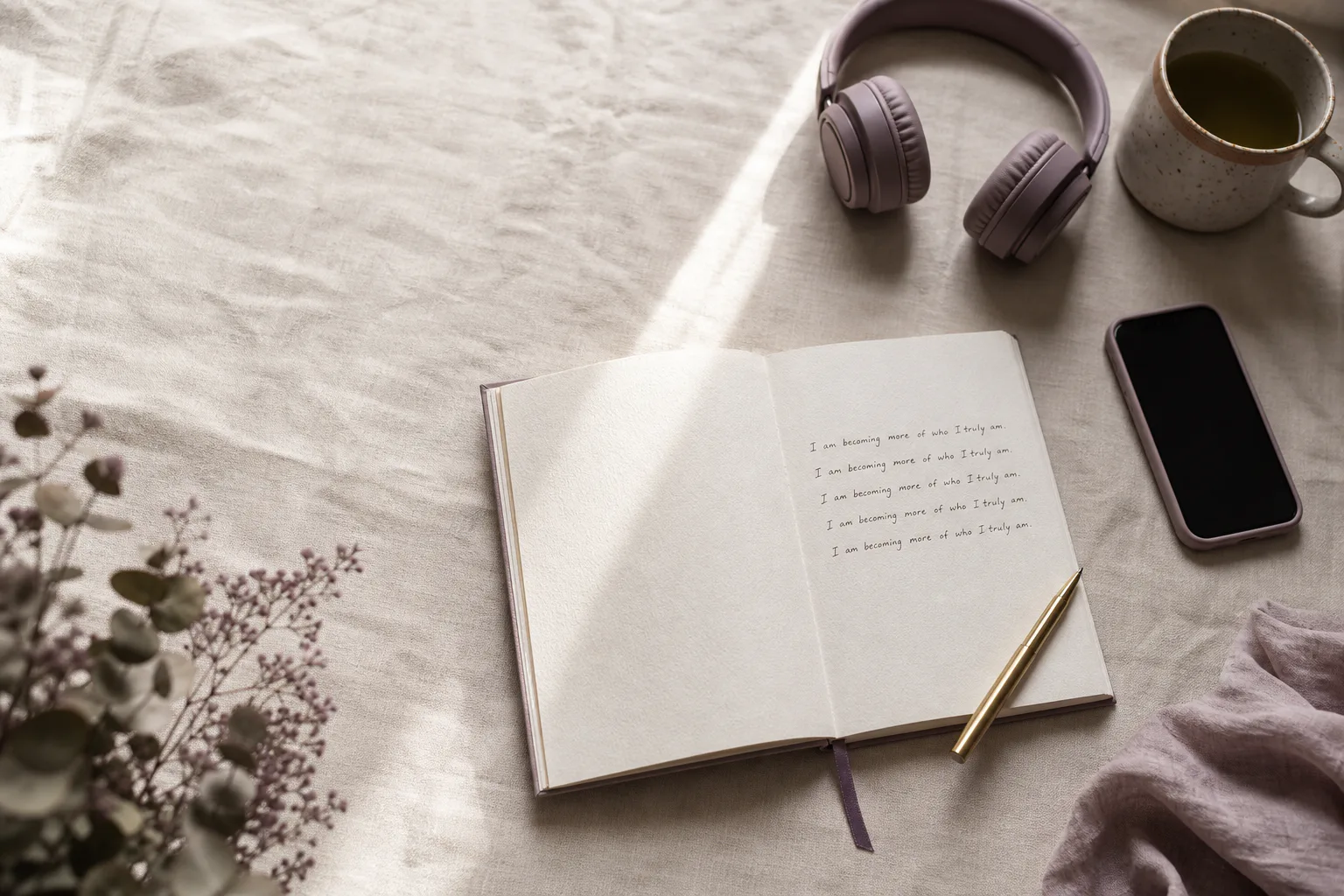
A notebook sits beside the kettle. Your phone is already in your hand. The 369 manifestation method can work if writing steadies you, but future-self audio is usually kinder on busy days because it asks for fewer switches: one recording, one listen, one return.
What is the 369 manifestation method asking of you?
The 369 manifestation method asks you to repeat one chosen statement 18 times a day in three separate sessions.
The common form is simple: write your desire 3 times in the morning, 6 times in the afternoon, and 9 times at night. Many people practice it for 33 days or 45 days, though those numbers are tradition, not settled science. The math matters. Eighteen written lines a day becomes 594 lines over 33 days and 810 lines over 45 days. That is not nothing. A page can become a room you return to.
The method is often linked online to Nikola Tesla because of his fascination with 3, 6, and 9, but there is no serious historical proof that Tesla taught this as a manifestation practice. It sits closer to repetition, written intention, and attention training. Neville Goddard, writing in the 20th century, used the phrase living in the end to describe rehearsing the state of the fulfilled wish. Joe Dispenza later popularized mental rehearsal in a more modern wellness language. The 369 method borrows from that same old human instinct: say it until it feels less foreign.
Writing has its own authority. In expressive writing research, James Pennebaker often used 15 to 20 minutes of writing across 3 to 4 sessions and found measurable effects on emotional processing in some studies. The 369 method is not the same protocol, but the hand still matters. It slows the sentence down. It makes you choose words.
A sentence written 18 times is not magic. It is a mirror you agree to keep meeting.
The trouble is the shape of a real day. Three sessions require three reminders, three pauses, and three small acts of privacy. If you have school drop-off at 8:10, a meeting at 1:00, and dishes at 9:40, the method may become another thing you did not finish. That does not mean you failed. It means the practice has a high switching cost.
How is future-self audio different from writing the sentence?
Future-self audio changes the practice from producing words to receiving them.
With writing, you generate the statement again and again. With audio, you listen to a short personalized recording from the version of you who already knows the life you intend. That difference is small on paper and very large at 7:30 in the morning. Writing asks for hand, page, privacy, and focus. Audio asks for headphones, a few minutes, and willingness to listen.
Here is the plain definition: The AYA Method is a daily audio manifestation practice. Each day you listen to a short personalized recording — your Dream-Self Moment — narrated from the version of you who has already manifested the life you intend. Listening is the practice. Repetition is the work. The audio is the method.
That matters because a busy day does not only reduce time. It reduces decision space. Cognitive psychology has studied working memory limits for decades, beginning with George Miller’s famous 1956 paper on 7 plus or minus 2 items, later refined by research suggesting that active mental capacity may be closer to 4 chunks. When your mind is holding groceries, Slack messages, a birthday card, and the name of the person you must call back, one more written ritual can feel far away.
| Practice | Daily action | Typical time | Main strength | Main friction |
|---|---|---|---|---|
| 369 manifestation method | 18 written repetitions | About 5–10 minutes | Clear written focus | 3 separate sessions |
| Future-self audio | 1 short listen | About 3–5 minutes | Low friction repetition | Requires a quiet enough moment |
| Daily affirmation | 1 supportive sentence | About 30–60 seconds | Quick verbal cue | Can feel thin without context |
| Manifestation Board | Visual review | About 1–3 minutes | Keeps desire visible | Easy to treat as decoration |
If you want the wider frame, the manifestation guide explains why repetition, identity, and attention keep appearing across old and new practices. The shared thread is not spectacle. It is familiarity. You return to the same inner picture until it starts to feel allowed.
Which practice fits a busy day better?
Future-self audio usually fits a busy day better because it removes the need to stop and write three different times.
A busy day is often not one long block of busyness. It is a string of interrupted minutes. The kettle clicks off. A child asks where the blue socks are. A calendar alert appears. Pew Research Center reported in 2024 that about 90 percent of adults in the United States own a smartphone. That means audio has a practical advantage: the device is already near you, often before the notebook is.
The 369 manifestation method can still be beautiful. I like it most when the day has edges. Morning desk. Afternoon train. Evening lamp. But when a day has no clean edges, the method can turn brittle. You miss the afternoon set, then the whole practice feels broken. Audio is more forgiving. One listen still counts. One return is still a return.
There is also the matter of state. Dr. Andrew Huberman has often discussed short nervous-system downshifts such as 10 to 20 minutes of non-sleep deep rest, noting how brief protocols can change alertness and recovery. Future-self audio is not NSDR, but it shares a practical insight: the body may receive repetition more easily when it is not being asked to perform.

The quiet advantage of audio is that it can meet you before you are impressive. You can listen while sitting on the edge of the bed, before your face is arranged for the world. You can listen after lunch with your eyes closed for four minutes. You can listen in a parked car. The practice is not weaker because it is smaller.
A practice you can keep on an ordinary Tuesday is worth more than one you only respect on a perfect Sunday.
For busy days, ask one question first: does this method lower the distance between remembering and doing? If the answer is yes, keep it close. If the answer is no, make it smaller.
When does the 369 method work better than audio?
The 369 method works better when your mind needs the page to become honest.
Some desires stay vague until the hand catches them. You may think you want a new job, then write the sentence 18 times and notice you actually want steadiness, respect, or a room where you do not have to shrink. Writing reveals resistance because you can see the word that bothers you. If the sentence says I am safe being seen and your chest tightens on safe, that is information.
This is where written practices can help more than listening. Implementation intention research by Peter Gollwitzer and Paschal Sheeran, including a 2006 meta-analysis of 94 studies, found that if-then planning can improve goal follow-through. The 369 manifestation method is not an if-then plan, but the page can become the place where intention gets more exact. You can revise a sentence until it becomes true enough to repeat.
There is also evidence that affirmations are not neutral for everyone. In 2009, Joanne Wood, W. Q. Elaine Perunovic, and John Lee published a study in Psychological Science showing that highly positive self-statements could make some people with low self-esteem feel worse. That finding is useful here. If your 369 sentence is too shiny, your body may argue with it 18 times a day. A quieter sentence often works better.
Try these softer written forms:
- I am learning to let this be real.
- I can take one small action from the self who already knows.
- I do not have to force belief. I can return.
- I can be with the next version of my life without rushing her.
The affirmations guide is useful if you want language that does not feel false. A daily affirmation can support the main practice, especially when it is honest enough to land. It is a complement, not the whole structure.
The page is not there to impress you. It is there to tell the truth back.
Choose 369 when writing calms you, when you like visible evidence, or when you need to refine the sentence itself. Choose audio when the sentence is already clear and you need to inhabit it more often.
Can you combine 369 and future-self audio without making too much?
Yes, you can combine them if one practice leads and the other stays small.
The mistake is making every support tool into a full ritual. Then the practice becomes crowded. Audio, writing, a board, a candle, a tracker, a morning routine, a night routine. Soon the desire has an administrative department. You do not need that. You need a daily return that your nervous system can believe.
Use audio as the center if your days are full. The AYA app also includes a daily affirmation and a Manifestation Board, but those are complements. The audio is the method. The Dream-Self Moment is the part that carries the identity in voice, tone, and repetition. If you add 369 writing, let it serve the listen.
A simple combined rhythm can look like this:
- Listen to your future-self audio once, preferably at the same time each day.
- Choose one sentence from what you heard or felt.
- Write it 3 times in the morning only, not 18 times, on crowded days.
- If the day opens, add 6 lines later and 9 at night.
- If it does not, do not punish the practice. Return tomorrow.
Habit research gives you permission to be practical. In a 2010 study by Phillippa Lally and colleagues in the European Journal of Social Psychology, the average time for a new habit to feel automatic was 66 days, with wide variation from 18 to 254 days. That range is a mercy. It says people are not machines.

Some readers also like to time practices with lunar or seasonal cues. If that helps you remember, the astrology and manifestation piece can give you a softer calendar. Just keep the hierarchy clear. Timing can support the practice. It should not become another test you can fail.
The method is not the number of things you do. It is the thing you actually return to.
A combined practice should leave you quieter, not more managed. If adding 369 writing makes the day feel heavier, remove it for a week. If audio alone starts to feel too invisible, bring back the page.
How do you choose the right practice for this week?
Choose the practice that matches your actual week, not your ideal self on a clean calendar.
Start with the next 7 days. Not your personality. Not your fantasy routine. Look at the appointments, the caretaking, the commute, the meals, the messages. Then choose the practice that can live there. BJ Fogg’s behavior model says action is more likely when motivation, ability, and a prompt meet at the same moment. If ability is low, the practice must become easier.
Use this as a quiet decision table:
| If this is true this week | Choose this first | Why it fits |
|---|---|---|
| You have 3 private pauses most days | 369 manifestation method | The rhythm can hold you |
| Your schedule is fractured | Future-self audio | One listen has fewer steps |
| You keep changing the desire | 369 writing | The page helps refine language |
| You know the desire but forget to feel it | Future-self audio | Voice brings it closer |
| You need a visible cue | Manifestation Board | It keeps the image nearby |
| Words feel too forced | Softer audio plus one line | Less pressure, more return |
You can also set a 5-day test. For 5 days, use 369 writing exactly as designed. Notice missed sessions, resistance, and after-feeling. Then for 5 days, use future-self audio once daily. Do not judge by drama. Judge by return. Which practice did you actually meet? Which one made you kinder after you finished?
For the larger philosophy, read the manifestation pillar and then come back to the smallest action. Big frameworks are only useful if they soften into the day. The body learns from repetition it can survive.
There is no prize for choosing the harder method. The 369 manifestation method is a meaningful written practice for people who love structure and visible repetition. Future-self audio is better for busy days because it removes steps while keeping the central work: hearing the self you are learning to recognize.
Keep the practice small enough to stay yours.